Loading…
← All schools
Westchester School for Medical & Dental Assistants
Ardsley, NYprivate forprofitwww.wsmda.edu/
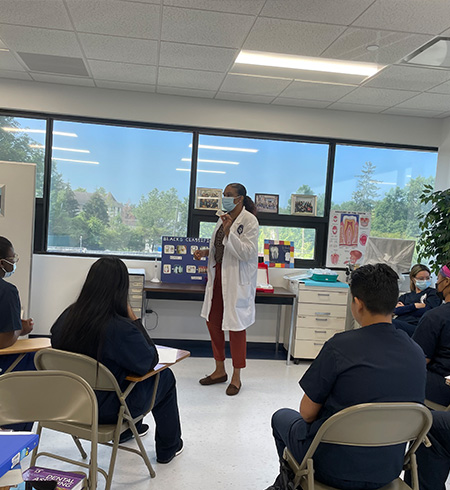
Westchester School for Medical & Dental Assistants is not a traditional college but a hyper-focused, no-frills trade school in Ardsley, NY, that operates with the single-minded efficiency of a career launchpad. It strips away the liberal arts trappings to deliver a 6-to-9-month certification blitz, promising a direct pipeline into entry-level healthcare jobs. The vibe is pragmatic and urgent, serving a student body that is overwhelmingly female and seeking a fast, practical credential.
More details
- Undergrad enrollment
- 67
- Location
- Ardsley, NY
- Accreditation
- ACCET
- Program Length
- 6 to 9 months
- Institution Type
- Private, For-Profit Trade School
- Job Placement Rate
- Over 88%
- Student Body Gender
- 92.5% Women
Outcomes & value
Outcomes & value
- Median debt at graduation
- $4,171
- Pell (lower-income) share
- 75%
- First-gen share (among federal-aid recipients)
- 64%
Earnings = median of students working ~10 years after entry; debt = median of graduates. Value divides 10-yr earnings by one year’s net price — read it as earnings per dollar of annual cost, not a full lifetime ROI; it favors lower-cost schools. Source: U.S. Dept. of Education College Scorecard. Figures lag ~2 years and reflect all students, not your intended major.
Financial health
1.9 / 3.0Meets the federal financial-responsibility standard
U.S. Dept. of Education Financial Responsibility Composite Score (FY2022-23). Scale −1.0 to 3.0; ≥1.5 meets the standard. Reported for private nonprofit & for-profit institutions only — public universities are state-backed and not scored, so this is a stability signal, not a ranking.
Campus & location
Campus safety
- On-campus violent crimes (2024)
- 0
On-campus criminal offenses classed as violent (murder/non-negligent manslaughter, rape, robbery, aggravated assault) for the most recent reported year. Source: U.S. Dept. of Education Campus Safety and Security (Clery Act). Counts reflect what’s reported to the school, and urban campuses often report more partly due to non-student incidents nearby — read alongside campus size and setting, not as a standalone safety verdict.
Climate
- Pleasant days / yr
- 100
- Summer high
- 82°F
- Winter low
- 29°F
- Annual rain
- 43.2"
- Annual snow
- 22.3"
- Natural-hazard risk
- Relatively High
Pleasant days counts days per year with a mean temperature of 55–75°F, a high at or below 90°F, a low at or above 45°F, and little precipitation — a transparent comfort measure, not a weighting we invented. Computed from Open-Meteo ERA5 daily history (2019–2023). Natural-hazard risk is the county’s composite rating from the FEMA National Risk Index.
Quick answers
- How much does Westchester School for Medical & Dental Assistants cost?
- At Westchester School for Medical & Dental Assistants, the average net price (after aid) is about $16,177 per year. Actual cost varies with financial aid and residency.
- How many undergraduates attend Westchester School for Medical & Dental Assistants?
- Westchester School for Medical & Dental Assistants enrolls approximately 67 undergraduate students.
- Where is Westchester School for Medical & Dental Assistants located?
- Westchester School for Medical & Dental Assistants is located in Ardsley, NY.
Admissions
The admissions process at WSMDA is defined by its accessibility, not selectivity. The school has an open admission policy, meaning all applicants who meet the basic criteria are accepted. The primary qualifications are straightforward: you must be at least 17 years old and hold a high school diploma or GED (applicants with a foreign diploma will be evaluated). There is no mention of SAT or ACT requirements, and the process appears devoid of the factors—like essays, recommendations, or demonstrated interest—that characterize traditional college admissions. This open-door policy reflects the school's mission as a career-training institution focused on readiness for its intensive programs, not on crafting a competitive freshman class.
- Open Admission Policy: All qualified applicants are accepted.
- Basic Requirements: Age 17+, High School Diploma or GED.
- No Traditional Holistic Review: Factors like test scores, essays, and recommendations are not part of the stated criteria.
Academics
Academics at WSMDA are a laser-focused, practical immersion into the skills of medical and dental assisting. The curriculum is designed explicitly to develop skills needed for entry-level employment in these fields, with no electives or general education distractions. Programs are accelerated, with students able to through either day or evening classes, accommodating those who may be balancing other responsibilities. The school emphasizes and holds accreditation from ACCET (Accrediting Council for Continuing Education & Training), a signal of its legitimacy in the vocational education space. The academic experience is intensely hands-on, preparing students for immediate work in clinical settings.
Compare Westchester School for Medical & Dental Assistants
See colleges similar to Westchester School for Medical & Dental Assistants →Sources
- Westchester School for Medical & Dental Assistants
- Westchester School for Medical & Dental Assistants - Data USA
- Westchester School for Medical & Dental Assistants - Sallie
- Westchester School for Medical & Dental Assistants (off-campus)
- Common Data Set: Home
- Westchester School for Medical and Dental Assistants
- Westchester School for Medical and Dental Assistants - Niche
- Westchester School for Medical & Dental Assistants
- 914-682-9001 #WSMDA #dental #dentalassistant #teeth ... - Instagram
- Westchester School for Medical & Dental Assistants (off-campus)