Loading…
← All schools
William James College
Newton, MAprivate nonprofitwww.williamjames.edu/
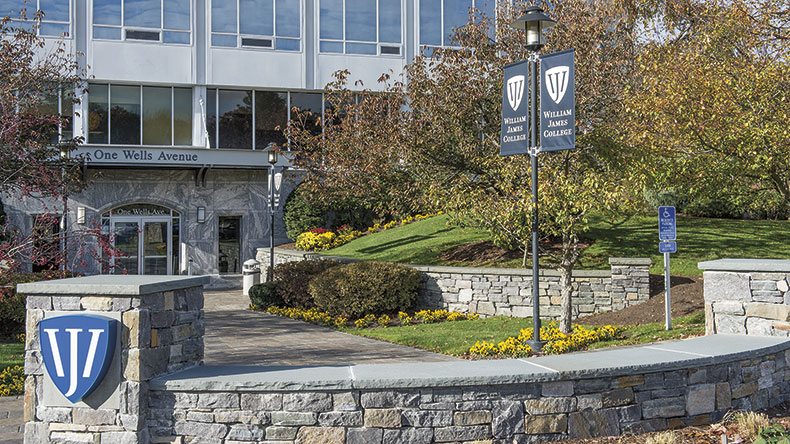
William James College isn't your typical liberal arts campus; it's a focused, professional training ground for the next generation of mental health practitioners and behavioral health leaders. Nestled just outside Boston, the college operates almost exclusively at the graduate level, with a singular, immersive mission: to turn out skilled, compassionate professionals ready to tackle the complexities of human psychology. Its identity is defined by a deep commitment to experiential education, a practitioner-faculty, and a student body that is overwhelmingly female and increasingly diverse.
More details
- Undergrad enrollment
- 39
- Primary Focus
- Psychology & Behavioral Health
- Students of Color
- 39%
- Field Training Sites
- 350+
- Median Earnings (10yr)
- $91,134
- First-Generation Students
- 33%
- Entering Class Size (Recent)
- 330 students
- Graduation Rate (150%, Total)
- 92%
Outcomes & value
Outcomes & value
- Pell (lower-income) share
- 56%
- Endowment / student
- $1,059
Earnings = median of students working ~10 years after entry; debt = median of graduates. Value divides 10-yr earnings by one year’s net price — read it as earnings per dollar of annual cost, not a full lifetime ROI; it favors lower-cost schools. Source: U.S. Dept. of Education College Scorecard. Figures lag ~2 years and reflect all students, not your intended major.
Financial health
2.7 / 3.0Meets the federal financial-responsibility standard
U.S. Dept. of Education Financial Responsibility Composite Score (FY2022-23). Scale −1.0 to 3.0; ≥1.5 meets the standard. Reported for private nonprofit & for-profit institutions only — public universities are state-backed and not scored, so this is a stability signal, not a ranking.
Campus & location
Campus safety
- On-campus violent crimes (2024)
- 0
- Per 1,000 students
- 0.00
On-campus criminal offenses classed as violent (murder/non-negligent manslaughter, rape, robbery, aggravated assault) for the most recent reported year. Source: U.S. Dept. of Education Campus Safety and Security (Clery Act). Counts reflect what’s reported to the school, and urban campuses often report more partly due to non-student incidents nearby — read alongside campus size and setting, not as a standalone safety verdict.
Climate
- Pleasant days / yr
- 97
- Summer high
- 81°F
- Winter low
- 25°F
- Annual rain
- 39.1"
- Annual snow
- 32"
- Natural-hazard risk
- Relatively High
Pleasant days counts days per year with a mean temperature of 55–75°F, a high at or below 90°F, a low at or above 45°F, and little precipitation — a transparent comfort measure, not a weighting we invented. Computed from Open-Meteo ERA5 daily history (2019–2023). Natural-hazard risk is the county’s composite rating from the FEMA National Risk Index.
Deep dive — research, future-scholar output & economic mobility
Research output
- Institutional h-index
- 155
- Scholarly works
- 1,360
Institutional research volume and impact from OpenAlex. The h-index reflects large research universities and will be low for teaching-focused liberal-arts colleges — not a measure of undergraduate quality.
Quick answers
- How many undergraduates attend William James College?
- William James College enrolls approximately 39 undergraduate students.
- Where is William James College located?
- William James College is located in Newton, MA.
Admissions
Admissions at William James College reflect its specialized, graduate-focused mission. The process is selective but accessible, with an reported around 60% for its graduate programs. For its 50th anniversary entering class, the college welcomed 330 new students, a 15% increase over the previous year, indicating growing demand. This cohort was notably diverse, with one-third being students and 39% identifying as students of color. While specific SAT/ACT score requirements for graduate admissions are not typically emphasized, one source cites an average SAT score of 1511 and an average ACT of 34, though these figures should be interpreted with caution as they may not align with standard graduate admissions practices. The college does not appear to heavily publicize an Early Decision or Early Action policy for its graduate programs, with one source noting that Early Action statistics are unavailable and the Regular Decision acceptance rate has consistently stood at 60% since 2015. The admissions philosophy prioritizes readiness for rigorous professional training over standardized undergraduate metrics.
Academics
Academics at William James College are laser-focused on psychology and its applied fields. The college describes its mission as training professionals for careers in mental health, behavioral health, and organizational leadership. It is not a broad liberal arts institution; as one review notes, 'The only major offered is Psychology.' Its programs span from the bachelor's to doctoral level, including a BS in Psychology and Human Services (a completion program) with a specialization in Crisis Response, Master's degrees (like the MA in Clinical Mental Health Counseling), and a Doctor of Psychology (PsyD) program. A key differentiator is the faculty, described as 'experienced practitioners who pride themselves on being able to deliver rigorous instruction, high-quality learning.' This practitioner-scholar model is central. The curriculum is built on a triad of 'rigorous academic instruction, field education, and close attention to professional development.' With over 350 field sites, experiential education is not an add-on but the core of the training, ensuring students graduate with substantial hands-on experience. The college offers flexible formats, including on-campus, online, and hybrid opportunities to accommodate working professionals.
Compare William James College
vs Dominican University New Yorkvs Roberts Wesleyan Universityvs Dean Collegevs Saint Joseph's University - Lancaster
See colleges similar to William James College →Sources
- Common Data Set - Harrisonburg
- Common Data Set: Home
- Common Data Set – Institutional Research - Community Hub
- Common Data Set Explorer 2026: Compare 100 Colleges
- A-Z Databases
- University of West Georgia Common Data Set 2024-2025
- William James College Admissions & Acceptance
- William James College - Tuition and Acceptance Rate
- William James College [Acceptance Rate + Statistics]
- 50th Anniversary Entering Class Marks Largest in College's History
- William James College Acceptance Rate