Admit rate has ranged 34%–47% over the last 5 years — notably volatile. Source: IPEDS via Urban Institute.
Acceptance & SAT from Common Data Set / IPEDS; net price, earnings & graduation from the U.S. Dept. of Education College Scorecard. Figures lag ~1–2 years — verify with the school.
William Jewell College is a small, selective liberal arts college in Liberty, Missouri, that punches well above its weight in outcomes. Its identity is defined by a tight-knit, tradition-rich campus life centered on Greek organizations and NCAA Division II athletics, paired with surprisingly strong pipelines to graduate schools and careers, particularly in the sciences, business, and nonprofit leadership. This is a school where community is palpable and the return on investment, according to external rankings, is notably high for a regional institution.
Admission requirements
Test-optional — scores considered if submitted
Required
High school transcript
Grade point average
College-prep program
TOEFL (non-native English)
Considered (not required)
Class rank
Letters of recommendation
Test scores (SAT/ACT)
Source: IPEDS Admissions survey (2022) via Urban Institute. Covers formal factors only — it does not reflect essays, extracurriculars, or other holistic criteria.
More details
Undergrad enrollment
924
In-state tuition
$20,610
Out-of-state tuition
$20,610
Graduation Rate
68%
Median Earnings (10yr)
$59,268
Students Receiving Financial Aid
98%
Outcomes & value
Outcomes & value
Median earnings (10 yr)
$59,268
Value (earnings ÷ net price)
3.4×
Median debt at graduation
$24,498
Graduation rate
68%
First-year retention
74%
Reducing loan balance (3 yr)
77%
Pell (lower-income) share
32%
First-gen share (among federal-aid recipients)
20%
Top-earning majors
Median earnings by field of study (highest credential), ~2 years after completion.
Registered Nursing, Nursing Administration, Nursing Research and Clinical Nursing$57,403
Liberal Arts and Sciences, General Studies and Humanities$43,798
Communication and Media Studies$38,337
Business Administration, Management and Operations$37,856
Psychology, General$33,993
English Language and Literature, General
Campus & location
Campus safety
On-campus violent crimes (2024)
0
Per 1,000 students
0.00
On-campus criminal offenses classed as violent (murder/non-negligent manslaughter, rape, robbery, aggravated assault) for the most recent reported year. Source: U.S. Dept. of Education Campus Safety and Security (Clery Act). Counts reflect what’s reported to the school, and urban campuses often report more partly due to non-student incidents nearby — read alongside campus size and setting, not as a standalone safety verdict.
Climate
Pleasant days / yr
75
Summer high
86°F
Winter low
25°F
Annual rain
47.7"
Annual snow
19.3"
Natural-hazard risk
Relatively Moderate
Pleasant days counts days per year with a mean temperature of 55–75°F, a high at or below 90°F, a low at or above 45°F, and little precipitation — a transparent comfort measure, not a weighting we invented. Computed from Open-Meteo ERA5 daily history (2019–2023). Natural-hazard risk is the county’s composite rating from the FEMA National Risk Index.
Deep dive — research, future-scholar output & economic mobility▾
Research output
Institutional h-index
42
Scholarly works
568
Institutional research volume and impact from OpenAlex. The h-index reflects large research universities and will be low for teaching-focused liberal-arts colleges — not a measure of undergraduate quality.
Economic mobility
Mobility rate
0.6%
Bottom → top quintile
15%
From bottom quintile
4%
Mobility rate = the share of students who both start in the bottom household-income quintile and reach the top quintile; bottom → top is that chance conditional on starting at the bottom. Source: Opportunity Insights Mobility Report Cards (Chetty, Friedman, Saez, Turner & Yagan). Reflects 1980–82 birth cohorts, so it’s directional, not current.
Quick answers
What is the acceptance rate at William Jewell College?
William Jewell College's acceptance rate is approximately 38% (Liberty, MO), based on the most recent figures we compiled from public and primary sources.
What SAT score do you need for William Jewell College?
Admitted students at William Jewell College typically score 1080–1270 on the SAT (the middle-50% range). Scores outside this band are still admitted, especially with strong applications.
How much does William Jewell College cost?
At William Jewell College, the average net price (after aid) is about $17,562 per year. Actual cost varies with financial aid and residency.
How many undergraduates attend William Jewell College?
William Jewell College enrolls approximately 924 undergraduate students.
Where is William Jewell College located?
William Jewell College is located in Liberty, MO.
Admissions
William Jewell operates as a selective liberal arts college, with an admissions process that is but maintains clear academic standards. The college reports that standardized ACT and/or SAT scores are not required for admission but are considered if submitted for entry. While the sources do not specify a minimum GPA, one notes that "A 3.0 unweighted GPA is the minimum for" consideration, suggesting a baseline academic expectation. The admissions rate—the percentage of admitted students who enroll—is reported at 32.97%, which is below the national average for schools with similar . The is referenced as the standardized source for admissions data, and sources indicate that the level of an applicant's demonstrated interest is a factor colleges can consider in admissions decisions (as outlined in Section C7 of the CDS), though Jewell's specific policy is not detailed in the provided snippets.
Earnings = median of students working ~10 years after entry; debt = median of graduates. Value divides 10-yr earnings by one year’s net price — read it as earnings per dollar of annual cost, not a full lifetime ROI; it favors lower-cost schools. Source: U.S. Dept. of Education College Scorecard. Figures lag ~2 years and reflect all students, not your intended major.
$26,896
Source: U.S. Dept. of Education College Scorecard (field-of-study earnings). Figures cover graduates who received federal aid and lag ~2 years; not all programs report data.
Jewell offers a classic liberal arts curriculum with notable strength in pre-professional and science tracks. The most popular majors, according to U.S. News, are Business Administration and Management, General; Registered Nursing/Registered Nurse; and Psychology. Each year, the college grants about 34 degrees in Business Administration, its most popular program. Students and observers specifically highlight "the strong science and pre-med program" and the "well established" nonprofit leadership program as standout offerings. The college provides a customized program finder tool to help students identify majors and minors based on their academic strengths and interests. Available majors span from Accounting, Biochemistry, and Biology to Civil Engineering, Chemistry, and Ancient Mediterranean Studies, reflecting a blend of traditional arts and sciences with direct career pathways.
Campus life at William Jewell is intensely communal and heavily shaped by two forces: Greek life and athletics. A full 84% of students live in college-owned, -operated, or -affiliated housing, creating a residential bubble where, as the college itself states, the "Cardinal community is always abuzz." Students report a "strong sense of community, especially through Greek Life and athletics," which play a significant role in the social fabric. The college is an NCAA Division II school, and its active student life office promotes a calendar full of traditions, intramurals, concerts, and organization events. The official Instagram account for student life positions itself as the go-to source for campus happenings, events, and community building. With "infinite ways to find your niche," the environment is one of high participation, where finding your group is a central part of the experience.
This is where William Jewell makes a compelling case for itself, with outcome metrics that rank highly against national peers. A Washington Monthly ranking highlights several standout figures: Jewell ranks No. 6 nationally for the proportion of graduates who go on to earn a Ph.D. (placing it in the top 3%), No. 14 for predicted earnings (top 10%), and No. 17 for actual earnings measured nine years after college entry (top 10%). Forbes also includes alumni salary (20% of its ranking formula) and gauges leadership and entrepreneurial success in its assessments. The college has been named a "Smart Asset Exceptional Value" based on a composite score of graduation rates and median alumni earnings. While one source notes a graduation rate of 62%, the college's own reporting through IPEDS includes graduation rates data with response rates exceeding 99% for most survey components.
Jewell is aggressive with financial aid, aiming to make attendance feasible for a broad range of students. The college states that 98% of its students receive financial aid. Aid packages blend merit and need-based considerations; scholarships can range from $1,000 up to 100% of tuition, room, and board, and need-based grants are also available. The college provides a Calculator for families to estimate their actual cost, defining net price as the estimated minus grants and scholarships. Financial aid proceeds are applied directly to student charges for tuition, fees, room, and board. While the sources discuss "no-loan" policies at other institutions—where 100% of need is met with grants—and mention policies for students with family income below $60,000, the provided snippets do not specify that William Jewell College has a universal no-loan or full-need meeting policy. The college did distribute emergency financial grants to students via the CARES Act, prioritizing those with the greatest demonstrated need.
William Jewell College stands out for delivering a high-return, community-intensive liberal arts experience that defies the modest profile of a regional Missouri college. Its distinctiveness lies in the potent combination of three elements:
A Proven Pipeline to Advanced Degrees: Its ranking in the top 3% of colleges for producing Ph.D. holders is extraordinary and signals a faculty and curriculum that successfully prepare students for rigorous graduate study, particularly in the sciences.
A Vibe of Total Immersion: With the vast majority of students living on campus and social life orbiting around Greek organizations and Division II athletics, Jewell offers the classic, all-in undergraduate experience where it's easy to belong—a stark contrast to commuter-school anonymity.
Outcome-Oriented Value: Rankings that place it in the top 10% for earnings and predicted earnings nine years out underscore a tangible return on investment. This isn't just a cozy college; it's a launchpad, with especially strong reputations in nursing, business, nonprofit leadership, and pre-med tracks. It’s a small college that thinks—and delivers—big.
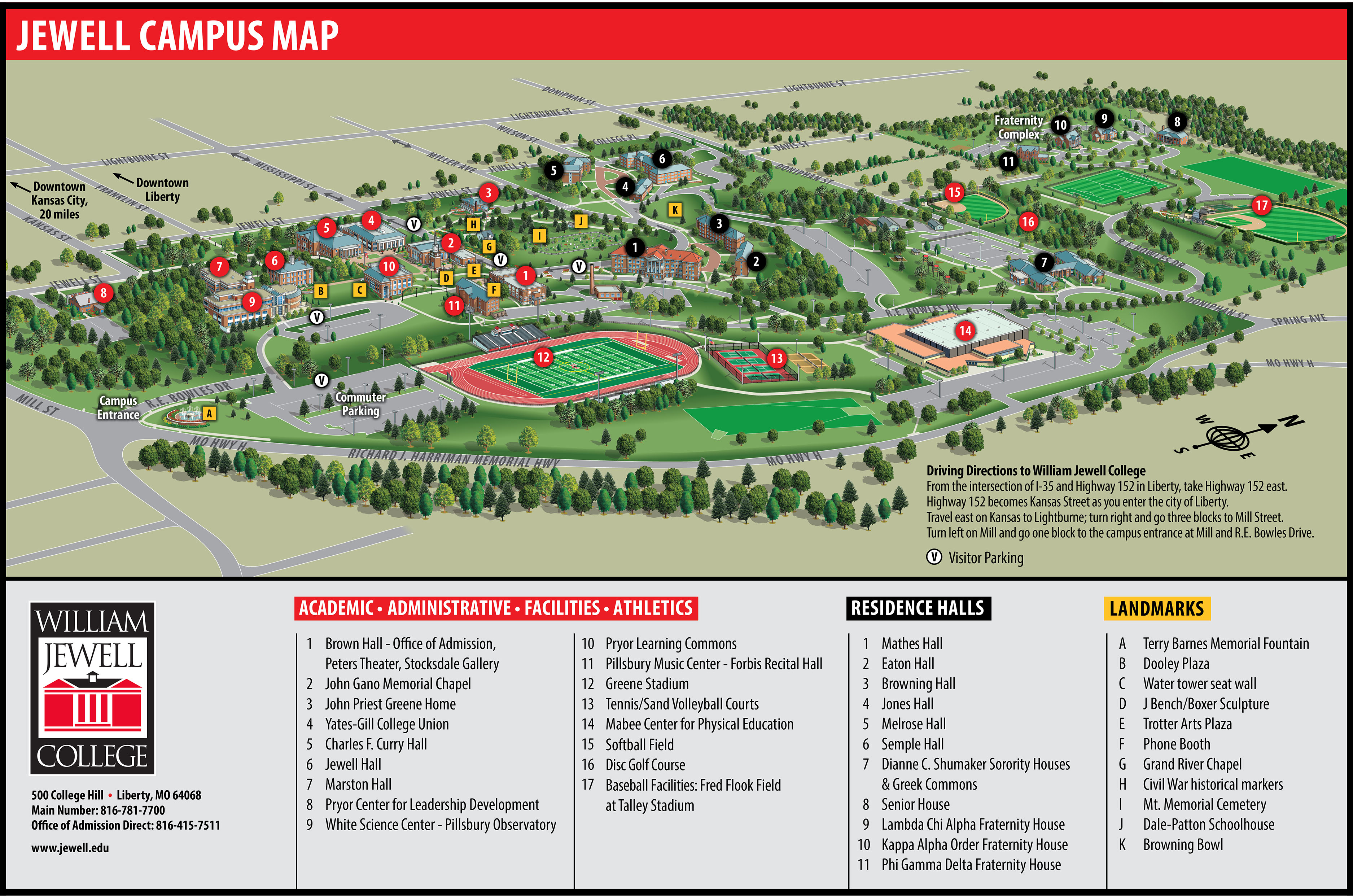
William Jewell College seal · sourceCampus Map | William Jewell College · sourceWilliam Jewell College - Profile, Rankings and Data | US News Best Colleges · sourceWilliam Jewell College - Profile, Rankings and Data | US News Best Colleges · source