Admit rate has ranged 65%–78% over the last 5 years — notably volatile, though the latest figure above (56%) falls outside that window. Source: IPEDS via Urban Institute.
Acceptance & SAT from Common Data Set / IPEDS; net price, earnings & graduation from the U.S. Dept. of Education College Scorecard. Figures lag ~1–2 years — verify with the school.
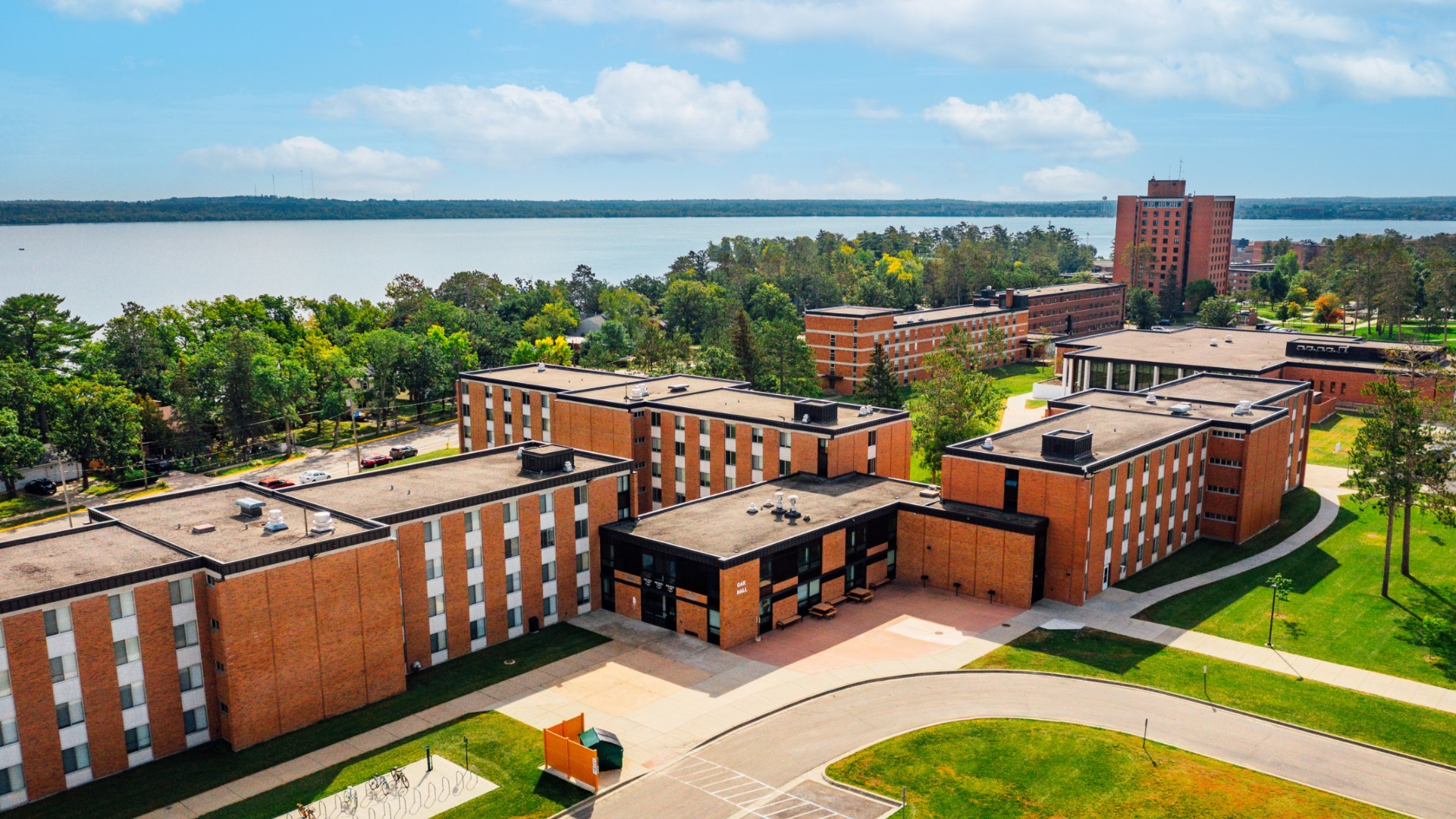
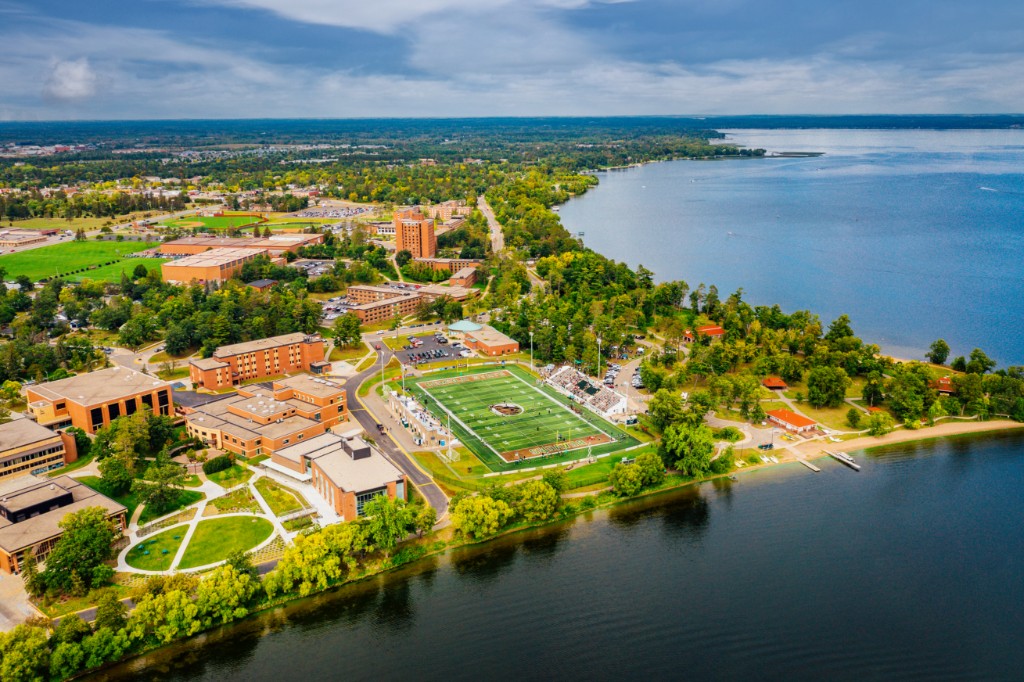
Bemidji State University is Minnesota's 'Premier North Woods University,' a public institution where the academic catalog is as expansive as the surrounding lakes and forests. With a mission deeply rooted in access and regional service, BSU offers over 200 programs—from a standout social work department to an award-winning fishing team—to a student body that thrives on a rugged, community-oriented campus. This is a place where the cost is kept deliberately low, the admission policy is straightforward and test-optional, and the defining experience is a potent blend of practical education and an unabashed love for the outdoors.
Admission requirements
Test-optional — scores considered if submitted
Required
Grade point average
Class rank
TOEFL (non-native English)
Considered (not required)
Test scores (SAT/ACT)
Source: IPEDS Admissions survey (2022) via Urban Institute. Covers formal factors only — it does not reflect essays, extracurriculars, or other holistic criteria.
More details
Undergrad enrollment
3,139
In-state tuition
$10,237
Out-of-state tuition
$10,237
Graduation Rate
48%
Early Decision Plan
Not offered
First-Year Retention
72%
Demonstrated Interest
Not considered
Student-Faculty Ratio
16:1
Median Earnings (10yr)
$53,755
Social Work Licensure Pass Rate
96% (vs. 76% state avg.)
Students Receiving Grant/Scholarship Aid
89%
Outcomes & value
Outcomes & value
Median earnings (10 yr)
$53,755
Value (earnings ÷ net price)
3.5×
Median debt at graduation
$19,750
Graduation rate
48%
First-year retention
73%
Reducing loan balance (3 yr)
68%
Pell (lower-income) share
28%
First-gen share (among federal-aid recipients)
27%
Top-earning majors
Median earnings by field of study (highest credential), ~2 years after completion.
Registered Nursing, Nursing Administration, Nursing Research and Clinical Nursing$62,654
Computer Science$62,069
Industrial Production Technologies/Technicians$55,512
Mathematics$47,260
Accounting and Related Services
Campus & location
Campus safety
On-campus violent crimes (2024)
1
Per 1,000 students
0.29
On-campus criminal offenses classed as violent (murder/non-negligent manslaughter, rape, robbery, aggravated assault) for the most recent reported year. Source: U.S. Dept. of Education Campus Safety and Security (Clery Act). Counts reflect what’s reported to the school, and urban campuses often report more partly due to non-student incidents nearby — read alongside campus size and setting, not as a standalone safety verdict.
Climate
Pleasant days / yr
95
Summer high
77°F
Winter low
5°F
Annual rain
27.9"
Annual snow
47.2"
Natural-hazard risk
Relatively Low
Pleasant days counts days per year with a mean temperature of 55–75°F, a high at or below 90°F, a low at or above 45°F, and little precipitation — a transparent comfort measure, not a weighting we invented. Computed from Open-Meteo ERA5 daily history (2019–2023). Natural-hazard risk is the county’s composite rating from the FEMA National Risk Index.
Deep dive — research, future-scholar output & economic mobility▾
Research output
Institutional h-index
55
Scholarly works
1,013
Institutional research volume and impact from OpenAlex. The h-index reflects large research universities and will be low for teaching-focused liberal-arts colleges — not a measure of undergraduate quality.
Quick answers
What is the acceptance rate at Bemidji State University?
Bemidji State University's acceptance rate is approximately 56% (Bemidji, MN), based on the most recent figures we compiled from public and primary sources.
How much does Bemidji State University cost?
At Bemidji State University, the average net price (after aid) is about $15,261 per year. Actual cost varies with financial aid and residency.
How many undergraduates attend Bemidji State University?
Bemidji State University enrolls approximately 3,139 undergraduate students.
Where is Bemidji State University located?
Bemidji State University is located in Bemidji, MN.
Admissions
Bemidji State operates with a moderately selective, transparent, and accessible admissions process squarely aimed at serving Minnesota and the region. The university reports an of 56%, a figure consistently cited across multiple sources. The process is ; ACT or SAT scores are not required for admission. Instead, the primary gatekeeper is high school GPA. Applicants with a GPA of 2.75 or higher are admitted outright, while those with a GPA between 2.5 and 2.74 are admitted conditionally. For those who do submit scores, the middle 50% of admitted students who submitted ACT scores fell between 18 and 24. Admitted SAT scores reportedly range up to a 75th percentile score of 1180, with an average around 1100. The rate—the percentage of accepted students who enroll—is reported as 22%, which is characterized as 'Medium.' The university does not have an early decision plan, and based on analysis, 'demonstrated interest' is typically marked as 'not considered' in admissions criteria for schools like BSU, meaning visits or contact with admissions officers are not factored into decisions.
Earnings = median of students working ~10 years after entry; debt = median of graduates. Value divides 10-yr earnings by one year’s net price — read it as earnings per dollar of annual cost, not a full lifetime ROI; it favors lower-cost schools. Source: U.S. Dept. of Education College Scorecard. Figures lag ~2 years and reflect all students, not your intended major.
$46,193
Social Work$41,937
Criminal Justice and Corrections$41,789
Source: U.S. Dept. of Education College Scorecard (field-of-study earnings). Figures cover graduates who received federal aid and lag ~2 years; not all programs report data.
Bemidji State's academic identity is defined by breadth, practicality, and a few pockets of notable excellence. The university boasts over 200 undergraduate majors, minors, certificates, and graduate programs, organized into broad categories like Business, Education, Communication & Media, Science & Sustainability, and Medicine & Health. The student-faculty ratio is 16:1, supporting a more personalized classroom experience than many large public universities. Within this expansive catalog, certain programs stand out. The Business Administration department offers emphases ranging from Entrepreneurship and Finance to Indigenous Business Leadership. Perhaps most impressively, the social work program reports a 96% pass rate on licensing exams, significantly outperforming the 76% state average. The average first-year retention rate, a key indicator of student satisfaction and academic support, is 72%. This suggests that most students who start at BSU find their footing and choose to continue.
Life at Bemidji State is inextricably linked to its location—a campus that calls itself 'a haven for Bemidji's arts and culture scene' while also serving as a basecamp for the Northern Minnesota wilderness. The university actively promotes a 'robust outdoor culture' that includes paddling, hunting, hiking, and foraging. This isn't just marketing; student clubs reflect these passions, ranging from an anime club to an award-winning fishing team. A strong sense of community is fostered from day one, with students living and learning alongside peers from diverse backgrounds. Safety is a notable strength, with 81% of students reporting they feel 'extremely safe and secure' on campus. The overall vibe is one of active, engaged camaraderie, where the energy and diverse perspectives of the student body are seen as central to the campus experience.
Graduation and career outcomes at Bemidji State reflect its mission as an access-oriented public university. The six-year graduation rate is reported variably between sources, with figures of 48%, 49%, 51%, and 56% all cited. The four-year graduation rate is lower, at 46%. A significant number of students who don't graduate from BSU transfer out, with a transfer-out rate of 28%. For those who do earn a degree, career earnings show steady growth. Median earnings one year after graduation are reported at $48,587. This figure rises to $55,807 five years after graduation. The university's retention rate, a precursor to graduation, is 73%.
Affordability is a cornerstone of Bemidji State's value proposition. The university offers in-state tuition rates to all qualified applicants, keeping baseline costs manageable. The —the average cost after grants and scholarships—is a central figure. A substantial 89% of full-time beginning undergraduates receive grant or scholarship aid. The average total aid awarded is $7,904. The university's financial aid system is need-based, requiring the completion of the FAFSA or MN Dream Act application. Aid packages typically include grants first, with federal subsidized loans available to undergraduates who demonstrate financial need that remains after scholarships and grants. It's important to note that if financial need is fully met with other types of assistance, a student will not receive a subsidized loan. Bemidji State does not advertise a 'no-loan' policy where all need is met without loans; its policy is to use grants and scholarships first, then offer loans to fill remaining need.
Bemidji State University carves out a distinctive niche by refusing to be just another regional public school. Its identity is a deliberate and potent fusion of three elements: unabashed regional stewardship, practical academic excellence, and a culture forged by its environment. First, it embraces its role as 'Minnesota's Premier North Woods University' with pride, structuring access ( admissions, conditional admits), cost (in-state tuition for all, high aid rates), and programs to serve its community. Second, within its broad catalog are programs of genuine distinction, most notably a social work department whose 96% licensure pass rate crushes the state average, proving that access and high-quality outcomes are not mutually exclusive. Finally, the campus culture is authentically shaped by its setting. The award-winning fishing team isn't a quirk; it's a symbol. Student life is a balanced equation of 'rigorous academia' and a 'fun, robust outdoor culture' of paddling, hiking, and foraging. This creates a specific type of student—one who is pragmatic, community-minded, resilient, and as comfortable in the woods as in the library. BSU stands out because it knows exactly what it is and whom it serves, offering a genuine, affordable, and hands-on education in a place where the boundary between campus and wilderness is beautifully blurred.