Admit rate has ranged 72%–74% over the last 5 years, though the latest figure above (70%) falls outside that window. Source: IPEDS via Urban Institute.
Acceptance & SAT from Common Data Set / IPEDS; net price, earnings & graduation from the U.S. Dept. of Education College Scorecard. Figures lag ~1–2 years — verify with the school.
Capital University is a private liberal arts institution in Columbus, Ohio, that operates with a clear, practical mission: to provide a hands-on, supportive education that connects directly to the professional world. With its roots in the Lutheran tradition, it offers a notably accessible admissions pathway and a curriculum built around 64 majors—most famously nursing—within a tight-knit campus community where nearly half of students live on-site. It’s a place for students who want a personalized, career-focused college experience in a major Midwestern city, without the cutthroat competition of more selective schools.
Admission requirements
Test-optional — scores considered if submitted
Required
High school transcript
Grade point average
TOEFL (non-native English)
Considered (not required)
Letters of recommendation
Test scores (SAT/ACT)
College-prep program
Source: IPEDS Admissions survey (2022) via Urban Institute. Covers formal factors only — it does not reflect essays, extracurriculars, or other holistic criteria.
More details
Undergrad enrollment
1,585
In-state tuition
$43,234
Out-of-state tuition
$43,234
Application Fee
None
Graduation Rate
60%
On-Campus Housing
48%
Most Popular Major
Registered Nursing
First-Year Retention
76%
Median Earnings (10yr)
$54,143
Outcomes & value
Outcomes & value
Median earnings (10 yr)
$54,143
Value (earnings ÷ net price)
2.4×
Median debt at graduation
$26,889
Graduation rate
60%
First-year retention
76%
Reducing loan balance (3 yr)
63%
Pell (lower-income) share
34%
First-gen share (among federal-aid recipients)
28%
Financial health
2.4 / 3.0Meets the federal financial-responsibility standard
U.S. Dept. of Education Financial Responsibility Composite Score (FY2022-23). Scale −1.0 to 3.0; ≥1.5 meets the standard. Reported for private nonprofit & for-profit institutions only — public universities are state-backed and not scored, so this is a stability signal, not a ranking.
Top-earning majors
Median earnings by field of study (highest credential), ~2 years after completion.
Registered Nursing, Nursing Administration, Nursing Research and Clinical Nursing$60,035
Computer Science$59,846
Accounting and Related Services$57,318
Business/Managerial Economics$49,683
Business Administration, Management and Operations$42,044
Public Relations, Advertising, and Applied Communication
Campus & location
Campus safety
On-campus violent crimes (2024)
1
Per 1,000 students
0.45
On-campus criminal offenses classed as violent (murder/non-negligent manslaughter, rape, robbery, aggravated assault) for the most recent reported year. Source: U.S. Dept. of Education Campus Safety and Security (Clery Act). Counts reflect what’s reported to the school, and urban campuses often report more partly due to non-student incidents nearby — read alongside campus size and setting, not as a standalone safety verdict.
Climate
Pleasant days / yr
87
Summer high
83°F
Winter low
26°F
Annual rain
45.9"
Annual snow
19.3"
Natural-hazard risk
Relatively High
Pleasant days counts days per year with a mean temperature of 55–75°F, a high at or below 90°F, a low at or above 45°F, and little precipitation — a transparent comfort measure, not a weighting we invented. Computed from Open-Meteo ERA5 daily history (2019–2023). Natural-hazard risk is the county’s composite rating from the FEMA National Risk Index.
Deep dive — research, future-scholar output & economic mobility▾
Research output
Institutional h-index
179
Scholarly works
26,911
Institutional research volume and impact from OpenAlex. The h-index reflects large research universities and will be low for teaching-focused liberal-arts colleges — not a measure of undergraduate quality.
Economic mobility
Mobility rate
0.9%
Bottom → top quintile
15%
From bottom quintile
6%
Mobility rate = the share of students who both start in the bottom household-income quintile and reach the top quintile; bottom → top is that chance conditional on starting at the bottom. Source: Opportunity Insights Mobility Report Cards (Chetty, Friedman, Saez, Turner & Yagan). Reflects 1980–82 birth cohorts, so it’s directional, not current.
Quick answers
What is the acceptance rate at Capital University?
Capital University's acceptance rate is approximately 70% (Columbus, OH), based on the most recent figures we compiled from public and primary sources.
What SAT score do you need for Capital University?
Admitted students at Capital University typically score 910–1180 on the SAT (the middle-50% range). Scores outside this band are still admitted, especially with strong applications.
How much does Capital University cost?
At Capital University, the average net price (after aid) is about $22,576 per year. Actual cost varies with financial aid and residency.
How many undergraduates attend Capital University?
Capital University enrolls approximately 1,585 undergraduate students.
Where is Capital University located?
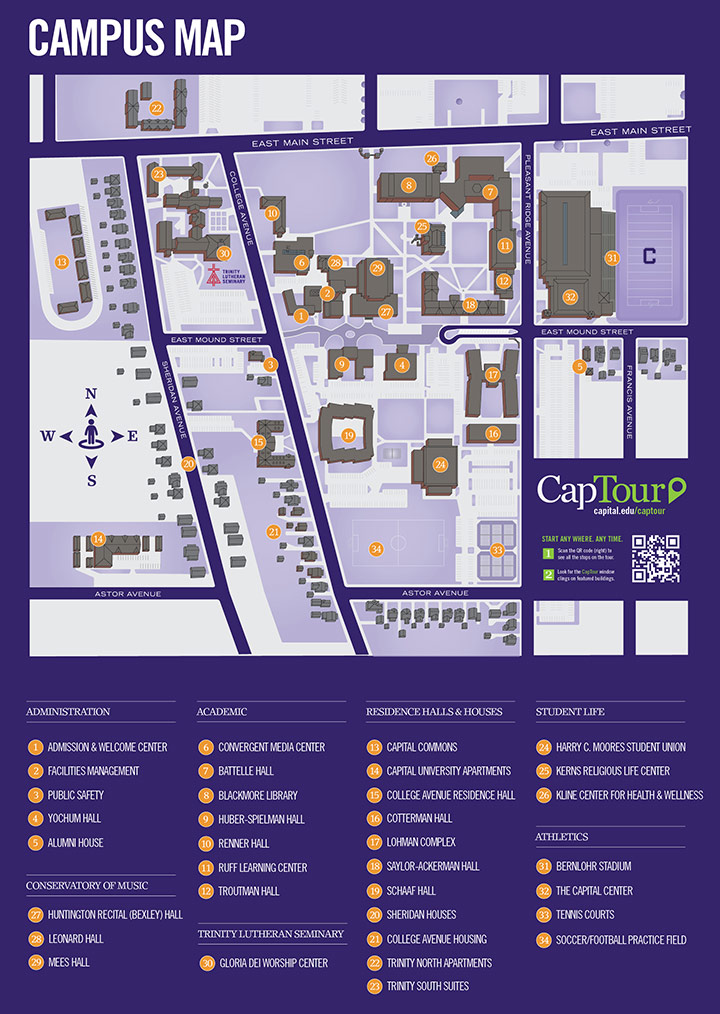
Capital University is located in Columbus, OH.
Admissions
Capital University's admissions process is characterized by its accessibility. The university is less selective, with a high that makes it a realistic target for a broad range of students. The middle 50% SAT range for admitted students who submitted scores falls between 910 and 1180, and the average high school GPA of incoming students is 3.49. The admissions decision is based primarily on a of the applicant's high school academic record, including cumulative GPA and the rigor of the curriculum taken. Standardized test scores are considered but are not the sole determining factor, and requirements may vary. The university does not charge an application fee, lowering the barrier to apply. While the details the factors considered, specific information on the consideration of demonstrated interest or early decision advantages at Capital is not provided in the available sources.
Primary Factors: High school GPA, high school curriculum rigor.
Test Scores: Middle 50% SAT: 910–1180; ACT range: 18–25.
Earnings = median of students working ~10 years after entry; debt = median of graduates. Value divides 10-yr earnings by one year’s net price — read it as earnings per dollar of annual cost, not a full lifetime ROI; it favors lower-cost schools. Source: U.S. Dept. of Education College Scorecard. Figures lag ~2 years and reflect all students, not your intended major.
$40,068
Marketing$39,801
Special Education and Teaching$36,560
Source: U.S. Dept. of Education College Scorecard (field-of-study earnings). Figures cover graduates who received federal aid and lag ~2 years; not all programs report data.
Capital's academic structure is built for exploration and depth, offering 64 majors and 57 minors alongside 10 graduate degrees. The curriculum emphasizes practical, career-ready skills infused with critical thinking and problem-solving from the start. Signature programs include a strong focus on writing across disciplines, offered to 100% of students, and first-year experiences for 70% of undergraduates. A notable 30% of students participate in undergraduate research or creative projects. The most popular and heavily granted degree is in Registered Nursing/Registered Nurse, reflecting the university's strength in pre-professional health fields. The academic culture is hands-on and supportive, blurring the lines between broad liberal arts knowledge and focused skill development.
Life at Capital is defined by an inclusive, supportive, and active on-campus community. The university promotes a residential experience, with 48% of students living in college-owned, -operated, or -affiliated housing, while 52% live off-campus. Student engagement is high, fueled by over 100 student organizations that host more than 400 meetings annually. These groups span arts and culture, athletics, political activism, and student government. Greek life is a visible part of the social fabric, with social fraternities and sororities available. The atmosphere is one where students are encouraged to dive into conversations with professors, form lasting friendships, and share meals and laughter, creating a cohesive environment that balances academic focus with social connection.
Capital University's outcomes reflect its mission of providing a direct path to career readiness. The four-year graduation rate is 55%, while the six-year rate is higher. Post-graduation earnings show steady growth: the median salary one year after graduation is reported as $45,255, which increases to $55,095 after five years. The university's first-year retention rate—a key indicator of student satisfaction—is 76%. These figures suggest that students who persist find value in their Capital degree, with earnings progressing positively in the years following graduation.
Capital is a private university with a published full-time tuition of $45,100 per year. However, the —the average cost after grants and scholarships are applied—is significantly lower. The university provides a Net Price Calculator to help families estimate their actual cost. Financial aid packages include federal direct loans, which are available to all students who submit the FAFSA, regardless of financial need. The Office of Financial Aid outlines various payment strategies and types of aid, including the Main Street Scholarship. While the sources detail the availability of federal loans and scholarships, they do not specify a university policy of meeting 100% of demonstrated financial need or of offering aid packages without loans for qualifying students.
Capital University carves out a distinct niche by marrying the intimate, supportive environment of a small liberal arts college with the practical, career-oriented programming of a metropolitan university. Its identity is not built on exclusivity, but on access and applied learning. The standout feature is its deep investment in nursing and health sciences, which anchors its academic reputation. Furthermore, it commits to high-impact educational practices—like writing across the curriculum and undergraduate research—for a significant portion of its student body, ensuring that even in a less-selective environment, the academic experience is engaged and substantive. The campus culture is deliberately crafted to be inclusive and community-focused, with a strong residential component and a vast array of student organizations fostering connection. For a student seeking a personalized education with clear professional pathways in the vibrant setting of Columbus, without facing the intense pressure of a hyper-competitive admissions process, Capital offers a compelling and pragmatic alternative.
Capital University seal · sourceMaps and Locations | Capital University, Columbus Ohio · sourceCapital University - Profile, Rankings and Data | US News Best Colleges · sourceReligious and Spiritual | Capital University, Columbus Ohio · source
.jpg?width=1600)