Admit rate has ranged 62%–82% over the last 5 years — notably volatile. Source: IPEDS via Urban Institute.
Acceptance & SAT from Common Data Set / IPEDS; net price, earnings & graduation from the U.S. Dept. of Education College Scorecard. Figures lag ~1–2 years — verify with the school.
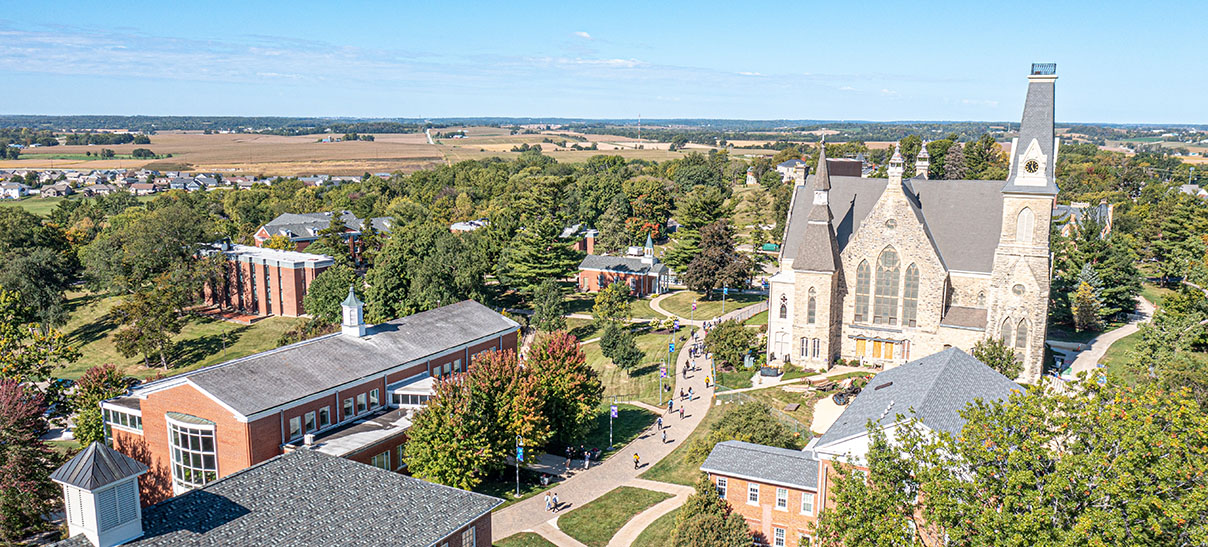
Cornell College in Mount Vernon, Iowa, is a distinctive liberal arts institution defined by its singular academic calendar: the One Course At A Time (OCAAT) block plan. Here, students immerse themselves in a single subject for 18 days before moving on, creating an intense, focused, and flexible learning environment that feels more like a graduate seminar than a traditional undergraduate lecture. This structure attracts self-directed, adventurous learners and fosters a tight-knit, collaborative campus culture on its historic hilltop, a world away from the pressures of its Ivy League namesake.
Admission requirements
Test-optional — scores considered if submitted
Required
Grade point average
Considered (not required)
High school transcript
Class rank
Letters of recommendation
Test scores (SAT/ACT)
College-prep program
TOEFL (non-native English)
Source: IPEDS Admissions survey (2022) via Urban Institute. Covers formal factors only — it does not reflect essays, extracurriculars, or other holistic criteria.
More details
Undergrad enrollment
1,086
In-state tuition
$52,660
Out-of-state tuition
$52,660
Graduation Rate
62%
Demonstrated Interest
Not considered
Median Earnings (10yr)
$53,460
Student Loan Partnership
Yes, for 4-year graduates
Four-Year Graduation Rate
67%
First-Year Merit Guarantee
$33,000/year
Outcomes & value
Outcomes & value
Median earnings (10 yr)
$53,460
Value (earnings ÷ net price)
2.3×
Median debt at graduation
$27,000
Graduation rate
62%
First-year retention
80%
Reducing loan balance (3 yr)
71%
Pell (lower-income) share
32%
First-gen share (among federal-aid recipients)
20%
Financial health
1.6 / 3.0Meets the federal financial-responsibility standard
U.S. Dept. of Education Financial Responsibility Composite Score (FY2022-23). Scale −1.0 to 3.0; ≥1.5 meets the standard. Reported for private nonprofit & for-profit institutions only — public universities are state-backed and not scored, so this is a stability signal, not a ranking.
Top-earning majors
Median earnings by field of study (highest credential), ~2 years after completion.
Computer Science$42,682
Teacher Education and Professional Development, Specific Levels and Methods$29,685
Psychology, General$24,035
English Language and Literature, General$23,340
Source: U.S. Dept. of Education College Scorecard (field-of-study earnings). Figures cover graduates who received federal aid and lag ~2 years; not all programs report data.
On-campus criminal offenses classed as violent (murder/non-negligent manslaughter, rape, robbery, aggravated assault) for the most recent reported year. Source: U.S. Dept. of Education Campus Safety and Security (Clery Act). Counts reflect what’s reported to the school, and urban campuses often report more partly due to non-student incidents nearby — read alongside campus size and setting, not as a standalone safety verdict.
Climate
Pleasant days / yr
87
Summer high
82°F
Winter low
17°F
Annual rain
35.9"
Annual snow
31.6"
Natural-hazard risk
Relatively Moderate
Pleasant days counts days per year with a mean temperature of 55–75°F, a high at or below 90°F, a low at or above 45°F, and little precipitation — a transparent comfort measure, not a weighting we invented. Computed from Open-Meteo ERA5 daily history (2019–2023). Natural-hazard risk is the county’s composite rating from the FEMA National Risk Index.
Deep dive — research, future-scholar output & economic mobility▾
Research output
Institutional h-index
16
Scholarly works
46
Institutional research volume and impact from OpenAlex. The h-index reflects large research universities and will be low for teaching-focused liberal-arts colleges — not a measure of undergraduate quality.
Economic mobility
Mobility rate
0.9%
Bottom → top quintile
25%
From bottom quintile
4%
Mobility rate = the share of students who both start in the bottom household-income quintile and reach the top quintile; bottom → top is that chance conditional on starting at the bottom. Source: Opportunity Insights Mobility Report Cards (Chetty, Friedman, Saez, Turner & Yagan). Reflects 1980–82 birth cohorts, so it’s directional, not current.
Quick answers
What is the acceptance rate at Cornell College?
Cornell College's acceptance rate is approximately 80% (Mount Vernon, IA), based on the most recent figures we compiled from public and primary sources.
What SAT score do you need for Cornell College?
Admitted students at Cornell College typically score 1120–1285 on the SAT (the middle-50% range). Scores outside this band are still admitted, especially with strong applications.
How much does Cornell College cost?
At Cornell College, the average net price (after aid) is about $23,634 per year. Actual cost varies with financial aid and residency.
How many undergraduates attend Cornell College?
Cornell College enrolls approximately 1,086 undergraduate students.
Where is Cornell College located?
Cornell College is located in Mount Vernon, IA.
Admissions
Cornell College operates with an accessible admissions philosophy that prioritizes finding students who are a good fit for its unique block plan, rather than chasing ultra-low . The process is , allowing applicants to decide whether to submit SAT or ACT scores. For those who do submit, the middle 50% range for the SAT is 1120–1285, and for the ACT, it's 23–30. The college does not consider demonstrated interest as a factor in admissions decisions, meaning campus visits or contact with admissions officers are not weighed in the evaluation. This suggests the application review focuses primarily on the student's academic record, essays, and recommendations to assess their potential to thrive in Cornell's intensive, self-directed learning environment.
Application Volume: The college receives a manageable number of applications, allowing for a process.
Test-Optional Policy: Applicants can choose whether their SAT or ACT scores best represent their academic preparedness.
Focus on Fit: With demonstrated interest "not considered," the emphasis is squarely on the student's academic profile and personal alignment with the OCAAT model, as revealed in their application materials.
Earnings = median of students working ~10 years after entry; debt = median of graduates. Value divides 10-yr earnings by one year’s net price — read it as earnings per dollar of annual cost, not a full lifetime ROI; it favors lower-cost schools. Source: U.S. Dept. of Education College Scorecard. Figures lag ~2 years and reflect all students, not your intended major.
Academics
The academic engine of Cornell College is its One Course At A Time (OCAAT) block plan, an educational model that defines every aspect of the student experience. Instead of juggling four or five courses simultaneously over a semester, students take one intensive course for three-and-a-half weeks (18 class days), then enjoy a four-day break before starting the next block. This structure allows for deep immersion, field trips, labs that aren't constrained by a 50-minute period, and the flexibility for professors to redesign their pedagogy around a single focus.
The college offers a robust range of over 40 majors, minors, and pre-professional programs within a liberal arts framework. These are organized into thematic clusters like Arts & Expression; Economics & Business; Education; Government & Politics; Health Professions; and Humans & Society. Popular and signature programs often leverage the block plan's strengths: psychology, biology, and biochemistry benefit from extended lab time; education majors can complete full-time practicums without other course conflicts; and arts students can dedicate themselves wholly to a production or portfolio. The curriculum is designed for exploration and interdisciplinary study, with the block plan making it logistically simple to take courses outside one's major. Every student completes a capstone experience, often taking the form of an intensive research project, artistic performance, or thesis in their final year.
Life on Cornell's hilltop campus in Mount Vernon is intensely communal, shaped by the rhythms of the block plan. The academic calendar creates a shared cadence—everyone is stressed about the same exam, working on the same project, or celebrating the same block break at the same time. This fosters a culture of mutual support rather than cutthroat competition. The residence life system is integral, with a requirement to live on campus that reinforces this community; students are described as "conscientious, respectful, and cooperative," contributing to a strong and safe campus culture.
With about 1,000 students, involvement is high. Over 80 student organizations cover interests from academic societies and cultural clubs to performing arts and unique groups. The small town of Mount Vernon (population ~4,500) is a designated "Distinctive Destination" and offers a handful of cafes and shops, but the campus itself is the hub of activity. The division of student life provides comprehensive resources, from health and wellness to leadership development, helping students navigate their personal and communal journey. Social life revolves around campus events, club activities, and informal gatherings in residence halls, creating a close-knit environment where it's hard to be anonymous.
Cornell College measures success not just by graduation rates but by the preparedness and initial career trajectory of its graduates. The four-year graduation rate is 67%, and the overall graduation rate is 72%, which places it in the top 25% of colleges nationally for this metric. This suggests that students who choose the OCAAT model tend to see it through to completion.
Post-graduation, outcomes data shows a strong launch into the workforce or graduate study. According to institutional data, the median earnings for graduates six years after entry is $39,299. More recent institutional profile data reports an average starting salary for graduates of $49,084, with a median of $47,000. The college actively surveys its graduates to track career outcomes, and many leverage the intense focus and project-based learning of the block plan to secure positions in fields like education, business, healthcare, and the sciences. The block plan's schedule also facilitates internships, which can occur during any academic block without course conflicts, providing significant professional experience before graduation.
Cornell College is aggressively committed to making its unique education affordable and transparent. A cornerstone of this effort is a guaranteed minimum merit scholarship for all first-year students, which was $30,000 per year as of 2024 and increased to $33,000 per year for entering students thereafter. The college states that 100% of full-time students receive financial aid from the institution itself.
To help families plan, the college provides a calculator to estimate the actual cost after grants and scholarships. The institution has also launched innovative programs to address student debt, such as the Student Loan Partnership for students entering in fall 2024. This program is designed to help graduates pay off their federal student loans if they complete their degree in four years, directly incentivizing on-time graduation and reducing post-college financial burden. The financial aid office emphasizes a personalized approach, working with families to assemble aid packages that can include scholarships, grants, and loans, with the goal of making the Cornell experience accessible regardless of economic background.
Cornell College stands out unequivocally for its One Course At A Time block plan. This isn't a minor scheduling quirk; it's a foundational pedagogical philosophy that transforms the learning experience. It demands and cultivates a specific type of student: one who can manage intense focus, adapt quickly to new subjects, and thrive in a collaborative (rather than competitive) environment. The benefits are profound: the ability to conduct fieldwork in geology, history, or environmental science without missing other classes; the chance for a theatre major to rehearse and produce a play as their sole academic commitment for a month; the opportunity for a professor to take a biology class to a research station for immersive study.
This structure creates an intellectual culture more akin to a graduate school seminar or an artist's residency than a typical undergraduate program. It also forges an exceptionally tight-knit community, as students and faculty journey through each academic block together. While the name often causes confusion with its Ivy League counterpart, Cornell College offers a radically different—and for the right student, deeply transformative—educational model that prioritizes depth, flexibility, and personal engagement over the sprawling breadth of a large university. It’s a college for doers, creators, and focused scholars who learn best by diving in headfirst.
Cornell College seal · sourceWhere We Are | Cornell College | Mount Vernon, Iowa · sourceCornell University · sourceMove-in Day |Cornell College | Mount Vernon, Iowa · source