Admit rate has ranged 42%–63% over the last 5 years — notably volatile. Source: IPEDS via Urban Institute.
Acceptance & SAT from Common Data Set / IPEDS; net price, earnings & graduation from the U.S. Dept. of Education College Scorecard. Figures lag ~1–2 years — verify with the school.
Defiance College is a small, private liberal arts institution in rural northwest Ohio that defines itself by its intimate scale and career-focused pragmatism. With a student body that skews heavily toward practical majors like business, criminal justice, and social work, the campus culture is shaped by its NCAA Division III athletics and a residential experience where over three-quarters of students live on campus. It's a college for students who want a direct, personalized path from the classroom to a first job, though its graduation rates reflect the challenges many of its students face in completing their degrees.
Admission requirements
Test-optional — scores considered if submitted
Required
High school transcript
Grade point average
TOEFL (non-native English)
Considered (not required)
Letters of recommendation
Test scores (SAT/ACT)
Source: IPEDS Admissions survey (2022) via Urban Institute. Covers formal factors only — it does not reflect essays, extracurriculars, or other holistic criteria.
More details
Undergrad enrollment
499
In-state tuition
$29,320
Out-of-state tuition
$29,320
Graduation Rate
31%
On-Campus Housing
77% of students
Most Popular Majors
Social Work; Business/Commerce; Kinesiology; Criminal Justice
Student-Faculty Ratio
15:1
Median Earnings (10yr)
$49,351
FAFSA Priority Deadline
April 1
First-Year Retention Rate
56%
Avg. First-Year Need-Based Grant
$21,432
Outcomes & value
Outcomes & value
Median earnings (10 yr)
$49,351
Value (earnings ÷ net price)
1.9×
Median debt at graduation
$26,813
Graduation rate
31%
First-year retention
56%
Reducing loan balance (3 yr)
53%
Pell (lower-income) share
50%
First-gen share (among federal-aid recipients)
36%
Financial health
1.1 / 3.0Passing, but in the added-oversight zone
U.S. Dept. of Education Financial Responsibility Composite Score (FY2022-23). Scale −1.0 to 3.0; ≥1.5 meets the standard. Reported for private nonprofit & for-profit institutions only — public universities are state-backed and not scored, so this is a stability signal, not a ranking.
Top-earning majors
Median earnings by field of study (highest credential), ~2 years after completion.
Accounting and Related Services$36,848
Business/Commerce, General$34,704
Criminal Justice and Corrections$33,993
Sports, Kinesiology, and Physical Education/Fitness$27,488
Teacher Education and Professional Development, Specific Subject Areas$25,194
Source: U.S. Dept. of Education College Scorecard (field-of-study earnings). Figures cover graduates who received federal aid and lag ~2 years; not all programs report data.
Compare on earnings:
Campus & location
Campus safety
On-campus violent crimes (2024)
0
Per 1,000 students
0.00
On-campus criminal offenses classed as violent (murder/non-negligent manslaughter, rape, robbery, aggravated assault) for the most recent reported year. Source: U.S. Dept. of Education Campus Safety and Security (Clery Act). Counts reflect what’s reported to the school, and urban campuses often report more partly due to non-student incidents nearby — read alongside campus size and setting, not as a standalone safety verdict.
Climate
Pleasant days / yr
89
Summer high
82°F
Winter low
24°F
Annual rain
36.8"
Annual snow
22.6"
Natural-hazard risk
Very Low
Pleasant days counts days per year with a mean temperature of 55–75°F, a high at or below 90°F, a low at or above 45°F, and little precipitation — a transparent comfort measure, not a weighting we invented. Computed from Open-Meteo ERA5 daily history (2019–2023). Natural-hazard risk is the county’s composite rating from the FEMA National Risk Index.
Deep dive — research, future-scholar output & economic mobility▾
Research output
Institutional h-index
27
Scholarly works
485
Institutional research volume and impact from OpenAlex. The h-index reflects large research universities and will be low for teaching-focused liberal-arts colleges — not a measure of undergraduate quality.
Economic mobility
Mobility rate
1.1%
Bottom → top quintile
22%
From bottom quintile
5%
Mobility rate = the share of students who both start in the bottom household-income quintile and reach the top quintile; bottom → top is that chance conditional on starting at the bottom. Source: Opportunity Insights Mobility Report Cards (Chetty, Friedman, Saez, Turner & Yagan). Reflects 1980–82 birth cohorts, so it’s directional, not current.
Quick answers
What is the acceptance rate at Defiance College?
Defiance College's acceptance rate is approximately 48% (Defiance, OH), based on the most recent figures we compiled from public and primary sources.
How much does Defiance College cost?
At Defiance College, the average net price (after aid) is about $26,337 per year. Actual cost varies with financial aid and residency.
How many undergraduates attend Defiance College?
Defiance College enrolls approximately 499 undergraduate students.
Where is Defiance College located?
Defiance College is located in Defiance, OH.
Admissions
Defiance College operates with a moderately selective admissions process, where most admitted freshmen have maintained at least a B average in their high school coursework. The institution is , meaning SAT or ACT scores are not required for admission consideration. While the sources do not specify an Early Decision or Early Action plan, they indicate that applicants can obtain early decisions. The framework, which colleges use to report standardized data, includes a factor for 'level of applicant's interest,' but the provided sources do not specify Defiance College's policy on whether demonstrated interest is considered in their admissions decisions.
Academics at Defiance are defined by small classes, a 15:1 student-faculty ratio, and a sharp focus on real-world preparation. The college emphasizes 'learning that leads' to what's next, with programs built around practical projects. The most popular majors are unambiguously career-oriented: Social Work, Business/Commerce (General), Kinesiology and Exercise Science, and Criminal Justice. The college offers a range of programs including Accounting, Autism Studies, Biology, Chemistry, Communication Studies, Computer Science, and Coaching. This is not a place for abstract theory; the curriculum is built for direct application, preparing students for fields like policing, social services, business, and education.
Earnings = median of students working ~10 years after entry; debt = median of graduates. Value divides 10-yr earnings by one year’s net price — read it as earnings per dollar of annual cost, not a full lifetime ROI; it favors lower-cost schools. Source: U.S. Dept. of Education College Scorecard. Figures lag ~2 years and reflect all students, not your intended major.
Life at Defiance is intensely campus-centric, with 77% of students living in college-owned, -operated, or -affiliated housing. The college promotes an active life beyond the classroom where 'friendships are built, leadership takes shape, and unforgettable memories are made.' A major part of the campus culture revolves around the athletic programs; as an NCAA Division III school, many students participate in or support Yellow Jackets sports. The college hosts events like '#FreshmenSwarm' orientation to welcome new students and runs a variety of student activities and organizations. The vibe is that of a close-knit, residential community where campus events and athletics provide the primary social scaffolding.
Outcomes for Defiance graduates are a mixed picture, heavily influenced by the practical fields they enter. The college's graduation rate is a point of focus, with one source indicating 42% of students complete their degrees within 150% of normal time (six years for a four-year degree). Another source notes a 56% first-year retention rate. Earnings vary significantly by major. Graduates with degrees in Criminal Justice and Corrections can expect to earn around $35,965 annually, while other majors may see salaries near $32,366. Median earnings four years after graduation are reported at $46,468. The college itself discloses completion, graduation, and transfer-out rates as part of federal Higher Education Act requirements.
Defiance College is proactive in offering financial aid to make attendance feasible. A very high percentage of students receive assistance—86.54% according to one source, with another stating 88% of first-year students receive . The average need-based scholarship or grant awarded to first-year students is $21,432, and the average financial aid package is $25,205. The college encourages students to use its official Calculator for the best cost estimate and has a FAFSA priority deadline of April 1 (school code 003041). The financial aid office acknowledges the real-world constraints of its student body, noting that many 'cannot take 15 credits while working 40 hours a week.' There is no indication in the provided sources that Defiance College has a 'no-loan' policy or meets 100% of demonstrated financial need without loans.
Defiance College stands out for its unapologetically practical mission within the liberal arts framework. It doesn't try to be everything to everyone; it focuses on delivering career-ready graduates in specific, high-demand fields like social work, business, and criminal justice. The small size is its superpower, allowing for a personalized, hands-on education where faculty presumably know students by name. Its identity is deeply tied to its Division III athletic programs and its role as a residential hub in a small Ohio town. The college has also shown a capacity for adaptation, having employed data-driven enrollment growth strategies that reportedly increased freshman enrollment by 78%. It's a college built for students who want a clear, supported, and direct route to a professional career, with all the camaraderie and challenges of a tight-knit campus community.
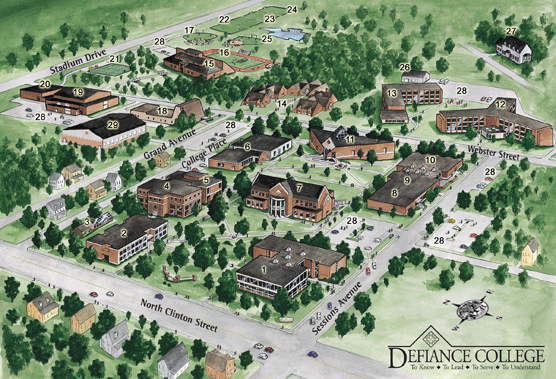
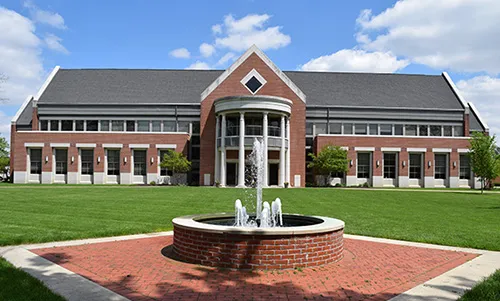
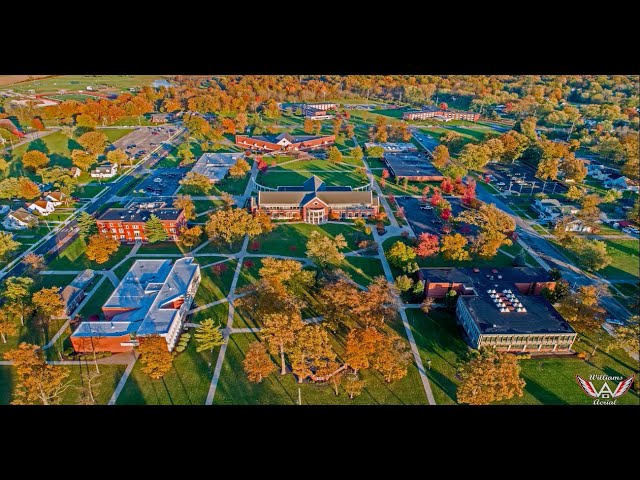
Defiance College seal · sourceVisit Defiance College | Campus Tours & Events · sourceDefiance College - Defiance, OH · sourceDefiance College Virtual Tour · source
_(14598203978).jpg?width=1600)