Admit rate has ranged 60%–100% over the last 5 years — notably volatile, though the latest figure above (37%) falls outside that window. Source: IPEDS via Urban Institute.
Acceptance & SAT from Common Data Set / IPEDS; net price, earnings & graduation from the U.S. Dept. of Education College Scorecard. Figures lag ~1–2 years — verify with the school.
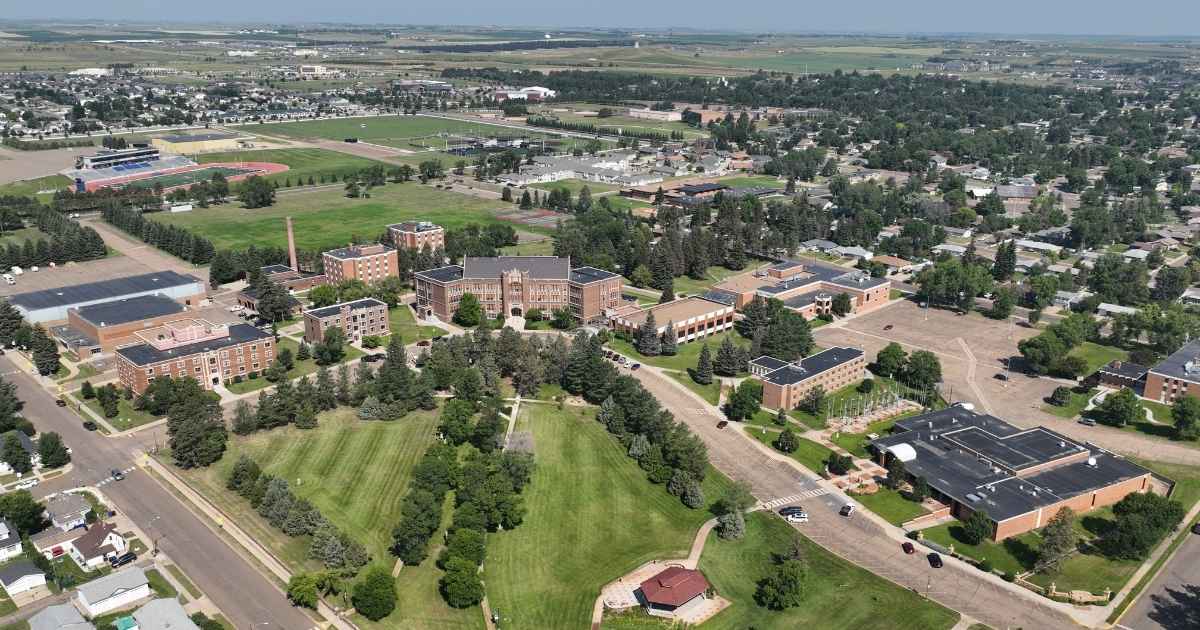
Dickinson State University is a small, public regional university in western North Dakota that operates with a distinctly practical, career-focused ethos. It's a place where open admission for in-state students meets a growing portfolio of technical and health science programs, all delivered with an emphasis on access and affordability. The campus vibe is quiet and residential, with a significant portion of students living off-campus, and its identity is firmly rooted in serving the workforce needs of its region.
Admission requirements
Test-optional — scores considered if submitted
Required
High school transcript
Grade point average
College-prep program
TOEFL (non-native English)
Considered (not required)
Class rank
Test scores (SAT/ACT)
Source: IPEDS Admissions survey (2022) via Urban Institute. Covers formal factors only — it does not reflect essays, extracurriculars, or other holistic criteria.
Median earnings by field of study (highest credential), ~2 years after completion.
Registered Nursing, Nursing Administration, Nursing Research and Clinical Nursing$63,005
Data Processing$45,696
Teacher Education and Professional Development, Specific Subject Areas$42,682
Sports, Kinesiology, and Physical Education/Fitness$42,682
Accounting and Related Services$42,123
Multi/Interdisciplinary Studies, Other
Campus & location
Campus safety
On-campus violent crimes (2024)
1
Per 1,000 students
0.86
On-campus criminal offenses classed as violent (murder/non-negligent manslaughter, rape, robbery, aggravated assault) for the most recent reported year. Source: U.S. Dept. of Education Campus Safety and Security (Clery Act). Counts reflect what’s reported to the school, and urban campuses often report more partly due to non-student incidents nearby — read alongside campus size and setting, not as a standalone safety verdict.
Climate
Pleasant days / yr
94
Summer high
81°F
Winter low
12°F
Annual rain
16.7"
Annual snow
31.1"
Natural-hazard risk
Very Low
Pleasant days counts days per year with a mean temperature of 55–75°F, a high at or below 90°F, a low at or above 45°F, and little precipitation — a transparent comfort measure, not a weighting we invented. Computed from Open-Meteo ERA5 daily history (2019–2023). Natural-hazard risk is the county’s composite rating from the FEMA National Risk Index.
Deep dive — research, future-scholar output & economic mobility▾
Research output
Institutional h-index
74
Scholarly works
1,162
Institutional research volume and impact from OpenAlex. The h-index reflects large research universities and will be low for teaching-focused liberal-arts colleges — not a measure of undergraduate quality.
Economic mobility
Mobility rate
4.1%
Bottom → top quintile
29%
From bottom quintile
14%
Mobility rate = the share of students who both start in the bottom household-income quintile and reach the top quintile; bottom → top is that chance conditional on starting at the bottom. Source: Opportunity Insights Mobility Report Cards (Chetty, Friedman, Saez, Turner & Yagan). Reflects 1980–82 birth cohorts, so it’s directional, not current.
Quick answers
What is the acceptance rate at Dickinson State University?
Dickinson State University's acceptance rate is approximately 37% (Dickinson, ND), based on the most recent figures we compiled from public and primary sources.
How much does Dickinson State University cost?
At Dickinson State University, the average net price (after aid) is about $14,092 per year. Actual cost varies with financial aid and residency.
How many undergraduates attend Dickinson State University?
Dickinson State University enrolls approximately 1,090 undergraduate students.
Where is Dickinson State University located?
Dickinson State University is located in Dickinson, ND.
Admissions
Dickinson State's admissions policy is defined by its accessibility, particularly for North Dakota residents. The university maintains an open admission policy for most in-state students, requiring only a minimum 2.0 GPA on a 4.0 scale for first-year applicants, with ACT or SAT scores not required but still accepted. However, it becomes more selective for out-of-state students and for admission into specific, often capacity-constrained programs. The university's overall is 37%, a figure that reflects this dual-track approach. Admitted students who submit test scores typically present an SAT range between 780–1150 or an ACT range of 17–22, with an average GPA around 3.27. The Spring 2026 student headcount was 1,359, indicating a small, intimate campus population.
Earnings = median of students working ~10 years after entry; debt = median of graduates. Value divides 10-yr earnings by one year’s net price — read it as earnings per dollar of annual cost, not a full lifetime ROI; it favors lower-cost schools. Source: U.S. Dept. of Education College Scorecard. Figures lag ~2 years and reflect all students, not your intended major.
$41,789
Teacher Education and Professional Development, Specific Levels and Methods$40,621
Business Administration, Management and Operations$38,597
Source: U.S. Dept. of Education College Scorecard (field-of-study earnings). Figures cover graduates who received federal aid and lag ~2 years; not all programs report data.
The academic profile at Dickinson State is unapologetically career-oriented, designed to funnel students directly into high-demand fields in the region and beyond. The most popular majors cluster in Business, Management, Marketing, and Related Support Services; Education; and Multi/Interdisciplinary Studies. The university offers a suite of career-focused programs in education, health sciences, nursing, business, agriculture, and technology. A recent and notable innovation is Dickinson State's status as the first North Dakota college to have a reduced-credit bachelor's degree program approved by the state, a move aimed at lowering cost and time-to-degree barriers. While the emphasis is on practical skills, programs like English and Writing aim to build foundational communication abilities, helping students "think clearly, write well, read critically, and speak effectively." The university promotes its "devoted faculty" and access to "high-end technology" as key components of the student experience.
Life at Dickinson State is quiet and self-contained, with a significant majority of students—72%—living off campus. Only 28% live in college-owned, -operated, or -affiliated housing. The university offers a standard array of clubs and organizations, and the campus provides ways "for all to engage in intercultural discussion" with a goal of helping students celebrate their cultural heritage. Student activities include cultural events on campus and visits to regional sites like Mount Rushmore. Social life is not centered on a bustling campus scene; as noted in student reviews, while there is no nightlife on campus, students often participate in off-campus parties or visit local bars if of legal age, though transportation can be a consideration. The overall atmosphere is one of a commuter-friendly campus where student life is often woven into the fabric of the wider Dickinson community.
Outcomes data paints a picture of a university serving a population where traditional four-year graduation is less common, but where graduates find solid economic footing. The graduation rate is 51%. Only 16% of students graduate within the normal 4-year time frame for a bachelor's degree. The university's spring 2026 commencement recognized 214 students, including 33 master's degree recipients, indicating a growing graduate presence. For earnings, the median income ten years after entry is $50,720. Other sources note median earnings six years after enrollment at $48,628 (about 11% above the national average) and earnings five years after graduation at $54,000. This suggests a positive trajectory for graduates' earning power as they progress in their careers, particularly in the practical fields the university emphasizes.
Affordability is a central tenet of the Dickinson State value proposition. The average after aid is $14,092. This net price—the average out-of-pocket cost for students receiving aid after grants and scholarships—is consistently reported as a key metric, with other estimates clustering around $14,698 to $16,554. The university encourages all students to apply for financial aid by completing the FAFSA as soon as possible after October 1 each year to access the full range of available programs. Financial assistance comes in the standard forms: grants, loans, student employment, department scholarships/awards, and waivers. The university provides a net price calculator to help families estimate their actual cost. There is no indication in the provided sources of a "no-loan" policy or a commitment to meet 100% of demonstrated financial need for all admitted students.
Dickinson State stands out for its unwavering commitment to being an engine of practical education and economic mobility for western North Dakota. It doesn't try to be a miniature liberal arts college or a sprawling research university. Instead, its identity is clearest in its role as a first-mover in the state's higher education landscape, pioneering a reduced-credit bachelor's degree program aimed at lowering costs. Its admissions strategy—open door for locals, selective for others—explicitly prioritizes serving its regional community. The academic focus is tightly aligned with local and state workforce needs in health sciences, education, business, and agriculture. This results in a no-frills, high-value proposition where students can graduate with manageable debt and enter careers with strong earning potential, all within the context of a small, quiet campus where the line between college life and the surrounding community is intentionally porous.
Dickinson State University seal · sourceDickinson State University | Dickinson, ND · sourceDickinson State University - Profile, Rankings and Data | US News Best Colleges · sourceFrom the Hawks' Nest: Building from DSU's Past to an Even Brighter Future · source