Admit rate has ranged 66%–77% over the last 5 years — notably volatile, though the latest figure above (64%) falls outside that window. Source: IPEDS via Urban Institute.
Acceptance & SAT from Common Data Set / IPEDS; net price, earnings & graduation from the U.S. Dept. of Education College Scorecard. Figures lag ~1–2 years — verify with the school.
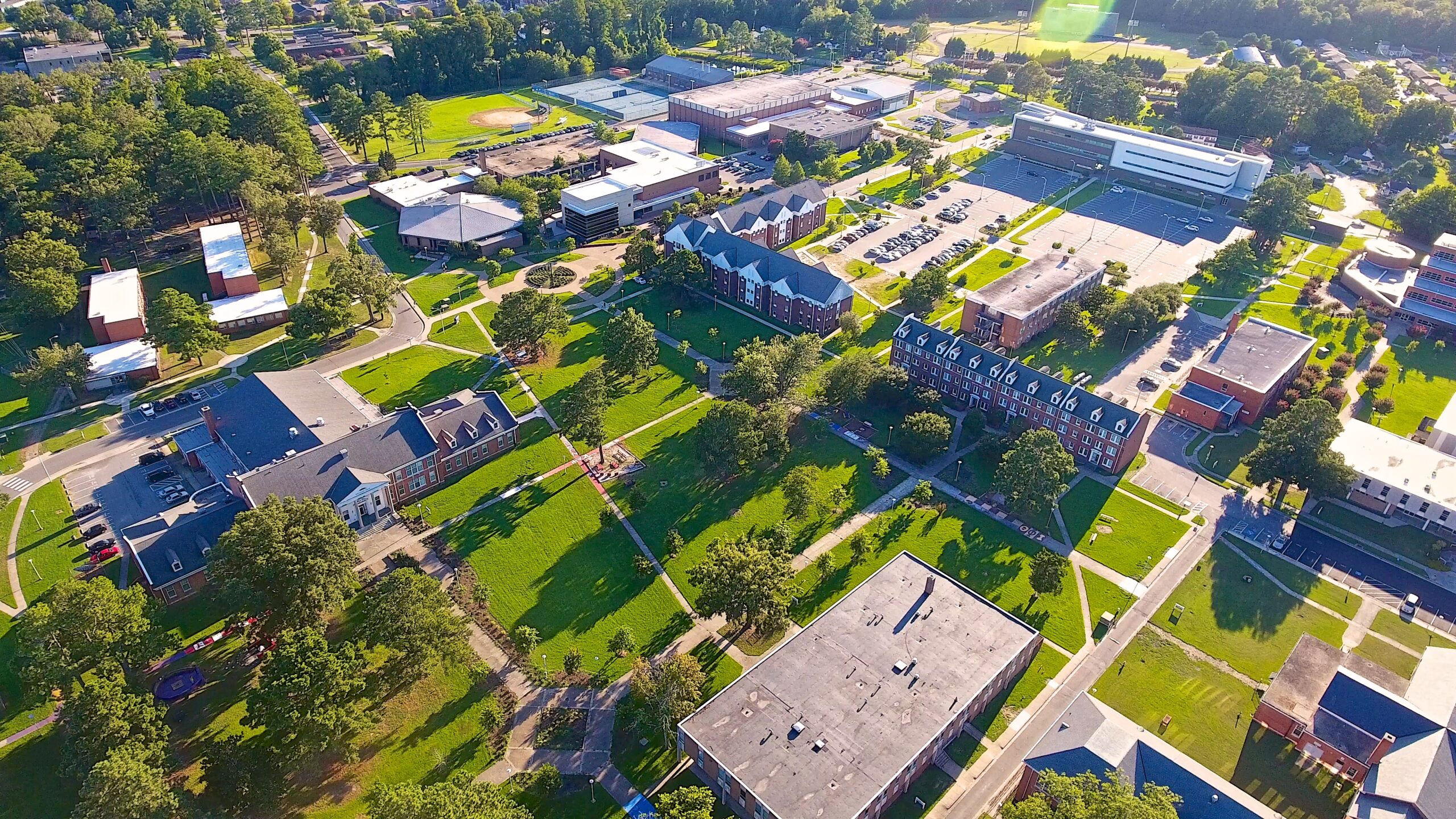
Elizabeth City State University is a public historically black university in northeastern North Carolina that operates with a clear, practical mission: to provide accessible, career-focused education with a profound sense of community. Founded in 1891 to train African American teachers, ECSU has evolved into a modern institution known for its distinctive aviation program and a campus culture described as a 'family.' It’s a school where a 64% acceptance rate opens the door to a surprisingly affordable education—with an average net price under $6,400—and where student life is defined by strong Viking spirit on a compact, supportive campus.
Admission requirements
Test-optional — scores considered if submitted
Required
High school transcript
Grade point average
TOEFL (non-native English)
Considered (not required)
Class rank
Test scores (SAT/ACT)
College-prep program
Source: IPEDS Admissions survey (2022) via Urban Institute. Covers formal factors only — it does not reflect essays, extracurriculars, or other holistic criteria.
More details
Undergrad enrollment
1,975
In-state tuition
$6,536
Out-of-state tuition
$10,536
Graduation Rate
44%
Median Earnings (10yr)
$40,026
First-Year Retention Rate
76-77%
Outcomes & value
Outcomes & value
Median earnings (10 yr)
$40,026
Value (earnings ÷ net price)
6.3×
Median debt at graduation
$21,463
Graduation rate
44%
First-year retention
77%
Reducing loan balance (3 yr)
26%
Pell (lower-income) share
54%
First-gen share (among federal-aid recipients)
37%
Top-earning majors
Median earnings by field of study (highest credential), ~2 years after completion.
Computer Science$45,696
Criminal Justice and Corrections$30,771
Accounting and Related Services$30,771
Biology, General$29,141
Teacher Education and Professional Development, Specific Levels and Methods$28,598
English Language and Literature, General
Campus & location
Campus safety
On-campus violent crimes (2024)
7
Per 1,000 students
3.37
On-campus criminal offenses classed as violent (murder/non-negligent manslaughter, rape, robbery, aggravated assault) for the most recent reported year. Source: U.S. Dept. of Education Campus Safety and Security (Clery Act). Counts reflect what’s reported to the school, and urban campuses often report more partly due to non-student incidents nearby — read alongside campus size and setting, not as a standalone safety verdict.
Climate
Pleasant days / yr
117
Summer high
85°F
Winter low
40°F
Annual rain
47.8"
Annual snow
2.1"
Natural-hazard risk
Relatively Low
Pleasant days counts days per year with a mean temperature of 55–75°F, a high at or below 90°F, a low at or above 45°F, and little precipitation — a transparent comfort measure, not a weighting we invented. Computed from Open-Meteo ERA5 daily history (2019–2023). Natural-hazard risk is the county’s composite rating from the FEMA National Risk Index.
Deep dive — research, future-scholar output & economic mobility▾
Research output
Institutional h-index
60
Scholarly works
1,086
Institutional research volume and impact from OpenAlex. The h-index reflects large research universities and will be low for teaching-focused liberal-arts colleges — not a measure of undergraduate quality.
Economic mobility
Mobility rate
3.9%
Bottom → top quintile
12%
From bottom quintile
32%
Mobility rate = the share of students who both start in the bottom household-income quintile and reach the top quintile; bottom → top is that chance conditional on starting at the bottom. Source: Opportunity Insights Mobility Report Cards (Chetty, Friedman, Saez, Turner & Yagan). Reflects 1980–82 birth cohorts, so it’s directional, not current.
Quick answers
What is the acceptance rate at Elizabeth City State University?
Elizabeth City State University's acceptance rate is approximately 64% (Elizabeth City, NC), based on the most recent figures we compiled from public and primary sources.
What SAT score do you need for Elizabeth City State University?
Admitted students at Elizabeth City State University typically score 920–1080 on the SAT (the middle-50% range). Scores outside this band are still admitted, especially with strong applications.
How much does Elizabeth City State University cost?
At Elizabeth City State University, the average net price (after aid) is about $6,364 per year. Actual cost varies with financial aid and residency.
How many undergraduates attend Elizabeth City State University?
Elizabeth City State University enrolls approximately 1,975 undergraduate students.
Where is Elizabeth City State University located?
Elizabeth City State University is located in Elizabeth City, NC.
Admissions
ECSU’s admissions process is designed to be accessible, with a focus on meeting clear minimum academic benchmarks rather than hyper-selectivity. The university reports an of 64%, admitting a significant majority of its applicants. The middle 50% SAT range for admitted students who submit scores falls between 920 and 1080. The primary academic gatekeeper is a minimum 2.5 weighted high school GPA, alongside required coursework in English, math, science, and social studies. The process is described as 'somewhat selective,' but the emphasis is on foundational readiness. There is no available source data from the provided URLs indicating whether ECSU has an Early Decision program, tracks demonstrated interest, or has a specific rate; the admissions landscape is defined by its straightforward, requirement-driven approach.
Growth and practical career preparation are the watchwords of academics at ECSU. The university offers 28 baccalaureate degrees organized into three schools: The School of Education, Humanities, & Public Service; The School of Business, Health, & Applied Sciences; and The School of Aviation. This structure highlights its signature and most distinctive program: Aviation. Beyond that, the curriculum is tailored toward in-demand fields. The most popular majors for recent graduates reflect this focus, with Homeland Security, Law Enforcement, Firefighting, and Related Protective Services leading at 17% of graduates, followed by Multi/Interdisciplinary Studies. It’s a hands-on academic environment where degrees are 'tailored for your success,' blending traditional liberal arts with direct pathways to professions in business, health, education, and public service.
Earnings = median of students working ~10 years after entry; debt = median of graduates. Value divides 10-yr earnings by one year’s net price — read it as earnings per dollar of annual cost, not a full lifetime ROI; it favors lower-cost schools. Source: U.S. Dept. of Education College Scorecard. Figures lag ~2 years and reflect all students, not your intended major.
$28,598
Teacher Education and Professional Development, Specific Subject Areas$26,353
Air Transportation$26,353
Source: U.S. Dept. of Education College Scorecard (field-of-study earnings). Figures cover graduates who received federal aid and lag ~2 years; not all programs report data.
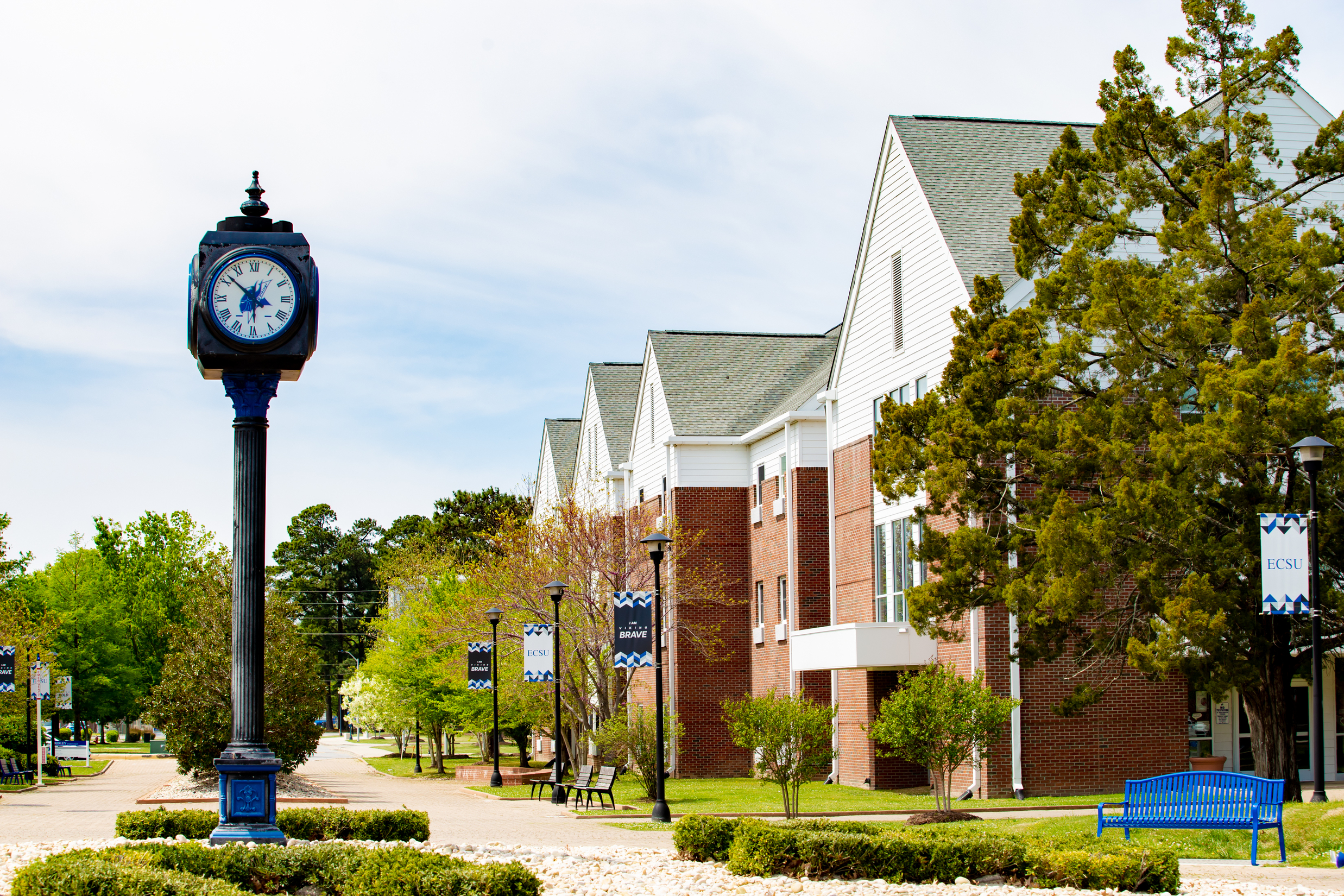
Life at ECSU is consistently described as 'vibrant and welcoming,' with a strong, familial sense of community that defines the campus experience. The culture is characterized by significant school spirit—Viking pride—and a feeling that students are part of a close-knit group. The university facilitates this through a dedicated Office of Student Engagement & Leadership, which organizes a calendar of 'fun and creative social, multicultural, recreational and educational activities' to promote involvement. While the campus is located in the small, historic riverfront city of Elizabeth City, student life revolves around on-campus clubs, groups, and sports events. The overall vibe is one of an active, supportive home base where students are encouraged to grow both inside and outside the classroom.
ECSU’s outcomes profile centers on strong student satisfaction and solid early-career earnings potential, especially given its low . The first-year retention rate—a key indicator of student satisfaction—is reported at 76-77%. The six-year graduation rate is 44%. For alumni, the median earnings ten years after entry are $40,026. The university itself has highlighted that its graduates' earning potential proves the value of the education offered. Some program-level data exists, noting that biology graduates tend to earn approximately $29,000. These metrics, particularly the retention rate and earnings, are often cited in the context of ECSU being ranked among the best value colleges in North Carolina, framing its return on investment as a key strength.
Affordability is arguably ECSU’s most powerful draw. The average after aid is a remarkably low $6,364. The university offers a full array of financial aid options, including grants, scholarships, loans, and Federal Work-Study. For first-year students, the average need-based scholarship or grant award is $11,923, and 67% of first-year students receive some form of need-based financial aid. A Net Price Calculator is available to help prospective families estimate their actual cost. While the provided sources detail federal aid programs and the importance of meeting financial clearance deadlines, there is no information in the allowed URLs indicating that ECSU has a 'no-loan' policy or commits to meeting 100% of demonstrated financial need without loans. The story here is one of substantial grant and scholarship support that drives down the sticker price significantly.
Elizabeth City State University stands out for delivering a specific, high-value proposition: it’s an accessible, community-anchored HBCU that pairs career-ready degrees with one of the lowest in the country. Its identity is built on three pillars. First, its unique academic signature: it houses North Carolina’s only four-year aviation degree program, a rare and professionally lucrative offering at a public university. Second, its profound sense of place and community: from its 1891 founding as a teacher-training school for African Americans to its current 'family' atmosphere, ECSU fosters a tight-knit, supportive environment where student retention is strong. Third, its unmatched affordability: with an average net price hovering around $6,300, it makes a bachelor’s degree a realistic financial proposition for many families, earning it 'best value' accolades. It’s not a university of lofty, abstract prestige, but one of concrete opportunity—where you can learn to fly a plane, build a network that feels like kin, and graduate without a mountain of debt.
Elizabeth City State University seal · sourceECSU | Elizabeth City State University - Home · sourceElizabeth City State Teachers College Historic District - African American Experience of Northeast North Carolina · sourceElizabeth City State University - Profile, Rankings and Data | US News Best Colleges · source