Admit rate has ranged 66%–75% over the last 5 years — notably volatile, though the latest figure above (77%) falls outside that window. Source: IPEDS via Urban Institute.
Acceptance & SAT from Common Data Set / IPEDS; net price, earnings & graduation from the U.S. Dept. of Education College Scorecard. Figures lag ~1–2 years — verify with the school.
Embry-Riddle Aeronautical University in Prescott is less a traditional liberal arts college and more a high-octane, specialized trade school for the aerospace age, set against the high desert of Arizona. Its identity is laser-focused: this is where you go to become a pilot, an aerospace engineer, or an air traffic controller, surrounded by 3,200 similarly obsessed peers in a close-knit, technically-minded community. The trade-off is a singular professional trajectory for a premium price, offering a direct pipeline into aviation and defense careers but demanding a specific, all-in commitment from day one.
Admission requirements
Test-optional — scores considered if submitted
Required
High school transcript
College-prep program
TOEFL (non-native English)
Considered (not required)
Grade point average
Class rank
Letters of recommendation
Test scores (SAT/ACT)
Source: IPEDS Admissions survey (2022) via Urban Institute. Covers formal factors only — it does not reflect essays, extracurriculars, or other holistic criteria.
More details
Undergrad enrollment
3,218
In-state tuition
$44,149
Out-of-state tuition
$44,149
Graduation Rate
68%
Student-Faculty Ratio
17:1
Median Earnings (10yr)
$84,131
First-Year Students Receiving Need-Based Aid
65%
Outcomes & value
Outcomes & value
Median earnings (10 yr)
$84,131
Value (earnings ÷ net price)
2.1×
Median debt at graduation
$23,666
Graduation rate
68%
First-year retention
82%
Reducing loan balance (3 yr)
64%
Pell (lower-income) share
18%
First-gen share (among federal-aid recipients)
36%
Top-earning majors
Median earnings by field of study (highest credential), ~2 years after completion.
Aerospace, Aeronautical, and Astronautical/Space Engineering$65,080
Computer Engineering$62,012
Electrical, Electronics, and Communications Engineering$61,020
Business Administration, Management and Operations$59,314
Mechanical Engineering$55,964
Air Transportation
Campus & location
Campus safety
On-campus violent crimes (2024)
0
Per 1,000 students
0.00
On-campus criminal offenses classed as violent (murder/non-negligent manslaughter, rape, robbery, aggravated assault) for the most recent reported year. Source: U.S. Dept. of Education Campus Safety and Security (Clery Act). Counts reflect what’s reported to the school, and urban campuses often report more partly due to non-student incidents nearby — read alongside campus size and setting, not as a standalone safety verdict.
Climate
Pleasant days / yr
107
Summer high
88°F
Winter low
29°F
Annual rain
12.2"
Annual snow
15.6"
Natural-hazard risk
Relatively Moderate
Pleasant days counts days per year with a mean temperature of 55–75°F, a high at or below 90°F, a low at or above 45°F, and little precipitation — a transparent comfort measure, not a weighting we invented. Computed from Open-Meteo ERA5 daily history (2019–2023). Natural-hazard risk is the county’s composite rating from the FEMA National Risk Index.
Quick answers
What is the acceptance rate at Embry-Riddle Aeronautical University-Prescott?
Embry-Riddle Aeronautical University-Prescott's acceptance rate is approximately 77% (Prescott, AZ), based on the most recent figures we compiled from public and primary sources.
What SAT score do you need for Embry-Riddle Aeronautical University-Prescott?
Admitted students at Embry-Riddle Aeronautical University-Prescott typically score 1140–1370 on the SAT (the middle-50% range). Scores outside this band are still admitted, especially with strong applications.
How much does Embry-Riddle Aeronautical University-Prescott cost?
At Embry-Riddle Aeronautical University-Prescott, the average net price (after aid) is about $40,287 per year. Actual cost varies with financial aid and residency.
How many undergraduates attend Embry-Riddle Aeronautical University-Prescott?
Embry-Riddle Aeronautical University-Prescott enrolls approximately 3,218 undergraduate students.
Where is Embry-Riddle Aeronautical University-Prescott located?
Embry-Riddle Aeronautical University-Prescott is located in Prescott, AZ.
Admissions
Embry-Riddle Prescott operates with a less selective admissions process, prioritizing students with a clear, demonstrated focus on its STEM and aviation-centric programs. The university does not have an open admission policy, requiring a high school diploma or GED. While the process is accessible, admitted students typically present solid academic credentials, with a middle 50% SAT range of 1140–1370 and an ACT range of 24–29. The admissions office evaluates applicants holistically, but the core of the decision rests on academic preparedness for its rigorous technical curriculum. Notably, the university's rate—the percentage of admitted students who enroll—has historically averaged around 31.67%, though recent figures show a decline to 23.59% for the class of 2025. This suggests that while many students are admitted, a significant portion opts for other institutions, making demonstrated commitment to the field a valuable intangible for applicants.
The academic experience at Prescott is defined by intense specialization and hands-on learning from day one. The university offers over 90 degree programs, but the curriculum orbits firmly around aviation, aerospace, engineering, business, computers, technology, and security. This is not a place for exploratory general education; students dive directly into their majors, supported by a student-faculty ratio of 17:1, with over a third of classes having fewer than 20 students. The advantages of this model are clear: unparalleled focus, deep industry connections, and curriculum designed explicitly for technical proficiency. The trade-off, as noted in student discussions, is a relative lack of breadth in the humanities or social sciences. The environment is very academically focused, catering to students who know precisely why they are there—to earn a degree that functions as a direct ticket into the cockpit, the control tower, or the engineering lab.
Earnings = median of students working ~10 years after entry; debt = median of graduates. Value divides 10-yr earnings by one year’s net price — read it as earnings per dollar of annual cost, not a full lifetime ROI; it favors lower-cost schools. Source: U.S. Dept. of Education College Scorecard. Figures lag ~2 years and reflect all students, not your intended major.
$48,833
Clinical, Counseling and Applied Psychology$41,937
International Relations and National Security Studies$36,134
Source: U.S. Dept. of Education College Scorecard (field-of-study earnings). Figures cover graduates who received federal aid and lag ~2 years; not all programs report data.
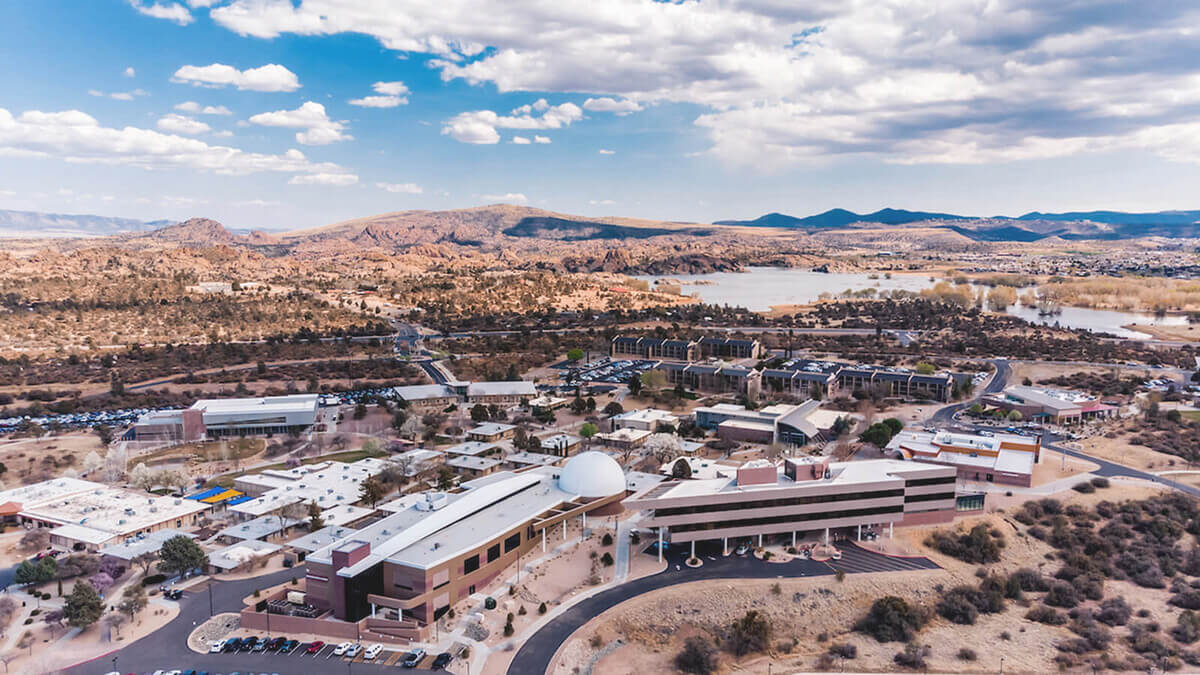
Life on the Prescott campus is shaped by its size, location, and the singular interests of its student body. With approximately 3,200 students, the campus fosters a close-knit, small-town feel. Student organizations run the gamut from academic and professional groups to service, social, hobby, spiritual, and cultural clubs, providing outlets within the community. The campus itself features notable landmarks like the Palm Walk and historic Old Main. However, the social and cultural experience is heavily influenced by the rural Arizona setting and the dominant technical focus of the student population. Students report that while there are "cool arts and culture events," the area is rural, and day trips are a popular way to explore. Online discussions also point to challenges with diversity and inclusion, with some students citing experiences of racism, homophobia, ableism, and misogyny, indicating the campus culture may not feel welcoming to all. For students passionate about aviation, it's a tribe; for others, it can feel isolating.
The investment in an Embry-Riddle Prescott education pays off in highly specific, lucrative career pathways. The university's graduation rate is strong, with a six-year rate for full-time, bachelor's degree-seeking students reported at 70%. The ultimate vindication of the model is in postgraduate earnings. While one source notes a median salary of $65,391 six years after graduation, more recent data indicates graduates earn a median of $93,582 just four years out—a figure 55% above the national average. This powerful return on investment underscores the degree's potency in the job market. The outcomes data validates the school's mission: it successfully prepares students for high-demand, well-compensated roles in aviation, aerospace, and related technical fields, with a clear and accelerated path from classroom to career.
Attending Embry-Riddle Prescott requires a significant financial commitment, though the university provides aid to offset the sticker price. The average need-based scholarship or grant awarded to first-year students is $24,227, and 65% of first-year students receive need-based financial aid. After accounting for grants and scholarships, the average —the actual annual cost to families—is substantial. Various sources estimate this net price between $38,909 and $41,209. The university offers a net price calculator and encourages students to explore all funding options, including federal aid and private student loans. There is no indication in the provided sources that Embry-Riddle Prescott has a "no-loan" policy or meets 100% of demonstrated financial need solely with grants; financial aid packages are likely to include a mix of grants, scholarships, and loans.
Embry-Riddle Prescott stands alone. There is simply no direct analogue in American higher education. It is a monastic, single-purpose institution dedicated to aerospace, offering a depth of focus that even its larger sibling campus in Daytona Beach can't quite match due to Prescott's smaller size and desert isolation. The campus culture is a direct reflection of this mission: it attracts students who speak in acronyms (ATC, ATC, UAV), whose idea of a good time might be a perfect crosswind landing, and whose career goals are plotted on a sectional chart. This creates an incredibly powerful network and identity—you are an "Eagle" for life, with all the industry doors that opens. The trade-offs are equally stark: a premium price tag, a socially narrow environment, and an education that is vocational in the best and most limiting sense. It's not for everyone, but for the right student—the one who has dreamed of flight since childhood—it is the only place.