Admit rate has ranged 58%–86% over the last 5 years — notably volatile. Source: IPEDS via Urban Institute.
Acceptance & SAT from Common Data Set / IPEDS; net price, earnings & graduation from the U.S. Dept. of Education College Scorecard. Figures lag ~1–2 years — verify with the school.
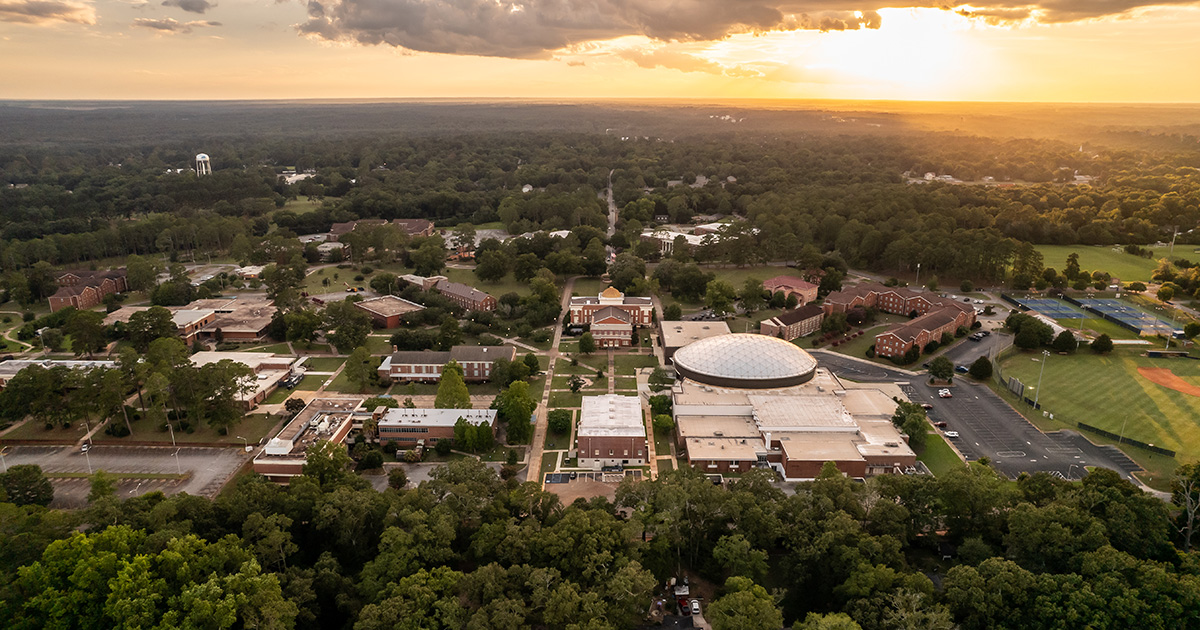
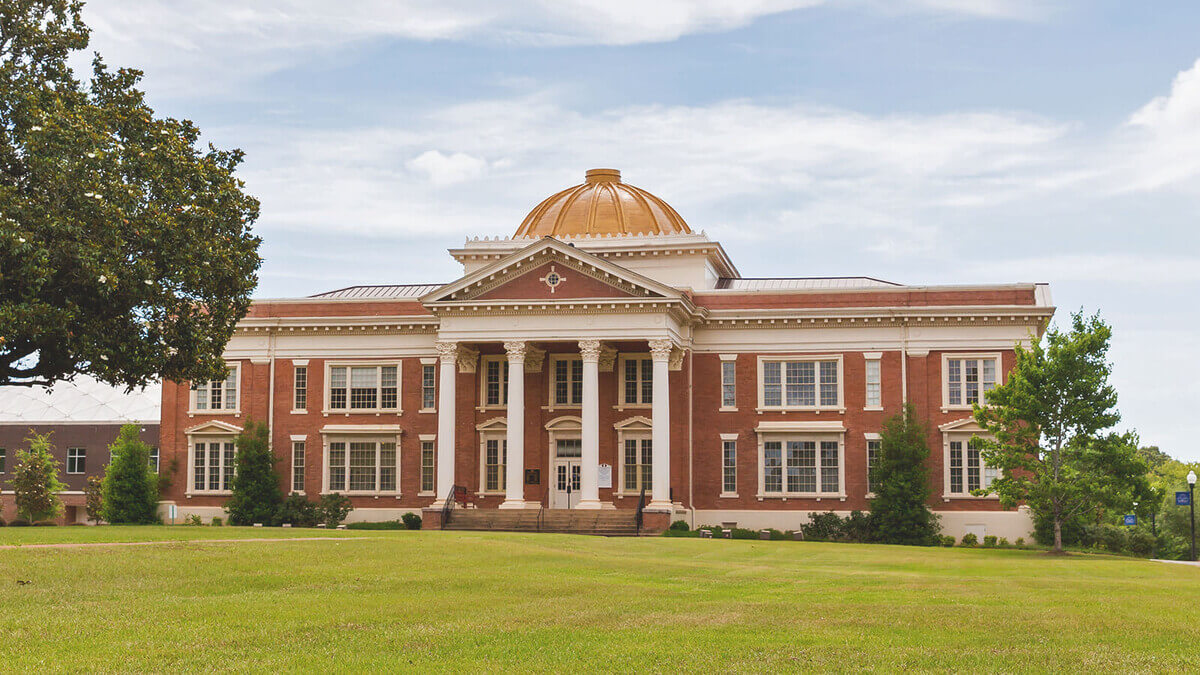
Georgia Southwestern State University (GSW) is a small but growing public university in Americus, Georgia, where students find an intimate, low-pressure academic environment with surprisingly strong early-career earnings. With a 75% acceptance rate and test-optional admissions, GSW attracts a mix of business, education, and nursing majors to its 85+ degree programs—many of whom graduate into jobs paying above state averages.
Admission requirements
Test scores required
Required
High school transcript
Grade point average
Test scores (SAT/ACT)
College-prep program
TOEFL (non-native English)
Considered (not required)
Letters of recommendation
Source: IPEDS Admissions survey (2022) via Urban Institute. Covers formal factors only — it does not reflect essays, extracurriculars, or other holistic criteria.
More details
Undergrad enrollment
2,424
In-state tuition
$5,220
Out-of-state tuition
$16,572
Campus Housing
27% of students
Most Popular Majors
Education, Business, Nursing
4-Year Graduation Rate
25%
Average Need-Based Aid Award
$6,520
Median Earnings (6 Years After Graduation)
$42,047
Outcomes & value
Outcomes & value
Median earnings (10 yr)
$48,757
Value (earnings ÷ net price)
4.1×
Median debt at graduation
$18,851
Graduation rate
41%
First-year retention
58%
Reducing loan balance (3 yr)
45%
Pell (lower-income) share
43%
First-gen share (among federal-aid recipients)
35%
Top-earning majors
Median earnings by field of study (highest credential), ~2 years after completion.
Registered Nursing, Nursing Administration, Nursing Research and Clinical Nursing$63,005
Computer Science$53,358
Business Administration, Management and Operations$41,193
Accounting and Related Services$36,914
Teacher Education and Professional Development, Specific Levels and Methods$33,053
Human Resources Management and Services
Campus & location
Campus safety
On-campus violent crimes (2024)
1
Per 1,000 students
0.32
On-campus criminal offenses classed as violent (murder/non-negligent manslaughter, rape, robbery, aggravated assault) for the most recent reported year. Source: U.S. Dept. of Education Campus Safety and Security (Clery Act). Counts reflect what’s reported to the school, and urban campuses often report more partly due to non-student incidents nearby — read alongside campus size and setting, not as a standalone safety verdict.
Climate
Pleasant days / yr
110
Summer high
91°F
Winter low
44°F
Annual rain
46.5"
Natural-hazard risk
Relatively Low
Pleasant days counts days per year with a mean temperature of 55–75°F, a high at or below 90°F, a low at or above 45°F, and little precipitation — a transparent comfort measure, not a weighting we invented. Computed from Open-Meteo ERA5 daily history (2019–2023). Natural-hazard risk is the county’s composite rating from the FEMA National Risk Index.
Deep dive — research, future-scholar output & economic mobility▾
Research output
Institutional h-index
50
Scholarly works
649
Institutional research volume and impact from OpenAlex. The h-index reflects large research universities and will be low for teaching-focused liberal-arts colleges — not a measure of undergraduate quality.
Economic mobility
Mobility rate
1.9%
Bottom → top quintile
15%
From bottom quintile
12%
Mobility rate = the share of students who both start in the bottom household-income quintile and reach the top quintile; bottom → top is that chance conditional on starting at the bottom. Source: Opportunity Insights Mobility Report Cards (Chetty, Friedman, Saez, Turner & Yagan). Reflects 1980–82 birth cohorts, so it’s directional, not current.
Quick answers
What is the acceptance rate at Georgia Southwestern State University?
Georgia Southwestern State University's acceptance rate is approximately 75% (Americus, GA), based on the most recent figures we compiled from public and primary sources.
What SAT score do you need for Georgia Southwestern State University?
Admitted students at Georgia Southwestern State University typically score 890–1110 on the SAT (the middle-50% range). Scores outside this band are still admitted, especially with strong applications.
How much does Georgia Southwestern State University cost?
At Georgia Southwestern State University, the average net price (after aid) is about $12,019 per year. Actual cost varies with financial aid and residency.
How many undergraduates attend Georgia Southwestern State University?
Georgia Southwestern State University enrolls approximately 2,424 undergraduate students.
Where is Georgia Southwestern State University located?
Georgia Southwestern State University is located in Americus, GA.
Admissions
GSW maintains an accessible admissions process with a 75% acceptance rate (sources vary slightly between 72-77%), making it one of Georgia's more open public universities. The school hit a record 4,017 students in 2025—an 8.5% year-over-year increase—though its rural location keeps competition modest. Notably, SAT/ACT scores are optional for freshmen, with admitted students typically showing ACT scores between 16-22. About 18% of enrollees had GPAs of 3.75+, while another 15% fell in the 3.50-3.74 range.
GSW offers 85+ undergraduate and graduate programs across four colleges, with business, education, and health sciences dominating enrollment. The university leans heavily into practical fields— were awarded in 2024, alongside 199 business degrees. Small classes are the norm, with students praising professors for being "approachable and passionate" (Niche). While not a research powerhouse, GSW emphasizes affordability and accessibility, billing itself as a "top value" among Georgia's public universities. The College of Nursing and Health Sciences is a particular strength, feeding graduates into regional healthcare jobs.
Earnings = median of students working ~10 years after entry; debt = median of graduates. Value divides 10-yr earnings by one year’s net price — read it as earnings per dollar of annual cost, not a full lifetime ROI; it favors lower-cost schools. Source: U.S. Dept. of Education College Scorecard. Figures lag ~2 years and reflect all students, not your intended major.
$32,711
Sociology$32,569
Marketing$32,391
Source: U.S. Dept. of Education College Scorecard (field-of-study earnings). Figures cover graduates who received federal aid and lag ~2 years; not all programs report data.
Life at GSW revolves around its close-knit, laid-back campus where most students know each other. Only 27% live on campus, with the majority commuting from Americus and surrounding towns. The vibe is decidedly unpretentious—think pickup basketball games over Greek life (just four sororities and fraternities exist). That said, the university pushes leadership and service opportunities, along with NCAA Division II athletics (the Hurricanes compete in the Peach Belt Conference). Safety initiatives are prominent, with the Office of Student Rights and Responsibilities promoting a culture of "well-being through education."
GSW punches above its weight in early-career earnings—its graduates rank #3 in Georgia for median income one year post-graduation, per 2026 data. While the 4-year graduation rate is just 25%, those who persist see solid returns: $36,427 median earnings at one year and $42,047 at six years (slightly below national averages but competitive for rural Georgia). About 90% of alumni are employed, many in local schools, hospitals, and agribusiness. The education department’s pipeline into Georgia’s K-12 system is particularly reliable.
GSW’s affordability is a major selling point—83% of first-years receive need-based aid, averaging $6,520 in grants/scholarships. The typical aid package blends federal ($6,632), state ($5,039), and institutional ($3,730) support, with Pell Grants common. Nearly 70% of students get some financial assistance, easing the burden of in-state tuition. The Calculator helps families estimate true costs after aid, though GSW’s rural location also keeps living expenses low compared to Atlanta-area schools.
GSW is the antithesis of a cutthroat flagship—a low-stakes, high-support environment where modest stats won’t disqualify you. Its secret sauce? Strong regional employment networks (especially in teaching and nursing) that deliver better-than-expected salaries. The campus feels like a throwback to a simpler college experience: professors who know your name, Friday night football games, and graduation without crippling debt. For students okay with rural Georgia’s pace, it’s a pragmatic choice that overdelivers on ROI.
Georgia Southwestern State University logo · sourceGeorgia Southwestern State University · sourceGeorgia Southwestern State University - Americus, GA | Appily · sourceGraduation | Georgia Southwestern | Georgia Southwestern State University · source