Loading…
← All schools
HVAC Technical Institute
Chicago, ILprivate forprofitwww.hvac-tech.com/
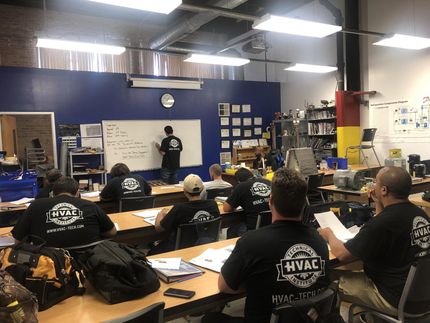
HVAC Technical Institute is a no-nonsense, minority-owned trade school in Chicago that operates on a radically different model than a traditional college. It's a direct pipeline into the skilled trades, offering a hyper-focused, hands-on curriculum in heating, ventilation, and air conditioning for a student body that is overwhelmingly male and career-focused. With an open-access admissions policy and a pragmatic approach centered on job-ready skills, it delivers solid graduation rates and strong early-career earnings for its graduates.
More details
- Undergrad enrollment
- 285
- Class Size Cap
- 20-24 students
- Graduation Rate
- 81%
- Most Popular Major
- HVAC and Refrigeration Engineering Technician
- Student Body Gender
- 96.8% men, 3.2% women
- Median Earnings (10yr)
- $49,913
- Pell Grant Recipient Share
- 84%
- First-Generation Student Share
- 64%
Outcomes & value
Outcomes & value
- Median debt at graduation
- $6,851
- Pell (lower-income) share
- 54%
- First-gen share (among federal-aid recipients)
- 64%
Earnings = median of students working ~10 years after entry; debt = median of graduates. Value divides 10-yr earnings by one year’s net price — read it as earnings per dollar of annual cost, not a full lifetime ROI; it favors lower-cost schools. Source: U.S. Dept. of Education College Scorecard. Figures lag ~2 years and reflect all students, not your intended major.
Financial health
2.4 / 3.0Meets the federal financial-responsibility standard
U.S. Dept. of Education Financial Responsibility Composite Score (FY2022-23). Scale −1.0 to 3.0; ≥1.5 meets the standard. Reported for private nonprofit & for-profit institutions only — public universities are state-backed and not scored, so this is a stability signal, not a ranking.
Campus & location
Campus safety
- On-campus violent crimes (2024)
- 0
On-campus criminal offenses classed as violent (murder/non-negligent manslaughter, rape, robbery, aggravated assault) for the most recent reported year. Source: U.S. Dept. of Education Campus Safety and Security (Clery Act). Counts reflect what’s reported to the school, and urban campuses often report more partly due to non-student incidents nearby — read alongside campus size and setting, not as a standalone safety verdict.
Climate
- Pleasant days / yr
- 85
- Summer high
- 81°F
- Winter low
- 22°F
- Annual rain
- 49.4"
- Annual snow
- 30.7"
- Natural-hazard risk
- Very High
Pleasant days counts days per year with a mean temperature of 55–75°F, a high at or below 90°F, a low at or above 45°F, and little precipitation — a transparent comfort measure, not a weighting we invented. Computed from Open-Meteo ERA5 daily history (2019–2023). Natural-hazard risk is the county’s composite rating from the FEMA National Risk Index.
Quick answers
- How much does HVAC Technical Institute cost?
- At HVAC Technical Institute, the average net price (after aid) is about $20,403 per year. Actual cost varies with financial aid and residency.
- How many undergraduates attend HVAC Technical Institute?
- HVAC Technical Institute enrolls approximately 285 undergraduate students.
- Where is HVAC Technical Institute located?
- HVAC Technical Institute is located in Chicago, IL.
Admissions
HVAC Technical Institute operates on an open-access, non-selective admissions model, a stark contrast to the competitive gates of traditional universities. The school reports a 100% , meaning it admits all applicants who meet its basic requirements. There is no mention of Early Decision programs or consideration of demonstrated interest in the admissions process—the focus is on readiness for a technical program, not crafting a selective class profile. The institute emphasizes meeting individual student needs and intentionally keeps class sizes small, capping them at 20 to 24 students to ensure personalized attention. The student body is heavily skewed toward men, with a gender distribution of 96.8% male and 3.2% female. A significant portion of the student population comes from lower-income or backgrounds, with one source noting an 84% Pell Grant share and a 64% first-generation share among students.
Compare HVAC Technical Institute
See colleges similar to HVAC Technical Institute →Sources
- Common Data Set: Home
- Common Data Set - Analytics & Institutional Effectiveness
- Common Data Set Explorer 2026: Compare 100 Colleges
- Common Data Set - Institutional Research & Planning - Georgia Tech
- HVAC Technical Institute Statistics
- Common Data Set Initiative - Institutional Research & Analytics
- First-Year Class Profile
- Accreditation Statistics for HVAC Technical Institute
- consumer information
- HVAC Technical Institute: Acceptance Rate, SAT & Cost - QuantAdmit
- HVAC Technical Institute - Chicago, IL