Admit rate has ranged 39%–63% over the last 5 years — notably volatile. Source: IPEDS via Urban Institute.
Acceptance & SAT from Common Data Set / IPEDS; net price, earnings & graduation from the U.S. Dept. of Education College Scorecard. Figures lag ~1–2 years — verify with the school.
Judson University is a small, evangelical Christian liberal arts institution in suburban Elgin, Illinois, where faith is woven into the fabric of daily life and learning. It operates with a distinctly residential, community-oriented model centered around a unique House System, offering a tight-knit environment for students pursuing degrees in fields like architecture, business, and ministry. While its admissions are accessible, the university reports a solid graduation rate and aims to make its education affordable for the majority of its students through financial aid.
Admission requirements
Test-optional — scores considered if submitted
Required
High school transcript
Grade point average
TOEFL (non-native English)
Considered (not required)
Class rank
Letters of recommendation
Test scores (SAT/ACT)
College-prep program
Source: IPEDS Admissions survey (2022) via Urban Institute. Covers formal factors only — it does not reflect essays, extracurriculars, or other holistic criteria.
More details
Undergrad enrollment
708
In-state tuition
$31,360
Out-of-state tuition
$31,360
Graduation Rate
60%
Housing (On-Campus)
57%
First-Year Retention
79%
Student-Faculty Ratio
10:1
Median Earnings (10yr)
$56,313
Outcomes & value
Outcomes & value
Median earnings (10 yr)
$56,313
Value (earnings ÷ net price)
3.0×
Median debt at graduation
$25,000
Graduation rate
60%
First-year retention
59%
Reducing loan balance (3 yr)
66%
Pell (lower-income) share
39%
First-gen share (among federal-aid recipients)
36%
Financial health
0.6 / 3.0Below the federal standard — financial stress
U.S. Dept. of Education Financial Responsibility Composite Score (FY2022-23). Scale −1.0 to 3.0; ≥1.5 meets the standard. Reported for private nonprofit & for-profit institutions only — public universities are state-backed and not scored, so this is a stability signal, not a ranking.
Top-earning majors
Median earnings by field of study (highest credential), ~2 years after completion.
Business Administration, Management and Operations$52,733
Human Services, General$30,554
Architecture$26,933
Source: U.S. Dept. of Education College Scorecard (field-of-study earnings). Figures cover graduates who received federal aid and lag ~2 years; not all programs report data.
On-campus criminal offenses classed as violent (murder/non-negligent manslaughter, rape, robbery, aggravated assault) for the most recent reported year. Source: U.S. Dept. of Education Campus Safety and Security (Clery Act). Counts reflect what’s reported to the school, and urban campuses often report more partly due to non-student incidents nearby — read alongside campus size and setting, not as a standalone safety verdict.
Climate
Pleasant days / yr
85
Summer high
82°F
Winter low
20°F
Annual rain
41.9"
Annual snow
33.7"
Natural-hazard risk
Relatively High
Pleasant days counts days per year with a mean temperature of 55–75°F, a high at or below 90°F, a low at or above 45°F, and little precipitation — a transparent comfort measure, not a weighting we invented. Computed from Open-Meteo ERA5 daily history (2019–2023). Natural-hazard risk is the county’s composite rating from the FEMA National Risk Index.
Deep dive — research, future-scholar output & economic mobility▾
Research output
Institutional h-index
30
Scholarly works
322
Institutional research volume and impact from OpenAlex. The h-index reflects large research universities and will be low for teaching-focused liberal-arts colleges — not a measure of undergraduate quality.
Economic mobility
Mobility rate
1.3%
Bottom → top quintile
20%
From bottom quintile
6%
Mobility rate = the share of students who both start in the bottom household-income quintile and reach the top quintile; bottom → top is that chance conditional on starting at the bottom. Source: Opportunity Insights Mobility Report Cards (Chetty, Friedman, Saez, Turner & Yagan). Reflects 1980–82 birth cohorts, so it’s directional, not current.
Quick answers
What is the acceptance rate at Judson University?
Judson University's acceptance rate is approximately 48% (Elgin, IL), based on the most recent figures we compiled from public and primary sources.
What SAT score do you need for Judson University?
Admitted students at Judson University typically score 816–1118 on the SAT (the middle-50% range). Scores outside this band are still admitted, especially with strong applications.
How much does Judson University cost?
At Judson University, the average net price (after aid) is about $18,558 per year. Actual cost varies with financial aid and residency.
How many undergraduates attend Judson University?
Judson University enrolls approximately 708 undergraduate students.
Where is Judson University located?
Judson University is located in Elgin, IL.
Admissions
Judson University maintains an accessible admissions process, accepting roughly half of its applicants. The middle 50% of admitted students who submit test scores have SAT scores between 800 and 1110, or ACT scores between 21 and 26. The average admitted freshman has a GPA of 3.34. While the university is , submitting scores is common. One source notes a rate—the percentage of accepted students who enroll—of 39%, which is considered high for an institution of its selectivity. The admissions office provides a clear profile of its typical incoming student, emphasizing that the process is holistic but grounded in these academic benchmarks.
Earnings = median of students working ~10 years after entry; debt = median of graduates. Value divides 10-yr earnings by one year’s net price — read it as earnings per dollar of annual cost, not a full lifetime ROI; it favors lower-cost schools. Source: U.S. Dept. of Education College Scorecard. Figures lag ~2 years and reflect all students, not your intended major.
Academics
Judson offers a focused, intimate academic environment with a 10:1 student-to-faculty ratio across 56 undergraduate majors. The curriculum is rooted in the liberal arts with a strong Christian perspective. Popular majors cluster in professional and service-oriented fields: Business Administration and Management, Architecture, and Psychology are among the most pursued. The university also has notable strength in areas like Elementary Education, Human Services, and Biblical & Theological Studies. A unique feature is its worship arts program, which boasts "more worship-specific classes than found in any other undergraduate curriculum." This blend of theory and practice defines the Judson academic experience, where majors in Christian Ministries, Communication Arts, and Computer Science are taught through the lens of faith and service.
Life at Judson is intentionally residential and community-driven. Over half (57%) of students live in college-owned, -operated, or -affiliated housing, creating a campus-centric culture. The heartbeat of this community is the unique House System, composed of five student-led communities that provide a "vibrant and intentional take on student life." In these houses, students build deep friendships, participate in intramurals, and engage in service. The university describes its environment as "Christ-centered," offering support through tutoring, mental health resources, counseling, and an on-campus nurse. While there is no Greek life, the House System fills a similar niche for community building. The campus is located in Elgin, Illinois, offering access to the amenities of the Chicago suburbs while maintaining a self-contained, supportive environment focused on personal and spiritual growth.
Judson University reports a graduation rate of 60% (the canonical figure), though other sources cite figures ranging from 53% to 67%. The university's own data shows strong retention rates, with 79% of full-time students returning for their second year. For recent graduates, median earnings are reported at $40,559, with 73% earning more than a high school graduate. The average time to degree is 4.4 years. These figures paint a picture of a university where a majority of students who enroll persist to graduation and enter the workforce, often in service-oriented or professional fields aligned with the institution's popular majors.
Affordability is a central pillar of Judson's messaging. The university states that 99% of students receive financial aid, with an average aid package of $17,772. This aid significantly reduces the sticker price, resulting in an average net price after aid of $18,558 (the canonical figure). Students and families are directed to use the university's Calculator for a personalized estimate. Aid comes in the form of scholarships, grants, loans, and work-study. The financial aid glossary clarifies that grants, which do not need to be repaid, are awarded based on demonstrated financial need as determined by the FAFSA. Judson's approach is to make its private, Christian education accessible through a high rate of aid distribution.
Judson University carves out a distinct niche as a small, evangelical Christian university that is more than just a classroom. Its defining characteristic is the deeply integrated House System, which transforms typical dorm life into a structured, student-led community focused on fellowship, competition, and growth—a rare feature outside of a handful of other institutions. Academically, it pairs a standard liberal arts core with unusually focused programs for its size, like a worship arts curriculum touted as uniquely comprehensive and a professional architecture major. The environment is unapologetically Christ-centered, providing wraparound support from spiritual life to mental health. For students seeking a tight-knit, faith-based community with a structured residential experience and practical majors, Judson offers a specific and intentional alternative to larger Christian or secular liberal arts colleges.
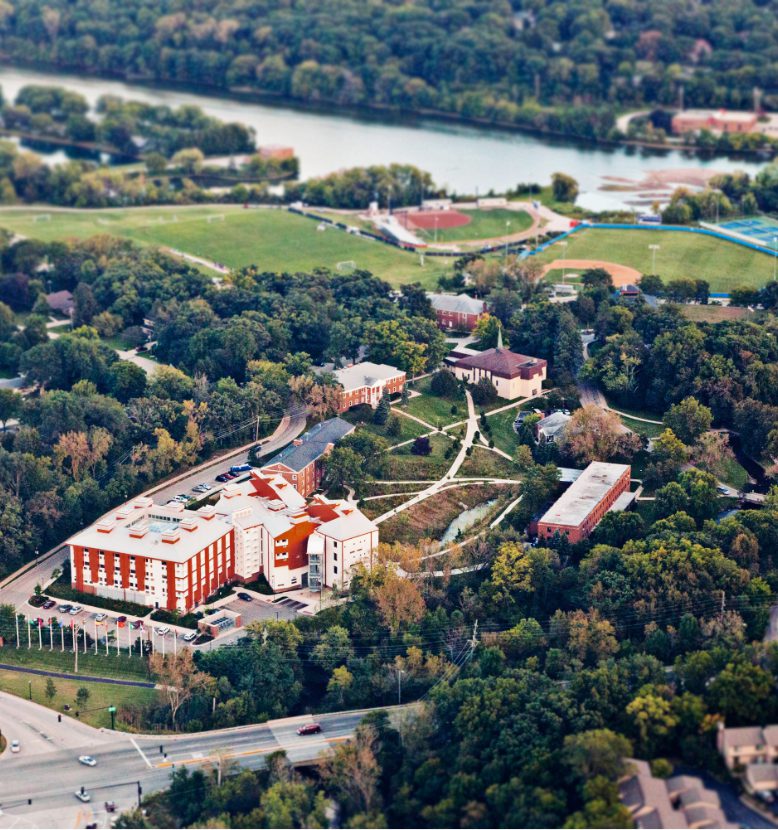
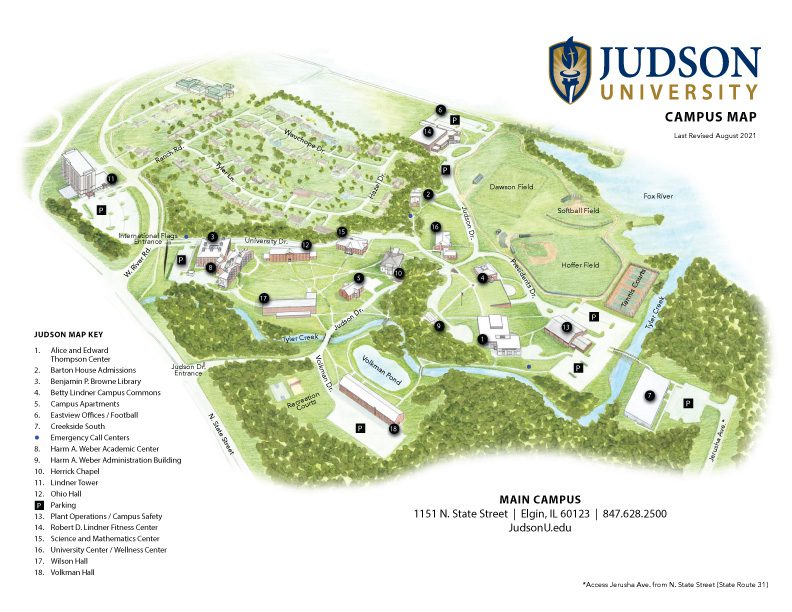
Judson University seal · sourceJudson University Map | Where is Judson University · sourceJudson University Map | Where is Judson University · sourceJudson University - Profile, Rankings and Data | US News Best Colleges · source