Admit rate has ranged 45%–61% over the last 5 years — notably volatile. Source: IPEDS via Urban Institute.
Acceptance & SAT from Common Data Set / IPEDS; net price, earnings & graduation from the U.S. Dept. of Education College Scorecard. Figures lag ~1–2 years — verify with the school.
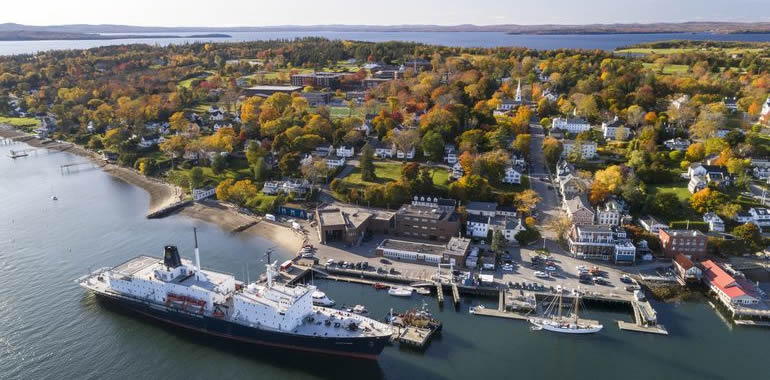
Maine Maritime Academy is not a typical liberal arts college; it's a hyper-specialized, career-focused institution where students trade quads for quarterdecks and seminars for engine rooms. Nestled in the tiny, windswept coastal village of Castine, the academy operates like a hybrid of a military academy, an engineering school, and a merchant marine training vessel, producing graduates who are immediately snapped up by the global maritime industry. The culture is intensely practical, physically demanding, and marked by a unique regimented lifestyle, all in service of achieving one of the highest post-graduation earning potentials in American higher education.
Admission requirements
Test-optional — scores considered if submitted
Required
High school transcript
Grade point average
Letters of recommendation
TOEFL (non-native English)
Considered (not required)
Test scores (SAT/ACT)
Source: IPEDS Admissions survey (2022) via Urban Institute. Covers formal factors only — it does not reflect essays, extracurriculars, or other holistic criteria.
On-campus criminal offenses classed as violent (murder/non-negligent manslaughter, rape, robbery, aggravated assault) for the most recent reported year. Source: U.S. Dept. of Education Campus Safety and Security (Clery Act). Counts reflect what’s reported to the school, and urban campuses often report more partly due to non-student incidents nearby — read alongside campus size and setting, not as a standalone safety verdict.
Climate
Pleasant days / yr
101
Summer high
72°F
Winter low
22°F
Annual rain
53.3"
Annual snow
44.7"
Natural-hazard risk
Relatively Low
Pleasant days counts days per year with a mean temperature of 55–75°F, a high at or below 90°F, a low at or above 45°F, and little precipitation — a transparent comfort measure, not a weighting we invented. Computed from Open-Meteo ERA5 daily history (2019–2023). Natural-hazard risk is the county’s composite rating from the FEMA National Risk Index.
Deep dive — research, future-scholar output & economic mobility▾
Research output
Institutional h-index
39
Scholarly works
303
Institutional research volume and impact from OpenAlex. The h-index reflects large research universities and will be low for teaching-focused liberal-arts colleges — not a measure of undergraduate quality.
Economic mobility
Mobility rate
3.5%
Bottom → top quintile
46%
From bottom quintile
8%
Mobility rate = the share of students who both start in the bottom household-income quintile and reach the top quintile; bottom → top is that chance conditional on starting at the bottom. Source: Opportunity Insights Mobility Report Cards (Chetty, Friedman, Saez, Turner & Yagan). Reflects 1980–82 birth cohorts, so it’s directional, not current.
Quick answers
What is the acceptance rate at Maine Maritime Academy?
Maine Maritime Academy's acceptance rate is approximately 54% (Castine, ME), based on the most recent figures we compiled from public and primary sources.
What SAT score do you need for Maine Maritime Academy?
Admitted students at Maine Maritime Academy typically score 1095–1260 on the SAT (the middle-50% range). Scores outside this band are still admitted, especially with strong applications.
How much does Maine Maritime Academy cost?
At Maine Maritime Academy, the average net price (after aid) is about $23,414 per year. Actual cost varies with financial aid and residency.
How many undergraduates attend Maine Maritime Academy?
Maine Maritime Academy enrolls approximately 942 undergraduate students.
Where is Maine Maritime Academy located?
Maine Maritime Academy is located in Castine, ME.
Admissions
Admission to Maine Maritime Academy is selective but accessible, with a focus on identifying students prepared for its rigorous, hands-on programs. The academy uses the Common Application and has an Early Action deadline of November 30 and a Regular Decision deadline of March 1. While the process is competitive, candidates are accepted based on an estimate of —the percentage of admitted students who actually enroll—indicating the school actively manages its incoming class size. The admitted student profile shows strong academic preparation, with an average GPA reported around 3.46 and middle 50% SAT scores aligning with the academy's career-focused rigor. The admissions office transitioned to SLATE software and the Common App to better collect data, including on student status.
Academics at Maine Maritime are unapologetically intense and career-oriented, built around engineering, management, science, and transportation. The school serves approximately 950 undergraduate students in a curriculum designed to lead directly to professional licenses and high-value careers at sea and ashore. Popular majors include Naval Architecture and Marine Engineering, Marine Science/Merchant Marine Officer, and Energy Systems Engineering. The workload is notoriously heavy, with credit loads in programs like Marine Engineering Systems reaching 19-21 credits per semester—a pace that demands discipline and focus. This isn't a place for academic exploration; it's a professional training ground where the 'rigorous and practical' curriculum, as described by the academy itself, is the main event. The programs are structured to be completed in four years, with a strong emphasis on applicable skills over theoretical exploration.
Earnings = median of students working ~10 years after entry; debt = median of graduates. Value divides 10-yr earnings by one year’s net price — read it as earnings per dollar of annual cost, not a full lifetime ROI; it favors lower-cost schools. Source: U.S. Dept. of Education College Scorecard. Figures lag ~2 years and reflect all students, not your intended major.
$49,464
Source: U.S. Dept. of Education College Scorecard (field-of-study earnings). Figures cover graduates who received federal aid and lag ~2 years; not all programs report data.
Life at Maine Maritime is defined by its regimented structure and its remote, coastal setting in Castine. A significant majority of students—58%—live in college-owned, -operated, or -affiliated housing, creating a tight-knit, on-campus community, while 42% live off campus. The Regiment of Midshipmen is a central feature for many, imposing a military-style discipline and uniform code that shapes daily routines. Beyond the regiment, student life is supported by clubs, organizations, and athletics, with campus events like movies, lectures, and dances scheduled throughout the year to provide cultural involvement. The Residential Life and Student Activities offices aim to foster a 'welcoming living and learning environment.' Facilities like a 24/7 gym and a pool with open swim hours offer outlets for the physically demanding lifestyle. It's a contained world where social and academic lives are deeply intertwined, far from the distractions of a city.
The return on investment is the core promise of a Maine Maritime education, and the data delivers. Graduates earn a median income of $113,000 just four years after graduation, a figure that reflects the academy's career-focused training and high demand for its alumni. The job-placement rate for graduates exceeds 90 percent, a testament to the direct pipeline from Castine to the global maritime, engineering, and transportation industries. Those with degrees in Naval Architecture and Marine Engineering report particularly high average earnings, around $94,796 annually. The academy's persistence, retention, and graduation rates are reported to be above national averages, though the school has publicly stated a goal to boost its six-year graduation rate to at least 70%. For students who complete the rigorous program, the financial payoff is swift and substantial, positioning MMA as a top school for return on investment in higher education.
Maine Maritime Academy offers a range of financial aid options, with a significant majority of degree-seeking students receiving grant aid. For 79% of all degree-seeking students, grant aid covers the full cost of tuition and fees. The average financial aid package is reported to be around $19,019, and 60.76% of students receive financial aid. The academy provides through programs like the Federal Supplemental Educational Opportunity Grant (FSEOG), awarded to undergraduates with extraordinary financial need on a first-come, first-served basis. Maine Maritime also has one endowed grant fund, with individual awards typically ranging from $600 to $2,000, available to all students. However, a review noted that the academy 'does not currently have the funding to award need-based aid to meet the need/bridge the affordability gap' for all applicants, indicating that aid may not always cover full demonstrated need. Prospective students are strongly encouraged to use the official Calculator and complete the FAFSA to understand their specific financial picture.
Maine Maritime Academy stands out as one of the most singular and consequential trade schools in the country—a place where the mission is not abstract liberal education but concrete professional preparation. Its identity is forged from three distinct elements: its spectacularly remote and rugged coastal location in Castine, which is as much a teacher as any professor; the pervasive influence of the Regiment of Midshipmen, which instills a discipline and camaraderie more common to military academies; and an academic model that is relentlessly practical, with credit-heavy semesters designed to fast-track students into high-paying, licensed professions. The result is a culture that is insular, demanding, and intensely focused. Students don't come here for a traditional college experience; they come for a proven launchpad into the global maritime industry. The payoff is starkly evident in the outcomes: a near-guarantee of employment and median earnings that outpace those of graduates from most elite liberal arts colleges within a few years of graduation. It's a high-stakes, high-reward proposition for those willing to embrace its unique and arduous path.
Maine Maritime Academy seal · sourceWaterfront - Maine Maritime Academy · sourceAdmissions - Maine Maritime Academy · sourceNew Report Finds That Maine Maritime Academy Is One Of The Best Values In Higher Education In U.S. | Maine Public · source