Admit rate has ranged 68%–94% over the last 5 years — notably volatile. Source: IPEDS via Urban Institute.
Acceptance & SAT from Common Data Set / IPEDS; net price, earnings & graduation from the U.S. Dept. of Education College Scorecard. Figures lag ~1–2 years — verify with the school.
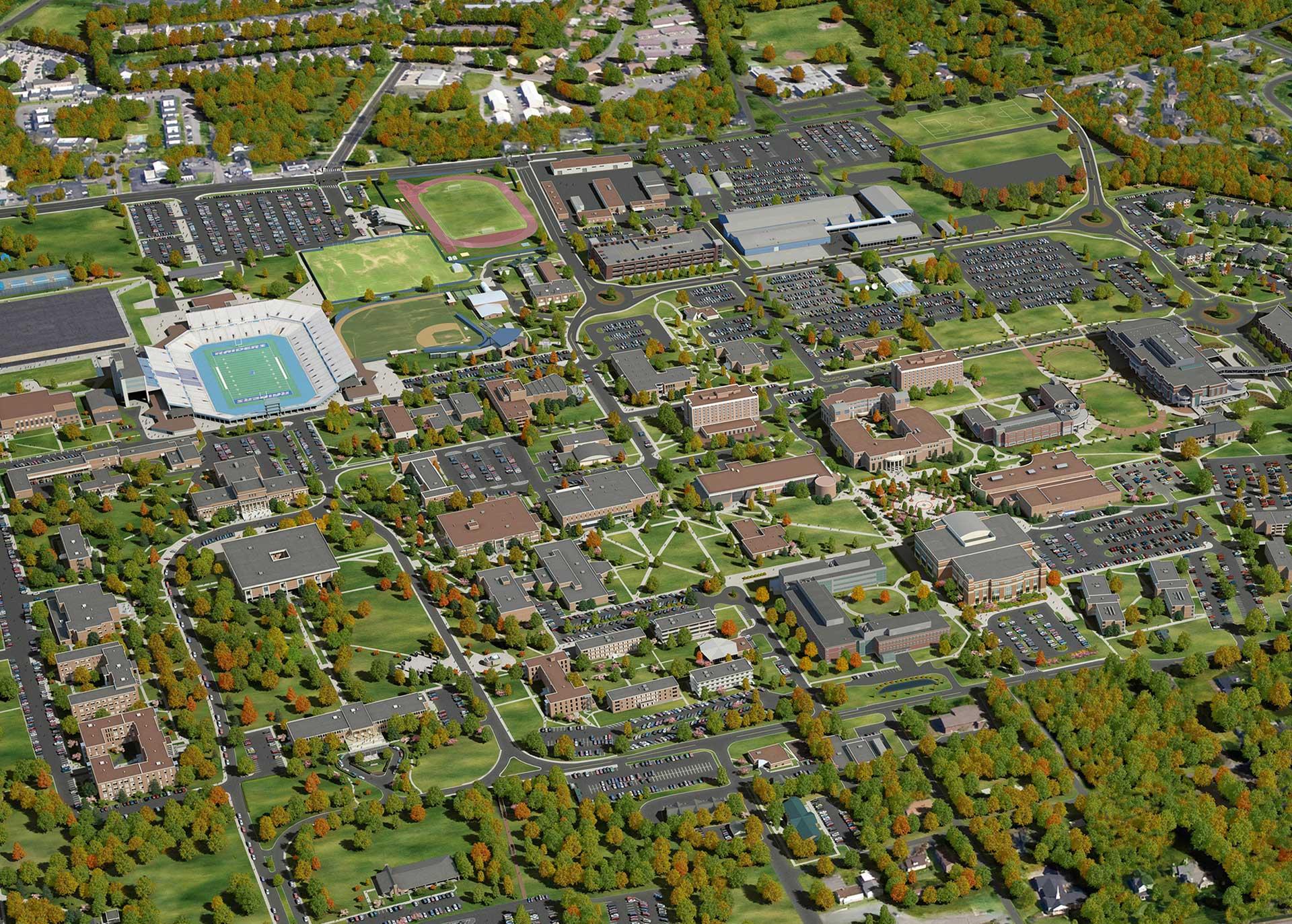
Middle Tennessee State University is a sprawling, pragmatic public university that functions as the primary workforce engine for the greater Nashville region. With over 300 majors, a notably accessible admissions profile, and a campus life that leans heavily on student-run organizations and Greek life, MTSU is built for the Tennessee student seeking a direct, career-oriented path. Its identity is less about elite selectivity and more about volume and connection—it's the place where 'one in six college graduates in greater Nashville' gets their start.
Admission requirements
Test scores required
Required
High school transcript
Grade point average
Test scores (SAT/ACT)
Considered (not required)
Letters of recommendation
College-prep program
TOEFL (non-native English)
Source: IPEDS Admissions survey (2022) via Urban Institute. Covers formal factors only — it does not reflect essays, extracurriculars, or other holistic criteria.
More details
Undergrad enrollment
16,301
In-state tuition
$10,266
Out-of-state tuition
$31,574
Graduation Rate
54%
Meets Full Need
No
Early Decision Plan
Not offered
Demonstrated Interest
Not considered
Student-Faculty Ratio
17:1
Median Earnings (10yr)
$48,541
Outcomes & value
Outcomes & value
Median earnings (10 yr)
$48,541
Value (earnings ÷ net price)
3.6×
Median debt at graduation
$20,000
Graduation rate
54%
First-year retention
80%
Reducing loan balance (3 yr)
50%
Pell (lower-income) share
32%
First-gen share (among federal-aid recipients)
36%
Top-earning majors
Median earnings by field of study (highest credential), ~2 years after completion.
Construction Management$66,541
Engineering-Related Fields$58,943
Registered Nursing, Nursing Administration, Nursing Research and Clinical Nursing$55,061
On-campus criminal offenses classed as violent (murder/non-negligent manslaughter, rape, robbery, aggravated assault) for the most recent reported year. Source: U.S. Dept. of Education Campus Safety and Security (Clery Act). Counts reflect what’s reported to the school, and urban campuses often report more partly due to non-student incidents nearby — read alongside campus size and setting, not as a standalone safety verdict.
Climate
Pleasant days / yr
88
Summer high
88°F
Winter low
36°F
Annual rain
69.2"
Annual snow
6.1"
Natural-hazard risk
Relatively Moderate
Pleasant days counts days per year with a mean temperature of 55–75°F, a high at or below 90°F, a low at or above 45°F, and little precipitation — a transparent comfort measure, not a weighting we invented. Computed from Open-Meteo ERA5 daily history (2019–2023). Natural-hazard risk is the county’s composite rating from the FEMA National Risk Index.
Deep dive — research, future-scholar output & economic mobility▾
Research output
Institutional h-index
190
Scholarly works
10,019
Institutional research volume and impact from OpenAlex. The h-index reflects large research universities and will be low for teaching-focused liberal-arts colleges — not a measure of undergraduate quality.
Economic mobility
Mobility rate
1.1%
Bottom → top quintile
17%
From bottom quintile
6%
Mobility rate = the share of students who both start in the bottom household-income quintile and reach the top quintile; bottom → top is that chance conditional on starting at the bottom. Source: Opportunity Insights Mobility Report Cards (Chetty, Friedman, Saez, Turner & Yagan). Reflects 1980–82 birth cohorts, so it’s directional, not current.
Quick answers
What is the acceptance rate at Middle Tennessee State University?
Middle Tennessee State University's acceptance rate is approximately 69% (Murfreesboro, TN), based on the most recent figures we compiled from public and primary sources.
What SAT score do you need for Middle Tennessee State University?
Admitted students at Middle Tennessee State University typically score 1010–1230 on the SAT (the middle-50% range). Scores outside this band are still admitted, especially with strong applications.
How much does Middle Tennessee State University cost?
At Middle Tennessee State University, the average net price (after aid) is about $13,359 per year. Actual cost varies with financial aid and residency.
How many undergraduates attend Middle Tennessee State University?
Middle Tennessee State University enrolls approximately 16,301 undergraduate students.
Where is Middle Tennessee State University located?
Middle Tennessee State University is located in Murfreesboro, TN.
Admissions
MTSU operates with a moderately selective, high-volume admissions process that prioritizes academic preparation within Tennessee. The university reports an of 69%, admitting a significant majority of its over 14,000 applicants. The middle 50% SAT range for admitted students is 1010–1230, with an ACT range of 19–26. The average high school GPA of the Fall 2025 freshman class was 3.67, with an average ACT of 22.47. The university does not offer an Early Decision plan, but it does have an Early Admission program for high-ability high school students with a 3.5 GPA and a 27 ACT or higher. Demonstrated interest is not a formal factor in admissions decisions. The process is largely driven by academic metrics, with the goal of enrolling a large, prepared freshman class each year.
Earnings = median of students working ~10 years after entry; debt = median of graduates. Value divides 10-yr earnings by one year’s net price — read it as earnings per dollar of annual cost, not a full lifetime ROI; it favors lower-cost schools. Source: U.S. Dept. of Education College Scorecard. Figures lag ~2 years and reflect all students, not your intended major.
$46,193
Geological and Earth Sciences/Geosciences$44,971
Accounting and Related Services$44,765
Source: U.S. Dept. of Education College Scorecard (field-of-study earnings). Figures cover graduates who received federal aid and lag ~2 years; not all programs report data.
MTSU's academic identity is defined by breadth and regional utility. The university offers more than 300 majors and concentrations, organized around a student-faculty ratio of 17:1. The most popular majors cluster in Business, Management, Marketing, and Related Support Services, followed by Visual and Performing Arts. Beyond the mainstream, the university promotes a suite of "noteworthy" programs that set graduates up for specific careers, including:
Accounting
Actuarial Science
Animation
Concrete Industry Management
Fermentation Science
Professional Aviation
Recording Industry
This curricular sprawl is in service to a clear mission: MTSU is the number one provider of college graduates to the greater Nashville region's workforce, with one in six area degree-holders holding an MTSU diploma. The academic experience is practical and geared toward direct application in the Tennessee economy.
Life on the Murfreesboro campus is activity-driven and self-directed. The Office of Campus Life serves as a central hub, promoting events, involvement opportunities, and over 300 student organizations and clubs. Greek life is a visible component of the social scene. The campus atmosphere is generally described as friendly and positive; anecdotal reports from students note, "I have not had a single bad experience with anybody students or staff." The university actively promotes getting involved, with its official campus life Instagram account serving as a one-stop shop for student events and activities. The location in Murfreesboro—a growing city just southeast of Nashville—provides access to both a collegiate town and the amenities of a major metropolitan area, with students reporting "plenty to do in and around" the city.
Outcomes at MTSU reflect its role as a large, accessible public university. The six-year graduation rate is 54%. The four-year graduation rate is notably lower, reported at 36%. For earnings, the median salary for graduates six years after entry is $48,541. Other sources cite earnings five years after graduation at $50,530 per year, and alumni average annual earnings of $66,935. The most significant outcome, however, is the university's massive footprint in the local economy: it has produced more than 70,000 alumni, solidifying its claim as the top feeder of talent to the Nashville region's workforce.
MTSU positions itself as an affordable public option, with an average after aid of $13,359. The university provides a Net Price Calculator for families to estimate their individual cost, which accounts for tuition, fees, books, and supplies minus grant and scholarship aid. The average financial aid package is reported to be $9,093. Aid includes federal Direct Student Loans, which are available as subsidized loans for undergraduates with demonstrated financial need or as unsubsidized loans. The university's stated policy is that financial aid is designed to "assist only (not fully fund)" educational expenses. There is no indication in the provided sources that MTSU meets 100% of demonstrated financial need or has a no-loan policy for low-income students.
MTSU stands out not for exclusivity, but for sheer scale and regional indispensability. It is the academic workhorse of Middle Tennessee. Its defining characteristic is the statistic that one in six college graduates in the greater Nashville area holds an MTSU degree—a claim of market penetration that few regional public universities can make. This is enabled by an academic portfolio of over 300 majors that is deliberately tuned to industry needs, from its famed Recording Industry program to niche fields like Concrete Industry Management and Fermentation Science. It’s a place of opportunity and access, where a 3.6 GPA and a mid-range test score can unlock a direct pipeline into the booming Nashville economy. The vibe is practical, unpretentious, and deeply connected to the state it serves.