Admit rate has ranged 70%–88% over the last 5 years — notably volatile. Source: IPEDS via Urban Institute.
Acceptance & SAT from Common Data Set / IPEDS; net price, earnings & graduation from the U.S. Dept. of Education College Scorecard. Figures lag ~1–2 years — verify with the school.
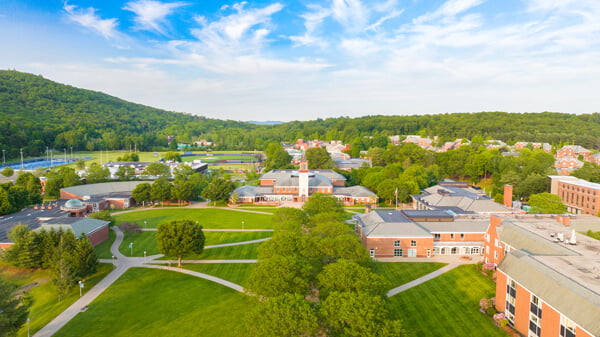
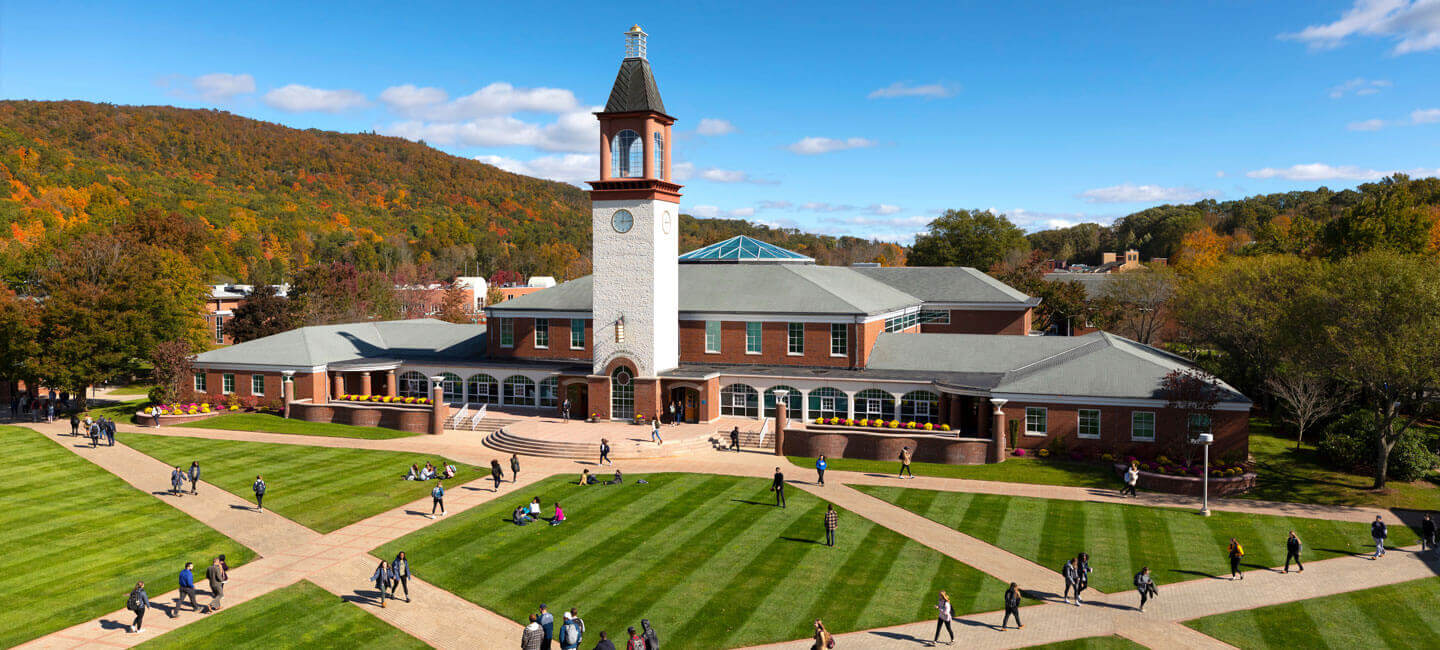
Quinnipiac University is a private institution in Hamden, Connecticut, that has built a formidable reputation on the back of its powerhouse health sciences and communications programs, wrapped in a high-energy, Division I athletic campus culture. It’s a school where career preparation isn’t just a talking point—it’s the curriculum’s organizing principle, driving students from immersive labs and clinical rotations directly into strong early-career earnings. The vibe is active and engaged, balancing rigorous academics with a bustling social scene centered around its nationally-ranked hockey and basketball teams.
Admission requirements
Test-optional — scores considered if submitted
Required
High school transcript
Grade point average
College-prep program
TOEFL (non-native English)
Considered (not required)
Class rank
Letters of recommendation
Test scores (SAT/ACT)
Source: IPEDS Admissions survey (2022) via Urban Institute. Covers formal factors only — it does not reflect essays, extracurriculars, or other holistic criteria.
More details
Undergrad enrollment
6,531
In-state tuition
$55,480
Out-of-state tuition
$55,480
Graduation Rate
76%
Meets Full Need
No
Median Earnings (10yr)
$83,759
Students Receiving Aid
>92%
Average Grant/Scholarship
$33,849
First-Year Retention Rate
89%
Regular Decision Deadline
February 1
Outcomes & value
Outcomes & value
Median earnings (10 yr)
$83,759
Value (earnings ÷ net price)
2.1×
Median debt at graduation
$26,000
Graduation rate
76%
First-year retention
89%
Reducing loan balance (3 yr)
82%
Pell (lower-income) share
16%
First-gen share (among federal-aid recipients)
20%
Financial health
3.0 / 3.0Meets the federal financial-responsibility standard
U.S. Dept. of Education Financial Responsibility Composite Score (FY2022-23). Scale −1.0 to 3.0; ≥1.5 meets the standard. Reported for private nonprofit & for-profit institutions only — public universities are state-backed and not scored, so this is a stability signal, not a ranking.
Top-earning majors
Median earnings by field of study (highest credential), ~2 years after completion.
Registered Nursing, Nursing Administration, Nursing Research and Clinical Nursing$75,548
Allied Health Diagnostic, Intervention, and Treatment Professions$61,681
Accounting and Related Services$61,020
Information Science/Studies$57,995
Finance and Financial Management Services$57,318
Economics
Campus & location
Campus safety
On-campus violent crimes (2024)
0
Per 1,000 students
0.00
On-campus criminal offenses classed as violent (murder/non-negligent manslaughter, rape, robbery, aggravated assault) for the most recent reported year. Source: U.S. Dept. of Education Campus Safety and Security (Clery Act). Counts reflect what’s reported to the school, and urban campuses often report more partly due to non-student incidents nearby — read alongside campus size and setting, not as a standalone safety verdict.
Climate
Pleasant days / yr
93
Summer high
81°F
Winter low
26°F
Annual rain
57.6"
Annual snow
25.5"
Pleasant days counts days per year with a mean temperature of 55–75°F, a high at or below 90°F, a low at or above 45°F, and little precipitation — a transparent comfort measure, not a weighting we invented. Computed from Open-Meteo ERA5 daily history (2019–2023).
Deep dive — research, future-scholar output & economic mobility▾
Research output
Institutional h-index
137
Scholarly works
5,941
Institutional research volume and impact from OpenAlex. The h-index reflects large research universities and will be low for teaching-focused liberal-arts colleges — not a measure of undergraduate quality.
Economic mobility
Mobility rate
0.9%
Bottom → top quintile
49%
From bottom quintile
2%
Mobility rate = the share of students who both start in the bottom household-income quintile and reach the top quintile; bottom → top is that chance conditional on starting at the bottom. Source: Opportunity Insights Mobility Report Cards (Chetty, Friedman, Saez, Turner & Yagan). Reflects 1980–82 birth cohorts, so it’s directional, not current.
Quick answers
What is the acceptance rate at Quinnipiac University?
Quinnipiac University's acceptance rate is approximately 72% (Hamden, CT), based on the most recent figures we compiled from public and primary sources.
What SAT score do you need for Quinnipiac University?
Admitted students at Quinnipiac University typically score 1150–1320 on the SAT (the middle-50% range). Scores outside this band are still admitted, especially with strong applications.
How much does Quinnipiac University cost?
At Quinnipiac University, the average net price (after aid) is about $40,675 per year. Actual cost varies with financial aid and residency.
How many undergraduates attend Quinnipiac University?
Quinnipiac University enrolls approximately 6,531 undergraduate students.
Where is Quinnipiac University located?
Quinnipiac University is located in Hamden, CT.
Admissions
Quinnipiac’s admissions process is moderately selective, with a focus on strong academic preparation. The university reports that admitted students typically have at least a 'B' average or a cumulative high school GPA of 3.3, with an average GPA of 3.60 for the enrolled first-year class. Standardized test scores remain a factor, with the middle 50% SAT range reported as 1150–1320 and an average SAT score of 1238 for enrolled students; the ACT middle 50% range is 24–29. The university states that a high school diploma is required and a GED is accepted. While the outlines the factors considered in admissions, specific institutional data on the weight given to demonstrated interest is not provided in the available sources. The regular decision deadline is February 1.
Admissions statistics show a consistent profile. For the Fall 2021 cycle, the university utilized a waiting list. The overall is widely reported at 72%, with some sources noting a rate as high as 77%.
Earnings = median of students working ~10 years after entry; debt = median of graduates. Value divides 10-yr earnings by one year’s net price — read it as earnings per dollar of annual cost, not a full lifetime ROI; it favors lower-cost schools. Source: U.S. Dept. of Education College Scorecard. Figures lag ~2 years and reflect all students, not your intended major.
$53,358
Computer Software and Media Applications$48,432
International Business$48,432
Source: U.S. Dept. of Education College Scorecard (field-of-study earnings). Figures cover graduates who received federal aid and lag ~2 years; not all programs report data.
Academics at Quinnipiac are intensely career-oriented, with a curriculum explicitly designed to power a student's 'transformation from a student to a leader.' The university offers a wide range of undergraduate programs that emphasize 'world-class career preparation and immersive learning experiences.' This practical focus is a recurring theme in institutional messaging, which highlights 'career readiness and real-world experience' at the core of the curriculum.
The most popular majors cluster in pre-professional fields, notably Health Professions and Related Programs and Business, Management, Marketing, and Related Support Services. The university is particularly recognized for the strength of its programs in health sciences, communications, and engineering, which are frequently bolstered by hands-on learning opportunities. The academic environment is supported by learning facilities that have been noted for their quality, contributing to the university's recognition for career preparation.
Campus life at Quinnipiac is described as active and thriving, with a strong emphasis on co-curricular engagement. The Department of Campus Life serves as a central hub where students are encouraged to 'find their place, pursue interests and develop passions, and cultivate their leadership.' The campus fosters a high-energy environment, a point of consideration for students comparing it to other institutions.
Student life is rich with organized activities. There are 140-plus student-run clubs and organizations, alongside theater and performing arts groups. Athletics are a major component of campus culture, featuring NCAA Division I teams, club sports, and intramurals. This contributes to a strong sense of school spirit. Safety appears to be a strength, with one poll indicating that 97% of students say they feel 'extremely safe and secure on campus.' The community is described as diverse and inclusive, focused on bringing together students with varied experiences and perspectives.
Quinnipiac demonstrates strong student outcomes, beginning with a high first-year retention rate of 89%. The university's graduation rate is a point of institutional pride and external recognition; it reports a 76% graduation rate, with other sources citing a 74% four-year rate, a 78% six-year rate, and an overall rate as high as 77%, which places it 'within the top 15% nationally.' The Wall Street Journal ranked Quinnipiac among the top 100 best universities in the country, noting it earned high scores specifically for graduation rate and salary impact.
Post-graduate earnings are robust. The median earnings for graduates 10 years after entry is reported as $83,759. Other data points show earnings one year after graduation at $56,569 and five years after graduation at $79,421. These strong outcomes are tied directly to the university's focus on career preparation and learning opportunities, which have received positive external evaluation.
Quinnipiac is a private university with a significant sticker price, but it uses institutional aid extensively to offset costs. More than 92% of full-time undergraduate students receive some type of financial aid. The average grant and scholarship award totals $33,849. Merit-based scholarships, awarded by the Office of Admissions without regard to financial need, can range from $7,000 to $28,000 per year.
However, the university is explicit that it does not meet 100% of demonstrated financial need for all admitted students. Its financial aid materials state plainly: 'Because we are unable to meet 100 percent of your financial need, you may need to borrow or pay additionally toward your educational costs.' This indicates Quinnipiac does not have a 'no-loan' policy for all qualifying students. Federal Direct Unsubsidized Loans are available to students with no demonstrated need or as a supplement. The —the average cost after aid and scholarships—is reported by the university as $40,675, though other estimates range from $39,051 to $44,491. Families are encouraged to use the university's Net Price Calculator for a personalized estimate.
Quinnipiac carves out a distinct niche by masterfully blending the immersive, hands-on training of a specialized pre-professional school with the vibrant, full-throttle campus life of a Division I athletic university. It’s not a liberal arts college pondering the eternal verities; it’s an engine for career launch, particularly in high-demand fields like health sciences and communications. This pragmatic mission is validated by outcomes: high graduation rates and median earnings that significantly outpace national averages. The campus culture mirrors this intensity—it’s busy, socially active, and proudly centered around Bobcat athletics. What you see is what you get: a clear, no-nonsense path from classroom and clinical rotation to a well-compensated profession, all experienced within a secure, spirited, and highly engaged community. For a student seeking that specific blend of professional focus and traditional college energy, Quinnipiac is a remarkably effective and cohesive choice.
Quinnipiac University seal · sourceMount Carmel Campus | Quinnipiac University · sourceVirtual Tour and Self-Guided Tour | Quinnipiac University · sourceCampuses and Facilities | Quinnipiac University · source
.jpg?width=1600)