Admit rate has ranged 73%–85% over the last 5 years — notably volatile, though the latest figure above (53%) falls outside that window. Source: IPEDS via Urban Institute.
Acceptance & SAT from Common Data Set / IPEDS; net price, earnings & graduation from the U.S. Dept. of Education College Scorecard. Figures lag ~1–2 years — verify with the school.
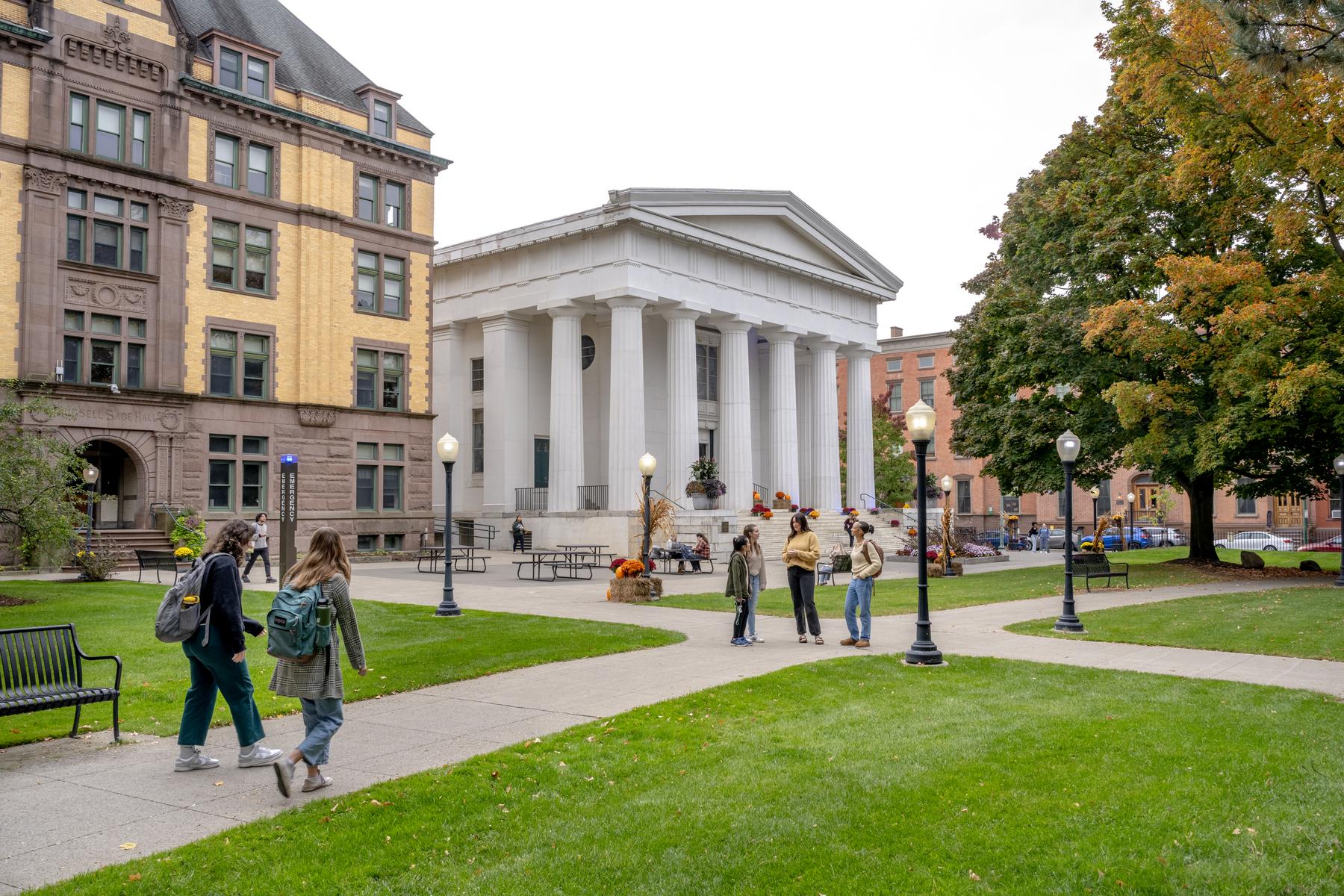
Russell Sage College, anchored in Troy, New York, is a small, career-focused institution that operates less like a traditional liberal arts college and more like a professional launchpad. It’s a place where broad, flexible academic programs—especially in health sciences, business, and education—are delivered with an emphasis on mentorship and student well-being, backed by a substantial financial aid program. The vibe is pragmatic and supportive, with a campus life that leans heavily on student-led clubs and activities rather than rah-rah traditions.
Admission requirements
Test-optional — scores considered if submitted
Required
High school transcript
Grade point average
Letters of recommendation
College-prep program
Considered (not required)
Class rank
Test scores (SAT/ACT)
Demonstrated competencies
Source: IPEDS Admissions survey (2022) via Urban Institute. Covers formal factors only — it does not reflect essays, extracurriculars, or other holistic criteria.
More details
Undergrad enrollment
1,244
In-state tuition
$38,164
Out-of-state tuition
$38,164
On-Campus Housing
46%
Demonstrated Interest
Considered
Pell Grant Recipients
43%
Graduation Rate (6-year)
62.6%
First-Year Merit Scholarships
$21,000 - $26,000
Median Earnings (Recent Grads)
$55,116
Students Receiving Financial Aid
100%
Outcomes & value
Outcomes & value
Median earnings (10 yr)
$58,316
Value (earnings ÷ net price)
2.5×
Median debt at graduation
$22,000
Graduation rate
56%
First-year retention
78%
Reducing loan balance (3 yr)
60%
Pell (lower-income) share
42%
First-gen share (among federal-aid recipients)
38%
Financial health
2.5 / 3.0Meets the federal financial-responsibility standard
U.S. Dept. of Education Financial Responsibility Composite Score (FY2022-23). Scale −1.0 to 3.0; ≥1.5 meets the standard. Reported for private nonprofit & for-profit institutions only — public universities are state-backed and not scored, so this is a stability signal, not a ranking.
Top-earning majors
Median earnings by field of study (highest credential), ~2 years after completion.
Registered Nursing, Nursing Administration, Nursing Research and Clinical Nursing$59,810
Information Science/Studies$47,260
Biological and Biomedical Sciences, Other$40,791
Nutrition Sciences$39,153
Social Sciences, Other$35,060
Business Administration, Management and Operations
Campus & location
Campus safety
On-campus violent crimes (2024)
2
Per 1,000 students
0.72
On-campus criminal offenses classed as violent (murder/non-negligent manslaughter, rape, robbery, aggravated assault) for the most recent reported year. Source: U.S. Dept. of Education Campus Safety and Security (Clery Act). Counts reflect what’s reported to the school, and urban campuses often report more partly due to non-student incidents nearby — read alongside campus size and setting, not as a standalone safety verdict.
Climate
Pleasant days / yr
88
Summer high
82°F
Winter low
23°F
Annual rain
47.9"
Annual snow
41.9"
Natural-hazard risk
Relatively Moderate
Pleasant days counts days per year with a mean temperature of 55–75°F, a high at or below 90°F, a low at or above 45°F, and little precipitation — a transparent comfort measure, not a weighting we invented. Computed from Open-Meteo ERA5 daily history (2019–2023). Natural-hazard risk is the county’s composite rating from the FEMA National Risk Index.
Deep dive — research, future-scholar output & economic mobility▾
Research output
Institutional h-index
65
Scholarly works
716
Institutional research volume and impact from OpenAlex. The h-index reflects large research universities and will be low for teaching-focused liberal-arts colleges — not a measure of undergraduate quality.
Quick answers
What is the acceptance rate at Russell Sage College?
Russell Sage College's acceptance rate is approximately 53% (Troy, NY), based on the most recent figures we compiled from public and primary sources.
How much does Russell Sage College cost?
At Russell Sage College, the average net price (after aid) is about $22,917 per year. Actual cost varies with financial aid and residency.
How many undergraduates attend Russell Sage College?
Russell Sage College enrolls approximately 1,244 undergraduate students.
Where is Russell Sage College located?
Russell Sage College is located in Troy, NY.
Admissions
Russell Sage's admissions process is moderately selective and operates on a rolling basis for regular decision, with no hard deadline. The school admits just over half of its applicants, but there's a notable advantage to applying early: the early is significantly higher at 78.9%. For those who submit scores, the middle 50% SAT range falls between 1020 and 1250, while the ACT range is 500-630. The , a key resource for understanding admissions factors, indicates that the level of an applicant's demonstrated interest is a 'considered' factor in the review process, meaning it can tip the scales but isn't paramount. Decisions for regular applicants are communicated after March 1st.
Selectivity: Admits about 53% of applicants overall.
Earnings = median of students working ~10 years after entry; debt = median of graduates. Value divides 10-yr earnings by one year’s net price — read it as earnings per dollar of annual cost, not a full lifetime ROI; it favors lower-cost schools. Source: U.S. Dept. of Education College Scorecard. Figures lag ~2 years and reflect all students, not your intended major.
$35,060
Liberal Arts and Sciences, General Studies and Humanities$32,391
Psychology, General$31,133
Source: U.S. Dept. of Education College Scorecard (field-of-study earnings). Figures cover graduates who received federal aid and lag ~2 years; not all programs report data.
The academic experience at Russell Sage is defined by career readiness and flexibility. The college offers a wide array of undergraduate majors, with particularly strong representation in the social sciences, biological and biomedical sciences, and liberal arts. Signature programs include Art + Extended Media (B.F.A.), Business Administration (B.B.A./B.S.), and a suite of education tracks like Childhood and Early Childhood Education. The curriculum is designed to be broad and adaptable, supported by what the college describes as 'caring faculty mentors.' This practical, student-centered approach is reflected in its national ranking as #36 for Best Value by U.S. News & World Report for 2026, suggesting a solid return on investment for the cost.
Campus life at Russell Sage is active but not overwhelming, with a significant portion of the student body—46%—living in college-owned, -operated, or -affiliated housing, while 54% live off-campus. The Student Life Office is the central hub, fostering a 'vibrant space where students from all backgrounds can connect, learn, and grow' through a wide range of activities. Students can choose from more than 30 clubs and organizations, which span academic, community service, and social interests, and are encouraged to start their own. The atmosphere is less defined by Greek life or massive sporting events and more by student-led initiatives, cultural events, and educational programming aimed at building community and leadership skills outside the classroom.
Graduation outcomes at Russell Sage show a steady climb towards degree completion. The overall six-year graduation rate is reported at 62.6%, with a four-year rate of 52.3%. The college's own data indicates that these rates are higher for full-time, first-time students. Post-graduation, alumni see a solid financial return. The median earnings for recent graduates is reported at $55,116, with 76% earning more than a typical high school graduate. The college's focus on career readiness appears to pay off for a majority of its graduates, positioning them for economic mobility.
Affordability is a central pillar of the Russell Sage proposition. The college states that 100% of incoming full-time undergraduate students receive financial aid, and 100% of full-time beginning undergraduates received grant or scholarship aid. Institutional aid is substantial, with Sage awarding over $20 million in assistance annually. First-year students are automatically considered for merit scholarships ranging from $21,000 to $26,000. The —the average cost after aid and scholarships—is a critical figure for families. While one source cites a net price of $30,535, the College Scorecard reports a lower figure. is available, with 43% of undergraduates benefiting from federal Pell Grants. The financial aid system requires annual filing of the FAFSA to determine eligibility and renew aid, which is typically offered for four years provided the student maintains satisfactory academic progress and demonstrates unmet financial need.
Russell Sage College distinguishes itself through a potent combination of accessibility, practical education, and generous financial support. It's not an ultra-selective institution, but it leverages that openness into a mission of uplift: getting students in the door with significant and then preparing them concretely for the workforce. The #36 national ranking for Best Value isn't just a marketing line; it's a reflection of a calculated model where the cost-to-outcome ratio is carefully managed. The environment is intimate and mentorship-driven, with faculty focused on student well-being as much as academic performance. It’s a college for the pragmatist—the student who wants a clear path to a career, a supportive community, and a bill at the end that doesn't dictate their life choices for decades afterward. Its character is defined by this no-nonsense, high-touch approach to career-focused higher education.
Russell Sage College seal · sourceRussell Sage College | Find Your Future at Russell Sage College · sourceThe Sage Colleges · sourceRussell Sage College · source