Admit rate has ranged 74%–79% over the last 5 years, though the latest figure above (80%) falls outside that window. Source: IPEDS via Urban Institute.
Acceptance & SAT from Common Data Set / IPEDS; net price, earnings & graduation from the U.S. Dept. of Education College Scorecard. Figures lag ~1–2 years — verify with the school.
Seton Hill University is a small, Catholic liberal arts institution in Greensburg, Pennsylvania, that defines itself by its practical, hands-on approach to education. It’s a place where nearly every student gets financial aid and a majority of freshmen stick around, but its identity is equally shaped by a strictly enforced dry campus policy and a sprawling list of direct-entry professional programs, from pharmacy to osteopathic medicine. This is a school for students who want a traditional, focused residential experience with a clear, career-oriented path.
Admission requirements
Test-optional — scores considered if submitted
Required
High school transcript
TOEFL (non-native English)
Considered (not required)
Grade point average
Class rank
Letters of recommendation
Test scores (SAT/ACT)
College-prep program
Source: IPEDS Admissions survey (2022) via Urban Institute. Covers formal factors only — it does not reflect essays, extracurriculars, or other holistic criteria.
More details
Undergrad enrollment
1,492
In-state tuition
$42,944
Out-of-state tuition
$42,944
Graduation Rate
67%
On-Campus Housing
51%
Average Aid Package
$26,702
First-Year Retention
81%
Median Earnings (10yr)
$51,748
Students Receiving Aid
99%
Student-to-Faculty Ratio
13:1
Outcomes & value
Outcomes & value
Median earnings (10 yr)
$51,748
Value (earnings ÷ net price)
2.3×
Median debt at graduation
$27,000
Graduation rate
67%
First-year retention
81%
Reducing loan balance (3 yr)
65%
Pell (lower-income) share
31%
First-gen share (among federal-aid recipients)
24%
Financial health
2.9 / 3.0Meets the federal financial-responsibility standard
U.S. Dept. of Education Financial Responsibility Composite Score (FY2022-23). Scale −1.0 to 3.0; ≥1.5 meets the standard. Reported for private nonprofit & for-profit institutions only — public universities are state-backed and not scored, so this is a stability signal, not a ranking.
Top-earning majors
Median earnings by field of study (highest credential), ~2 years after completion.
Computer Science$55,547
Accounting and Related Services$41,937
Marketing$41,565
Business Administration, Management and Operations$40,281
Human Resources Management and Services$37,568
Security Science and Technology$35,060
Campus & location
Campus safety
On-campus violent crimes (2024)
1
Per 1,000 students
0.52
On-campus criminal offenses classed as violent (murder/non-negligent manslaughter, rape, robbery, aggravated assault) for the most recent reported year. Source: U.S. Dept. of Education Campus Safety and Security (Clery Act). Counts reflect what’s reported to the school, and urban campuses often report more partly due to non-student incidents nearby — read alongside campus size and setting, not as a standalone safety verdict.
Climate
Pleasant days / yr
91
Summer high
81°F
Winter low
27°F
Annual rain
53.1"
Annual snow
23.3"
Natural-hazard risk
Relatively Moderate
Pleasant days counts days per year with a mean temperature of 55–75°F, a high at or below 90°F, a low at or above 45°F, and little precipitation — a transparent comfort measure, not a weighting we invented. Computed from Open-Meteo ERA5 daily history (2019–2023). Natural-hazard risk is the county’s composite rating from the FEMA National Risk Index.
Deep dive — research, future-scholar output & economic mobility▾
Research output
Institutional h-index
52
Scholarly works
417
Institutional research volume and impact from OpenAlex. The h-index reflects large research universities and will be low for teaching-focused liberal-arts colleges — not a measure of undergraduate quality.
Economic mobility
Mobility rate
1.3%
Bottom → top quintile
17%
From bottom quintile
8%
Mobility rate = the share of students who both start in the bottom household-income quintile and reach the top quintile; bottom → top is that chance conditional on starting at the bottom. Source: Opportunity Insights Mobility Report Cards (Chetty, Friedman, Saez, Turner & Yagan). Reflects 1980–82 birth cohorts, so it’s directional, not current.
Quick answers
What is the acceptance rate at Seton Hill University?
Seton Hill University's acceptance rate is approximately 80% (Greensburg, PA), based on the most recent figures we compiled from public and primary sources.
What SAT score do you need for Seton Hill University?
Admitted students at Seton Hill University typically score 1020–1240 on the SAT (the middle-50% range). Scores outside this band are still admitted, especially with strong applications.
How much does Seton Hill University cost?
At Seton Hill University, the average net price (after aid) is about $22,204 per year. Actual cost varies with financial aid and residency.
How many undergraduates attend Seton Hill University?
Seton Hill University enrolls approximately 1,492 undergraduate students.
Where is Seton Hill University located?
Seton Hill University is located in Greensburg, PA.
Admissions
Seton Hill operates on a rolling admissions basis, reviewing applications throughout the year and providing decisions shortly after they are received. The process is notably less selective, with a high . The university reports that it received 2,911 applications, accepted 2,315, and enrolled 1,502 in a recent cycle. The admitted student profile is solid, with an average high school GPA of 3.78. While the university has a rolling policy and does not highlight an Early Decision program in its admissions materials, the rate—the percentage of accepted students who enroll—is reported to be low, at 14%.
Demonstrated interest is a factor that colleges can weigh in admissions, and applicants can determine its importance by consulting a school's , a standardized document that details admissions criteria. For Seton Hill, the specific rating for demonstrated interest is not provided in the available sources, but the Common Data Set is the authoritative place to find such information.
The middle 50% SAT range for admitted students is 1020–1240, and the ACT range is 19–27.
Earnings = median of students working ~10 years after entry; debt = median of graduates. Value divides 10-yr earnings by one year’s net price — read it as earnings per dollar of annual cost, not a full lifetime ROI; it favors lower-cost schools. Source: U.S. Dept. of Education College Scorecard. Figures lag ~2 years and reflect all students, not your intended major.
Human Services, General$33,565
Biology, General$30,119
Source: U.S. Dept. of Education College Scorecard (field-of-study earnings). Figures cover graduates who received federal aid and lag ~2 years; not all programs report data.
Seton Hill bills itself as a "top Catholic liberal arts school" offering more than 80 undergraduate, graduate, and online degrees with an emphasis on "hands-on career preparation." The curriculum is a blend of traditional liberal arts and a robust suite of direct-entry professional programs that are unusual for a small university. These include accelerated, combined-degree tracks leading directly to graduate credentials in audiology (BS-DAud), dental medicine (BS-DDM), law (BA-DLaw), osteopathic medicine (BS-DO), and pharmacy.
The student-to-faculty ratio is 13:1, facilitating a close-knit academic environment. Students report strong opportunities for hands-on learning, including undergraduate research projects in fields like biology and healthcare. The university's academic structure is designed to provide a practical education, aiming to equip students with both a broad-based liberal arts foundation and specific professional skills.
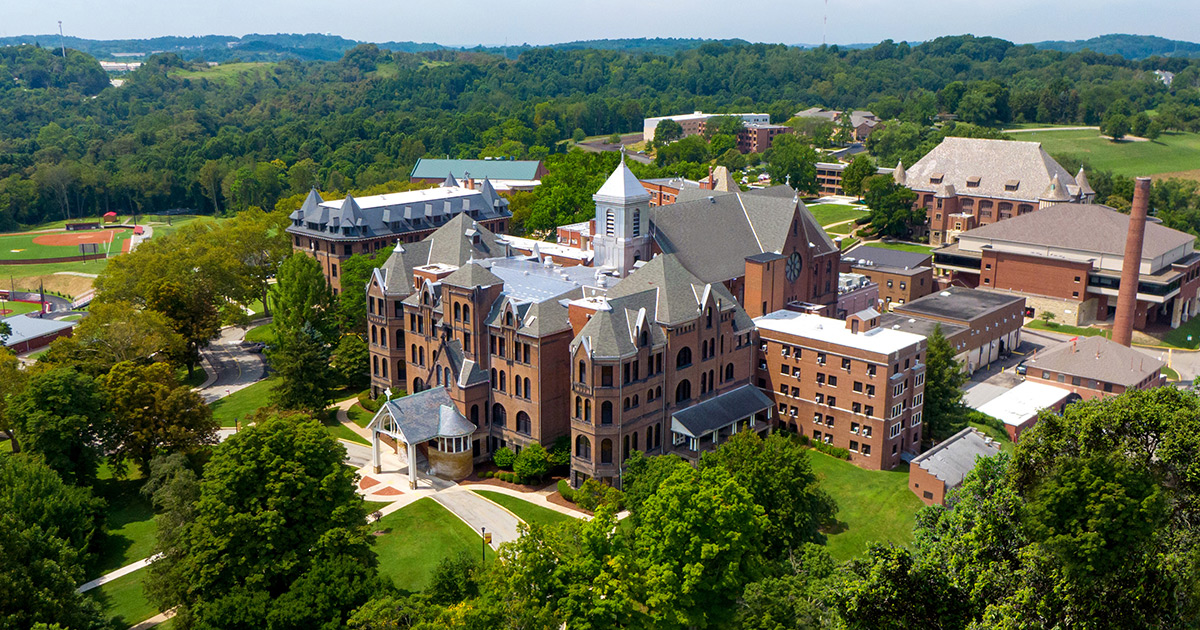
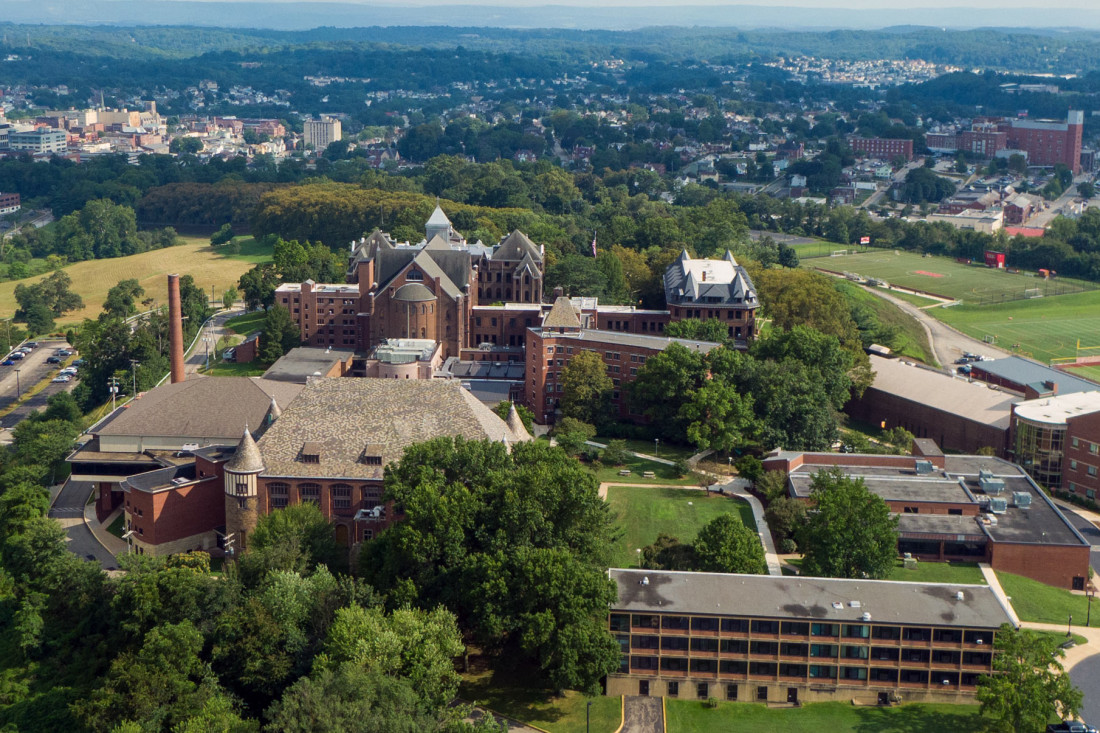
Life at Seton Hill is defined by its suburban campus setting and a distinctively strict community standard. The university is widely known as a dry campus with rigorous enforcement of alcohol and drug policies, which students and observers note contributes to a safe and focused environment. Just over half (51%) of students live in college-owned, -operated, or -affiliated housing, while 49% live off campus. The total undergraduate population is 1,484.
The university promotes a campus culture where students are encouraged to "follow your passions and curiosity — without fear of failure or being different." The cost for campus housing averages $14,784 per year. This combination of a residential, substance-free policy and a relatively small student body creates a particular kind of collegiate experience—one that is structured, intimate, and deliberately insulated from typical party-school pressures.
Seton Hill demonstrates solid retention and graduation outcomes, especially for an institution with its admissions profile. The first-year retention rate is 81%. The six-year graduation rate is 69%, which places the university within the top 25% of institutions nationally according to one analysis. Another source reports a 71% graduation rate.
Earnings data shows a trajectory of growth for graduates. Median earnings one year after graduation are $37,278. This figure rises to $51,187 five years after graduation. The median earnings ten years after entry are $51,748. According to federal data, 72% of Seton Hill graduates earn more than a high school graduate. These outcomes suggest that the university's career-focused programs and hands-on approach are translating into tangible economic mobility for its alumni.
Affordability is a central part of Seton Hill's pitch to families. The university reports that 99% of incoming students receive some form of financial aid. Furthermore, 100% of full-time beginning undergraduates receive grant or scholarship aid. The average financial aid package is $26,702.
The —what a student pays after scholarships and grants are applied—is a critical figure. Sources report an average net price of $22,204 per year. Another source cites a net price of $23,732. The university encourages families to use its Net Price Calculator to get a personalized estimate of merit scholarships, financial aid, and final costs.
The financial aid philosophy includes both need-based and non-. Seton Hill offers academic, division, and athletic scholarships. The university states it works with families to find "state, federal or private loans, grants, employer reimbursements and other sources of aid to meet remaining need." However, the available sources do not indicate that Seton Hill has a "no-loan" policy, where a school meets 100% of demonstrated need without including loans in the package. One analysis notes that 95% of Seton Hill students have loans, suggesting loans are a common component of financial aid packages.
Seton Hill carves out a unique niche by marrying a traditional, values-based Catholic liberal arts environment with an unusually pragmatic and direct professional focus. Its identity is defined by three powerful, concrete characteristics.
First, it is a strictly dry campus, a policy not just on the books but actively enforced and noted as a defining trait by students. This creates a specific type of residential community—one that is safe, focused, and appeals to families seeking an alternative to the stereotypical party scene.
Second, its academic portfolio is surprisingly career-forward for a small liberal arts school. The list of direct-entry, combined-degree programs (like the BS to DO in osteopathic medicine) is more commonly found at large research universities. This allows students to secure a graduate school seat as incoming freshmen, providing exceptional clarity and a accelerated path into high-demand fields.
Finally, it achieves remarkable financial accessibility. With 99% of incoming students receiving aid and an average package over $26,000, the university works aggressively to make its private education attainable. This combination—a substance-free living environment, a guaranteed professional track, and a high probability of significant aid—makes Seton Hill a compelling, no-nonsense option for a student who knows what they want to do and wants to do it in a structured, supportive setting.
Seton Hill University seal · sourceHome Page | Seton Hill University · sourceCampus, City & Region | Seton Hill University · sourceThe Hill | Seton Hill University · source