Admit rate has ranged 40%–70% over the last 5 years — notably volatile. Source: IPEDS via Urban Institute.
Acceptance & SAT from Common Data Set / IPEDS; net price, earnings & graduation from the U.S. Dept. of Education College Scorecard. Figures lag ~1–2 years — verify with the school.
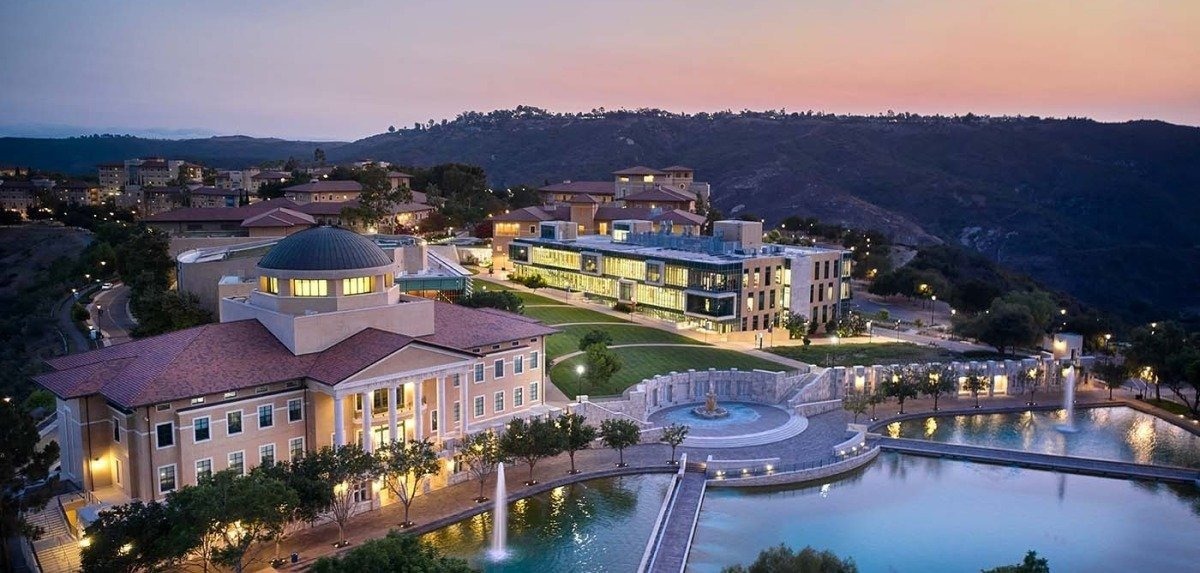
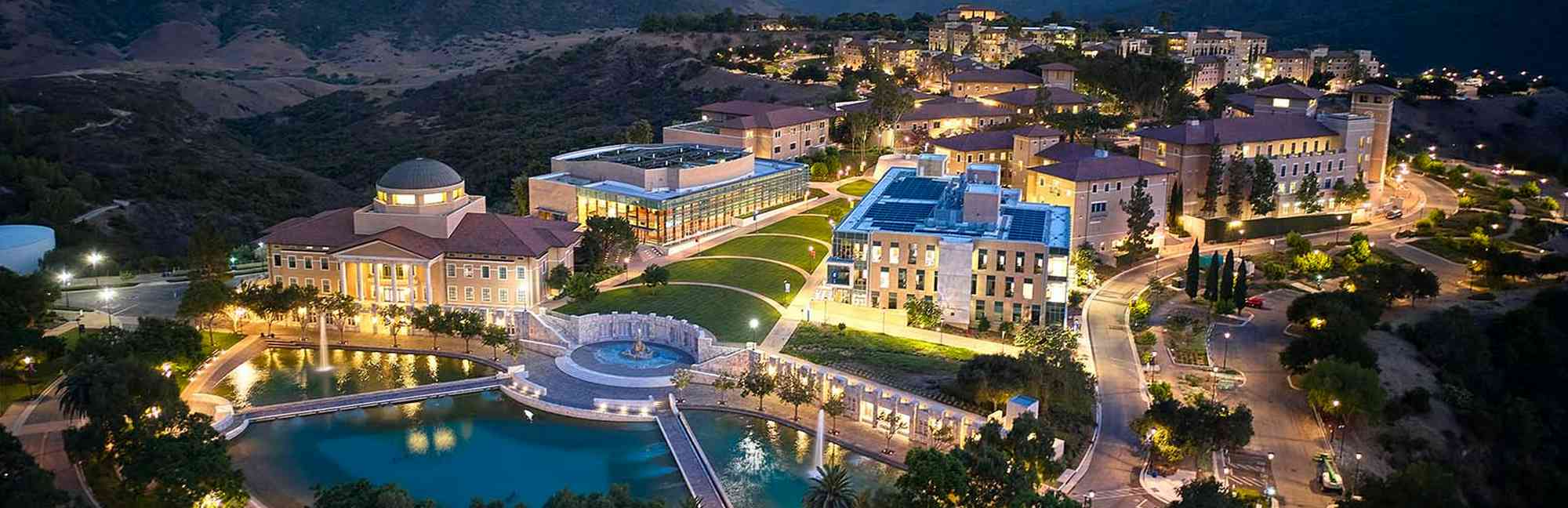
Soka University of America is a small, globally-minded liberal arts college in Southern California that feels more like an international summit than a typical campus. With a student body where 55% are international students representing over 40 nations, Soka’s defining ethos is a commitment to peace, human rights, and the ‘creative coexistence of nature and humanity.’ It pairs an intimate, discussion-heavy academic environment—average class size of 12—with a remarkably generous financial aid policy that covers full tuition for families earning under $90,000. This is a place for idealists and activists who want to think globally while living in a tight-knit, residential community perched in the hills of Aliso Viejo.
Admission requirements
Test-optional — scores considered if submitted
Required
High school transcript
Grade point average
Letters of recommendation
College-prep program
TOEFL (non-native English)
Considered (not required)
Class rank
Test scores (SAT/ACT)
Demonstrated competencies
Source: IPEDS Admissions survey (2022) via Urban Institute. Covers formal factors only — it does not reflect essays, extracurriculars, or other holistic criteria.
More details
Undergrad enrollment
484
In-state tuition
$38,728
Out-of-state tuition
$38,728
Early Action
Non-binding
On-Campus Safety
93% feel extremely safe
Average Class Size
12
Demonstrated Interest
Not Considered
Student-Faculty Ratio
7:1
International Students
55%
Median Earnings (10yr)
$55,017
Four-Year Graduation Rate
92%
Outcomes & value
Outcomes & value
Median earnings (10 yr)
$55,017
Value (earnings ÷ net price)
3.0×
Median debt at graduation
$15,650
Graduation rate
92%
First-year retention
90%
Reducing loan balance (3 yr)
79%
Pell (lower-income) share
20%
Endowment / student
$3,078,717
Earnings = median of students working ~10 years after entry; debt = median of graduates. Value divides 10-yr earnings by net price — read it as earnings per dollar of annual cost, not a full lifetime ROI; it favors lower-cost schools. Source: U.S. Dept. of Education College Scorecard. Figures lag ~2 years and reflect all students, not your intended major.
Financial health
2.2 / 3.0Meets the federal financial-responsibility standard
U.S. Dept. of Education Financial Responsibility Composite Score (FY2022-23). Scale −1.0 to 3.0; ≥1.5 meets the standard. Reported for private nonprofit & for-profit institutions only — public universities are state-backed and not scored, so this is a stability signal, not a ranking.
Top-earning majors
Median earnings by field of study (highest credential), ~2 years after completion.
Liberal Arts and Sciences, General Studies and Humanities$30,228
Source: U.S. Dept. of Education College Scorecard (field-of-study earnings). Figures cover graduates who received federal aid and lag ~2 years; not all programs report data.
Campus & location
Campus safety
On-campus violent crimes (2024)
1
Per 1,000 students
2.02
On-campus criminal offenses classed as violent (murder/non-negligent manslaughter, rape, robbery, aggravated assault) for the most recent reported year. Source: U.S. Dept. of Education Campus Safety and Security (Clery Act). Counts reflect what’s reported to the school, and urban campuses often report more partly due to non-student incidents nearby — read alongside campus size and setting, not as a standalone safety verdict.
Climate
Pleasant days / yr
257
Summer high
76°F
Winter low
46°F
Annual rain
17.8"
Natural-hazard risk
Very High
Pleasant days counts days per year with a mean temperature of 55–75°F, a high at or below 90°F, a low at or above 45°F, and little precipitation — a transparent comfort measure, not a weighting we invented. Computed from Open-Meteo ERA5 daily history (2019–2023). Natural-hazard risk is the county’s composite rating from the FEMA National Risk Index.
Deep dive — research, future-scholar output & economic mobility▾
Research output
Institutional h-index
80
Scholarly works
3,005
Institutional research volume and impact from OpenAlex. The h-index reflects large research universities and will be low for teaching-focused liberal-arts colleges — not a measure of undergraduate quality.
Quick answers
What is the acceptance rate at Soka University of America?
Soka University of America's acceptance rate is approximately 43% (Aliso Viejo, CA), based on the most recent figures we compiled from public and primary sources.
What SAT score do you need for Soka University of America?
Admitted students at Soka University of America typically score 1333–1510 on the SAT (the middle-50% range). Scores outside this band are still admitted, especially with strong applications.
How much does Soka University of America cost?
At Soka University of America, the average net price (after aid) is about $18,260 per year. Actual cost varies with financial aid and residency.
How many undergraduates attend Soka University of America?
Soka University of America enrolls approximately 484 undergraduate students.
Where is Soka University of America located?
Soka University of America is located in Aliso Viejo, CA.
Admissions
Soka is selective, with an hovering around 43-44%. The admissions process is test-flexible; while half of admitted applicants submitted SAT or ACT scores, they are not required. The middle 50% SAT range for admitted students is 1333–1510. The university offers a non-binding Early Action option, which tends to attract applicants with high academic qualifications, though a specific Early Action acceptance rate is not detailed in the provided sources. Demonstrated interest—tracking whether applicants visit, email, or otherwise show engagement—is not considered in admissions decisions, a fact determined by checking the 's C7 section. The student profile is notably international, with 55% of students coming from outside the United States, creating one of the most globally diverse undergraduate populations in the country. Each entering class is kept intentionally small, with about 126 students per grade.
Soka offers a single, intensive Bachelor of Arts in Liberal Arts, with all students completing a capstone senior thesis. The curriculum is a model of structured, holistic education: 100% of students participate in first-year experiences, service learning, and writing-intensive courses across disciplines. The general education core is comprehensive, covering writing and communication, science and mathematics, creative arts, and language and culture. The academic experience is defined by profound intimacy; the student-faculty ratio is 7:1, and the average class size is just 12 students. This allows for a seminar-style pedagogy where students 'know their professors very well.' The mission-driven approach aims to cultivate 'critical thinking, creative problem-solving, and the essential qualities of global citizenship.' Students are encouraged to develop 'an ethically grounded approach to leadership — learning to analyze systems, challenge inequities, and drive change.'
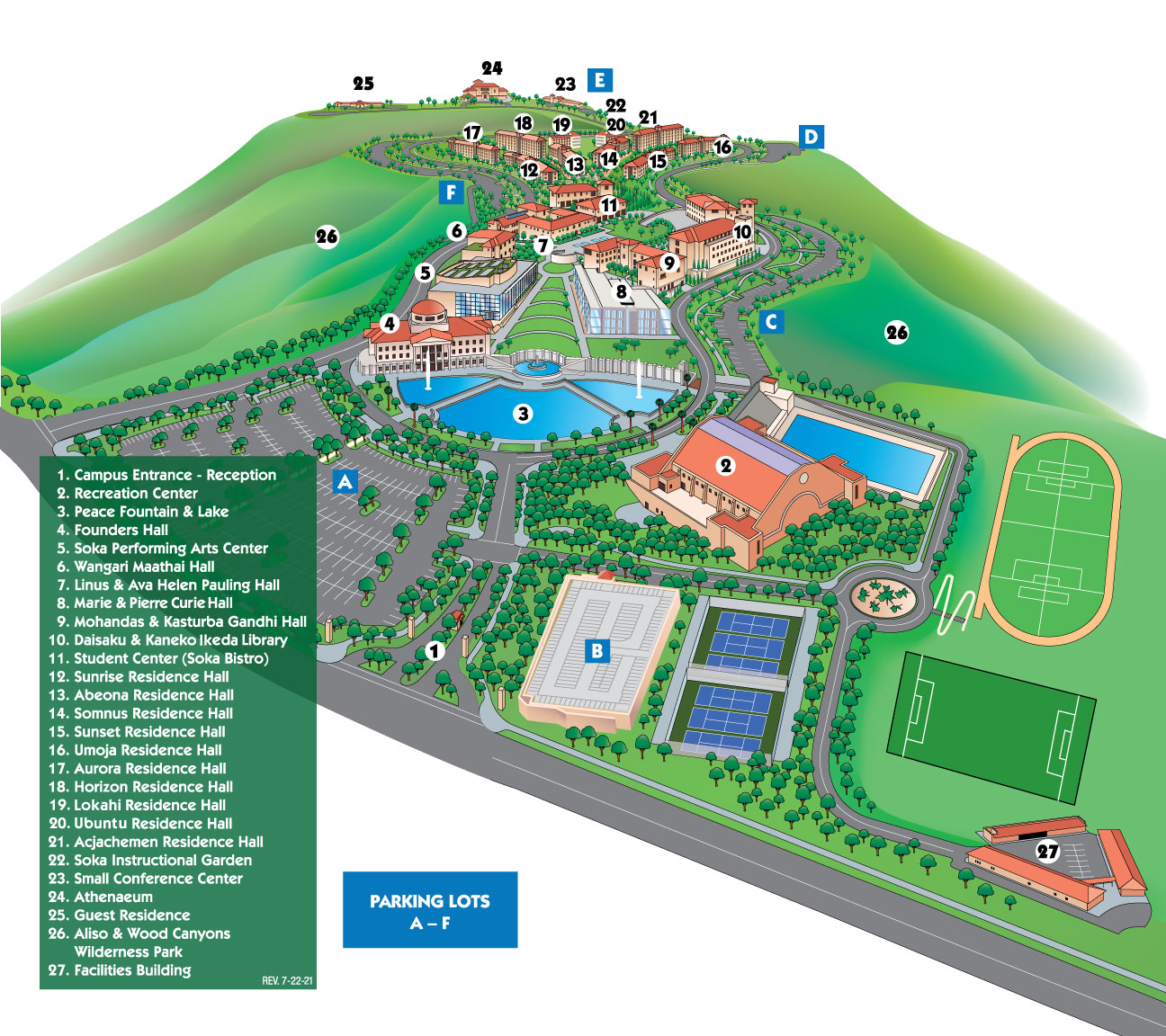
Life at Soka is intensely residential and communal, described as a place where 'living, learning, and leading happen in the same place.' All students live on campus in named residence halls like Horizon, Aurora, Abeona, and Sunrise, sharing spaces with peers from over 40 countries. This creates a daily life that feels like a continuous cultural exchange. The campus is considered extremely safe, with 93% of students reporting they feel 'extremely safe and secure.' Beyond the classroom, there are more than 50 student organizations, including cultural clubs, performing arts groups, athletic clubs, and advocacy organizations, allowing students to build leadership skills in a supportive environment. The overall vibe is one of a close-knit, purpose-driven global village nestled in the Southern California hills.
Soka graduates students at an exceptionally high rate, with a 92% four-year graduation rate. The median earnings for alumni ten years after entry is $55,017. Early career earnings one year after graduation are reported at $19,893, though this figure is noted to be lower than the national average for a similar mix of majors, potentially reflecting the high proportion of graduates who pursue service-oriented or international careers directly after college. The strong graduation rate suggests a highly supportive academic environment that effectively shepherds students to degree completion.
Soka’s financial aid policy is arguably its most distinctive and transformative feature. The university covers full tuition for admitted students whose family annual income is $90,000 or less. This is a form of need-based grant aid that does not need to be repaid. Merit scholarships are also available to all students, regardless of income. As a result, 95.25% of students receive financial aid, with an average aid package of $46,793. The average after grants and scholarships is $18,260. The university provides a net price calculator for personalized estimates and states its commitment to minimizing student debt through the financial aid process.
Soka University of America is a singular institution in the American higher education landscape. It is not just a liberal arts college; it is a deliberate experiment in creating a global citizenry. Its defining characteristics are its radical demographics (a majority-international student body), its hyper-focused single major, its exceptionally small class sizes, and its profoundly generous financial aid model. This combination creates a unique environment: a diverse community of idealists studying together on a beautiful California campus, largely free from the crushing burden of tuition debt for lower- and middle-income families. It appeals to students who are less interested in traditional pre-professional tracks and more driven by a mission to understand global systems, promote peace, and drive positive change. It’s a small, intense, and purpose-built community for those who want their college education to be both a deep intellectual exploration and a training ground for ethical global leadership.
Soka University of America seal · sourceWelcome to Soka University | Soka University of America · sourceCampus Map | Soka University of America · sourceSoka University of America - Niche · source