Admit rate has ranged 68%–76% over the last 5 years. Source: IPEDS via Urban Institute.
Acceptance & SAT from Common Data Set / IPEDS; net price, earnings & graduation from the U.S. Dept. of Education College Scorecard. Figures lag ~1–2 years — verify with the school.
Taylor University is a small, evangelical Christian liberal arts college in rural Indiana that punches above its weight academically, with a 99% graduate success rate and a curriculum blending rigorous academics with faith integration. Known for its tight-knit community (97% of students live on campus) and strong outcomes in fields like engineering and theology, Taylor attracts students who want a purposeful education steeped in Christian values—without the cutthroat selectivity of elite liberal arts colleges.
Admission requirements
Test-optional — scores considered if submitted
Required
High school transcript
Grade point average
Letters of recommendation
College-prep program
TOEFL (non-native English)
Considered (not required)
Class rank
Test scores (SAT/ACT)
Source: IPEDS Admissions survey (2022) via Urban Institute. Covers formal factors only — it does not reflect essays, extracurriculars, or other holistic criteria.
3.0 / 3.0Meets the federal financial-responsibility standard
U.S. Dept. of Education Financial Responsibility Composite Score (FY2022-23). Scale −1.0 to 3.0; ≥1.5 meets the standard. Reported for private nonprofit & for-profit institutions only — public universities are state-backed and not scored, so this is a stability signal, not a ranking.
Top-earning majors
Median earnings by field of study (highest credential), ~2 years after completion.
Computer Science$64,773
Finance and Financial Management Services$54,109
Accounting and Related Services$53,984
Business Administration, Management and Operations$46,790
Teacher Education and Professional Development, Specific Levels and Methods$38,529
Teacher Education and Professional Development, Specific Subject Areas
Campus & location
Campus safety
On-campus violent crimes (2024)
0
Per 1,000 students
0.00
On-campus criminal offenses classed as violent (murder/non-negligent manslaughter, rape, robbery, aggravated assault) for the most recent reported year. Source: U.S. Dept. of Education Campus Safety and Security (Clery Act). Counts reflect what’s reported to the school, and urban campuses often report more partly due to non-student incidents nearby — read alongside campus size and setting, not as a standalone safety verdict.
Climate
Pleasant days / yr
91
Summer high
82°F
Winter low
25°F
Annual rain
41.7"
Annual snow
21.4"
Natural-hazard risk
Relatively Low
Pleasant days counts days per year with a mean temperature of 55–75°F, a high at or below 90°F, a low at or above 45°F, and little precipitation — a transparent comfort measure, not a weighting we invented. Computed from Open-Meteo ERA5 daily history (2019–2023). Natural-hazard risk is the county’s composite rating from the FEMA National Risk Index.
Deep dive — research, future-scholar output & economic mobility▾
Research output
Institutional h-index
62
Scholarly works
1,303
Institutional research volume and impact from OpenAlex. The h-index reflects large research universities and will be low for teaching-focused liberal-arts colleges — not a measure of undergraduate quality.
Economic mobility
Mobility rate
1.0%
Bottom → top quintile
21%
From bottom quintile
5%
Mobility rate = the share of students who both start in the bottom household-income quintile and reach the top quintile; bottom → top is that chance conditional on starting at the bottom. Source: Opportunity Insights Mobility Report Cards (Chetty, Friedman, Saez, Turner & Yagan). Reflects 1980–82 birth cohorts, so it’s directional, not current.
Quick answers
What is the acceptance rate at Taylor University?
Taylor University's acceptance rate is approximately 74% (Upland, IN), based on the most recent figures we compiled from public and primary sources.
What SAT score do you need for Taylor University?
Admitted students at Taylor University typically score 1070–1330 on the SAT (the middle-50% range). Scores outside this band are still admitted, especially with strong applications.
How much does Taylor University cost?
At Taylor University, the average net price (after aid) is about $24,865 per year. Actual cost varies with financial aid and residency.
How many undergraduates attend Taylor University?
Taylor University enrolls approximately 2,025 undergraduate students.
Where is Taylor University located?
Taylor University is located in Upland, IN.
Admissions
Taylor University is moderately selective, with a 73.5% acceptance rate (1,783 admits from 2,425 applications in 2024). The middle 50% of admitted students have SAT scores between 1080–1320 (with averages of 589 Math, 609 Evidence-Based Reading/Writing) or ACT composites averaging 27. Nearly 40% of freshmen ranked in the top 10% of their high school class, and the average GPA is a 3.79. Admissions heavily weigh academic rigor (high school GPA, class rank, and standardized test scores) but also consider extracurriculars, character, and religious commitment—reflecting its evangelical identity.
Earnings = median of students working ~10 years after entry; debt = median of graduates. Value divides 10-yr earnings by one year’s net price — read it as earnings per dollar of annual cost, not a full lifetime ROI; it favors lower-cost schools. Source: U.S. Dept. of Education College Scorecard. Figures lag ~2 years and reflect all students, not your intended major.
$35,416
Social Work$31,133
Psychology, General$30,119
Source: U.S. Dept. of Education College Scorecard (field-of-study earnings). Figures cover graduates who received federal aid and lag ~2 years; not all programs report data.
Taylor offers 100+ undergraduate and graduate programs, with standout departments in engineering (ranked #117 nationally for non-doctorate programs), psychology (7% of majors), and theology (4%). The curriculum emphasizes faith integration across disciplines, requiring a minimum 2.30 GPA in majors (30+ credit hours). Small classes and a #1-ranked undergraduate teaching program in the Midwest foster close faculty mentorship. Flexible degree plans allow for interdisciplinary combinations, like pairing environmental science with biblical studies.
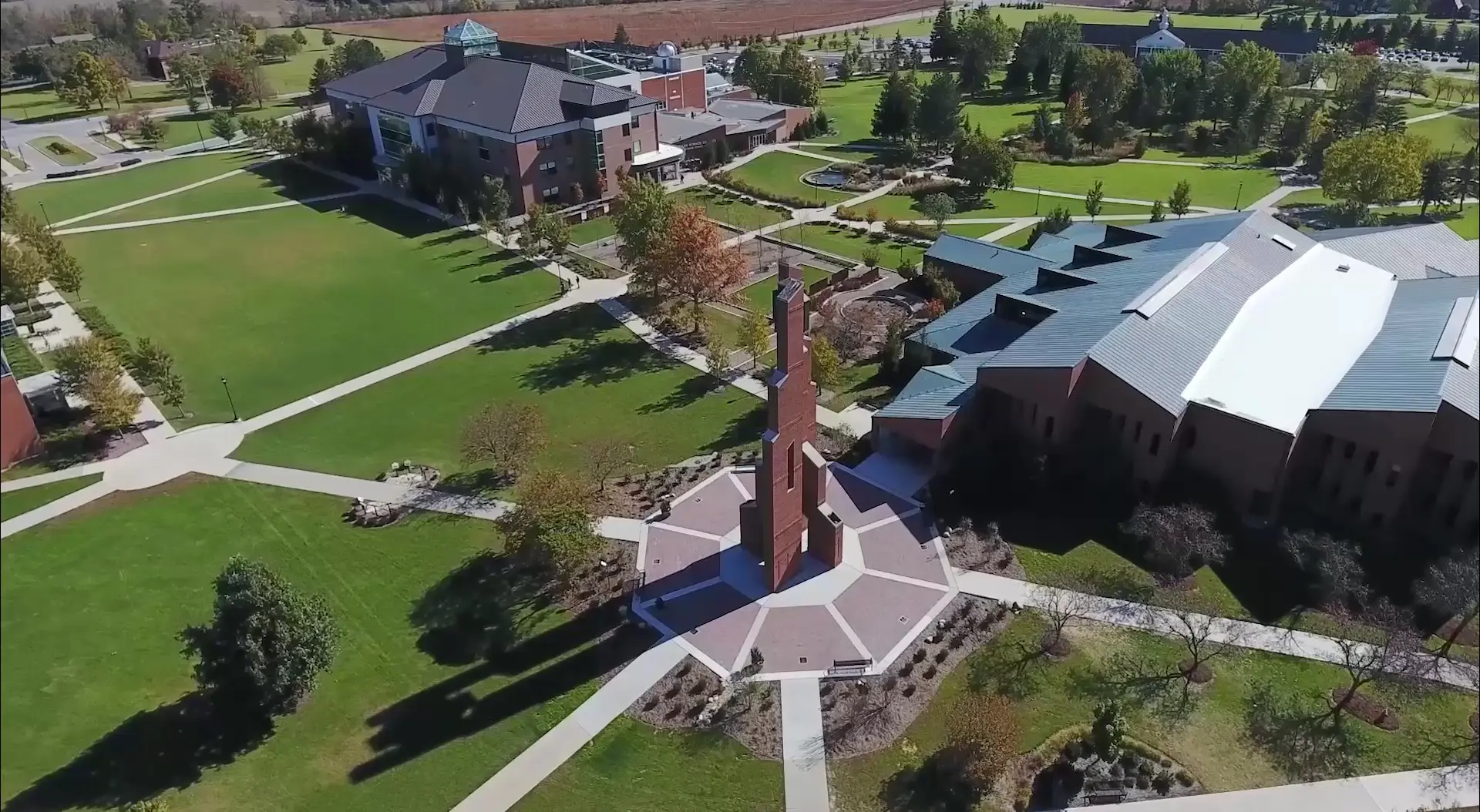
Life revolves around campus (97% live on-site), where traditions like sunsets over the rural Indiana fields and multicultural events (students hail from 40 countries) create a close-knit, globally aware community. The evangelical identity shapes social norms—no Greek life, with dorm Bible studies and service trips filling the gap. Students praise the ‘beautiful, welcoming’ campus, though some note the limited off-campus options in tiny Upland (population 3,800). Athletics (NAIA Division) and music ensembles are big draws.
Taylor delivers remarkable ROI: 99% of 2023 graduates achieved ‘success’ (employed, in grad school, or volunteering), with 92% in full-time roles. The 77% graduation rate (top 15% nationally) climbs to 98% employment post-degree. Early-career salaries start modestly ($31,300 at 6 years post-grad) but rise steadily ($40,400 by year 9), outperforming many regional peers. Strong alumni networks in ministry, education, and engineering help graduates land jobs.
The sticker price is steep ($55,922/year), but 99% of students receive aid, bringing the average down significantly. Taylor offers generous merit scholarships (based on GPA/test scores) and need-based grants, with tools like the Net Price Calculator to estimate individualized costs. For context: The median student loan debt is $27,000, below the national average for private colleges.
Taylor is unapologetically evangelical yet academically serious—a rare combo that draws students seeking rigorous scholarship fused with Christian mission. Its #1 Midwest teaching ranking reflects faculty dedication, while the 99% outcomes rate proves grads thrive. The rural campus fosters intensity (think: late-night theology debates, not frat parties), making it ideal for students who want a full-immersion faith community without sacrificing academic chops.
Taylor University logo · sourceTaylor University | Top Christian Liberal Arts University in Indiana | Taylor University Upland, IN · sourceTaylor University's Campus - YouTube · sourceTaylor University - Campus Center - 360 - Tour · source