Admit rate has ranged 30%–61% over the last 5 years — notably volatile. Source: IPEDS via Urban Institute.
Acceptance & SAT from Common Data Set / IPEDS; net price, earnings & graduation from the U.S. Dept. of Education College Scorecard. Figures lag ~1–2 years — verify with the school.
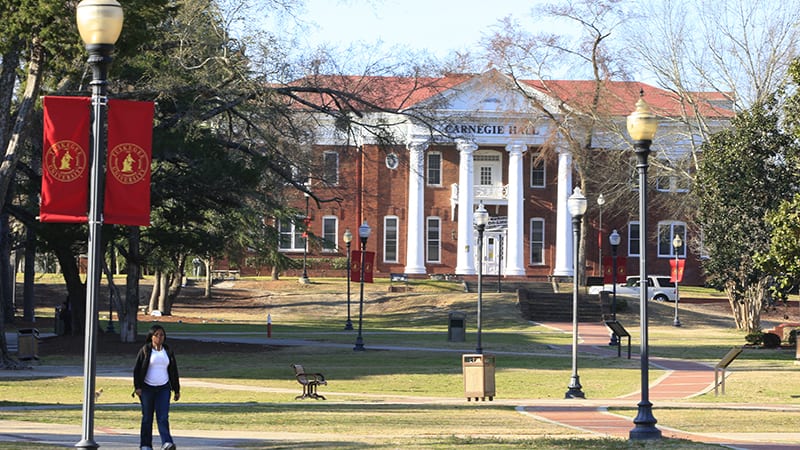
Tuskegee University is not just an HBCU; it's a living monument to Black excellence and self-determination, forged by Booker T. Washington and George Washington Carver. Its identity is rooted in a powerful, hands-on legacy of agricultural science, engineering, and the health professions, producing graduates who are as much technicians and healers as they are scholars. The campus vibrates with a deep-seated tradition and school spirit, yet its most compelling modern story is one of social mobility, consistently ranking as a top engine for lifting students into the professional class.
Admission requirements
Test scores required
Required
High school transcript
Grade point average
Test scores (SAT/ACT)
TOEFL (non-native English)
Considered (not required)
Class rank
Letters of recommendation
College-prep program
Demonstrated competencies
Source: IPEDS Admissions survey (2022) via Urban Institute. Covers formal factors only — it does not reflect essays, extracurriculars, or other holistic criteria.
More details
Undergrad enrollment
2,630
In-state tuition
$25,386
Out-of-state tuition
$25,386
Housing
86% on-campus
Top Majors
Animal Sciences, Biology, Business, Health
No-Loan Policy
Not stated in sources
Graduation Rate
55%
Meets Full Need
Not stated in sources
Social Mobility
#1 in the South (U.S. News)
ED Share of Class
Not offered
First-Year Retention
Not stated in sources
Demonstrated Interest
Not stated in sources
Outcomes & value
Outcomes & value
Median earnings (10 yr)
$49,641
Value (earnings ÷ net price)
1.4×
Median debt at graduation
$27,000
Graduation rate
55%
First-year retention
81%
Reducing loan balance (3 yr)
50%
Pell (lower-income) share
58%
First-gen share (among federal-aid recipients)
23%
Financial health
3.0 / 3.0Meets the federal financial-responsibility standard
U.S. Dept. of Education Financial Responsibility Composite Score (FY2022-23). Scale −1.0 to 3.0; ≥1.5 meets the standard. Reported for private nonprofit & for-profit institutions only — public universities are state-backed and not scored, so this is a stability signal, not a ranking.
Top-earning majors
Median earnings by field of study (highest credential), ~2 years after completion.
Electrical, Electronics, and Communications Engineering$68,499
Mechanical Engineering$67,101
Chemical Engineering$66,821
Registered Nursing, Nursing Administration, Nursing Research and Clinical Nursing$59,124
Finance and Financial Management Services$57,318
Aerospace, Aeronautical, and Astronautical/Space Engineering
Campus & location
Campus safety
On-campus violent crimes (2024)
2
Per 1,000 students
0.65
On-campus criminal offenses classed as violent (murder/non-negligent manslaughter, rape, robbery, aggravated assault) for the most recent reported year. Source: U.S. Dept. of Education Campus Safety and Security (Clery Act). Counts reflect what’s reported to the school, and urban campuses often report more partly due to non-student incidents nearby — read alongside campus size and setting, not as a standalone safety verdict.
Climate
Pleasant days / yr
103
Summer high
91°F
Winter low
43°F
Annual rain
52.2"
Natural-hazard risk
Very Low
Pleasant days counts days per year with a mean temperature of 55–75°F, a high at or below 90°F, a low at or above 45°F, and little precipitation — a transparent comfort measure, not a weighting we invented. Computed from Open-Meteo ERA5 daily history (2019–2023). Natural-hazard risk is the county’s composite rating from the FEMA National Risk Index.
Deep dive — research, future-scholar output & economic mobility▾
Research output
Institutional h-index
158
Scholarly works
5,305
Institutional research volume and impact from OpenAlex. The h-index reflects large research universities and will be low for teaching-focused liberal-arts colleges — not a measure of undergraduate quality.
Economic mobility
Mobility rate
5.2%
Bottom → top quintile
28%
From bottom quintile
19%
Mobility rate = the share of students who both start in the bottom household-income quintile and reach the top quintile; bottom → top is that chance conditional on starting at the bottom. Source: Opportunity Insights Mobility Report Cards (Chetty, Friedman, Saez, Turner & Yagan). Reflects 1980–82 birth cohorts, so it’s directional, not current.
Quick answers
What is the acceptance rate at Tuskegee University?
Tuskegee University's acceptance rate is approximately 49% (Tuskegee, AL), based on the most recent figures we compiled from public and primary sources.
How much does Tuskegee University cost?
At Tuskegee University, the average net price (after aid) is about $35,013 per year. Actual cost varies with financial aid and residency.
How many undergraduates attend Tuskegee University?
Tuskegee University enrolls approximately 2,630 undergraduate students.
Where is Tuskegee University located?
Tuskegee University is located in Tuskegee, AL.
Admissions
Gaining entry to Tuskegee is moderately difficult, with the university admitting roughly half of its applicants. The process is and accepts the Common Application. While historical data shows have fluctuated—dipping into the 30% range in recent years—the canonical figure stands at 49%. The admissions office states a preference for applicants with an ACT composite score of 21 or an SAT score of 1080. A notably low rate—the percentage of admitted students who enroll—sits at just 14%, indicating that Tuskegee competes fiercely for its students after acceptance. The university does not offer an Early Decision plan.
Earnings = median of students working ~10 years after entry; debt = median of graduates. Value divides 10-yr earnings by one year’s net price — read it as earnings per dollar of annual cost, not a full lifetime ROI; it favors lower-cost schools. Source: U.S. Dept. of Education College Scorecard. Figures lag ~2 years and reflect all students, not your intended major.
$55,338
Business Administration, Management and Operations$52,107
General Sales, Merchandising and Related Marketing Operations$46,790
Source: U.S. Dept. of Education College Scorecard (field-of-study earnings). Figures cover graduates who received federal aid and lag ~2 years; not all programs report data.
Tuskegee’s academic identity is powerfully pragmatic, built on a historic foundation in agriculture, engineering, and the sciences that continues to define its strengths today. The most popular majors reflect this: Animal Sciences, Biology/Biological Sciences, Business Administration and Management, and Health and Wellness. The university is organized into several colleges and schools, offering programs from Aerospace Science Engineering and Chemical Engineering to Fine and Performing Arts and History & Political Science. It is classified as a master's university, ranking 109th among 614 such institutions nationally. The curriculum emphasizes strengthening pathways in STEM, education, and professional development, a direct continuation of its founding mission to educate the hand, head, and heart.
Life at Tuskegee is intensely communal and tradition-bound, with a vibrant campus culture that students frequently highlight. The vast majority—86%—live in college-owned, -operated, or -affiliated housing, creating a tightly-knit residential experience. The Office of Student Life and Development serves as the central hub for co-curricular initiatives, overseeing a rich tapestry of campus civic, religious, and social organizations. Student programming is designed to create an inclusive and engaging atmosphere that encourages creativity and individuality. This strong sense of community and school spirit is personified in traditions like the University's Royal Court, and social events are a staple of the calendar, fostering a distinct and proud Tuskegee identity.
Tuskegee’s most powerful contemporary narrative is its role as an engine of social mobility. Recent U.S. News & World Report rankings place it as the top school for Social Mobility in the South and the number one HBCU in Alabama. This mission translates into tangible results for graduates, though earnings potential varies widely by field, with some reports indicating median earnings near $43,557. The university's canonical graduation rate is 55%. Its success in moving students into the professional class is a point of significant institutional pride and a key metric of its impact, underscoring a commitment to transforming lives across generations.
Affording Tuskegee requires careful planning. The canonical average after aid is $35,013. A very high percentage of students—over 90%—receive financial aid, with an average aid package reported around $8,000. However, families are often advised they may need outside scholarships or payment plans to cover costs, particularly for high-cost programs. The university maintains policies that require full-time student status (12+ credit hours) to receive full aid, and at least 6 hours to receive any financial aid. While the financial aid office offers various services, some public commentary has pointed to challenges with responsiveness, a factor prospective families may want to investigate.
Tuskegee stands apart as an institution where history is not just studied but inhabited. Its campus is the literal ground upon which George Washington Carver conducted his revolutionary agricultural research and where the Tuskegee Airmen were trained—a that infuses its strong engineering, aviation, and STEM programs with profound meaning. Unlike HBCUs focused primarily on the liberal arts, Tuskegee’s soul is technical, pragmatic, and hands-on. This produces graduates who are doers and builders. Coupled with its currently recognized leadership in social mobility, Tuskegee represents a unique blend: a sacred keeper of African American history that is fiercely focused on crafting future success, making it a singular destination for students seeking both roots and wings.
Tuskegee University seal · sourceTuskegee University - UNCF · sourceTuskegee University (1881- ) | BlackPast.org · sourceTuskegee University - Encyclopedia of Alabama · source