Admit rate has ranged 78%–89% over the last 5 years — notably volatile. Source: IPEDS via Urban Institute.
Acceptance & SAT from Common Data Set / IPEDS; net price, earnings & graduation from the U.S. Dept. of Education College Scorecard. Figures lag ~1–2 years — verify with the school.
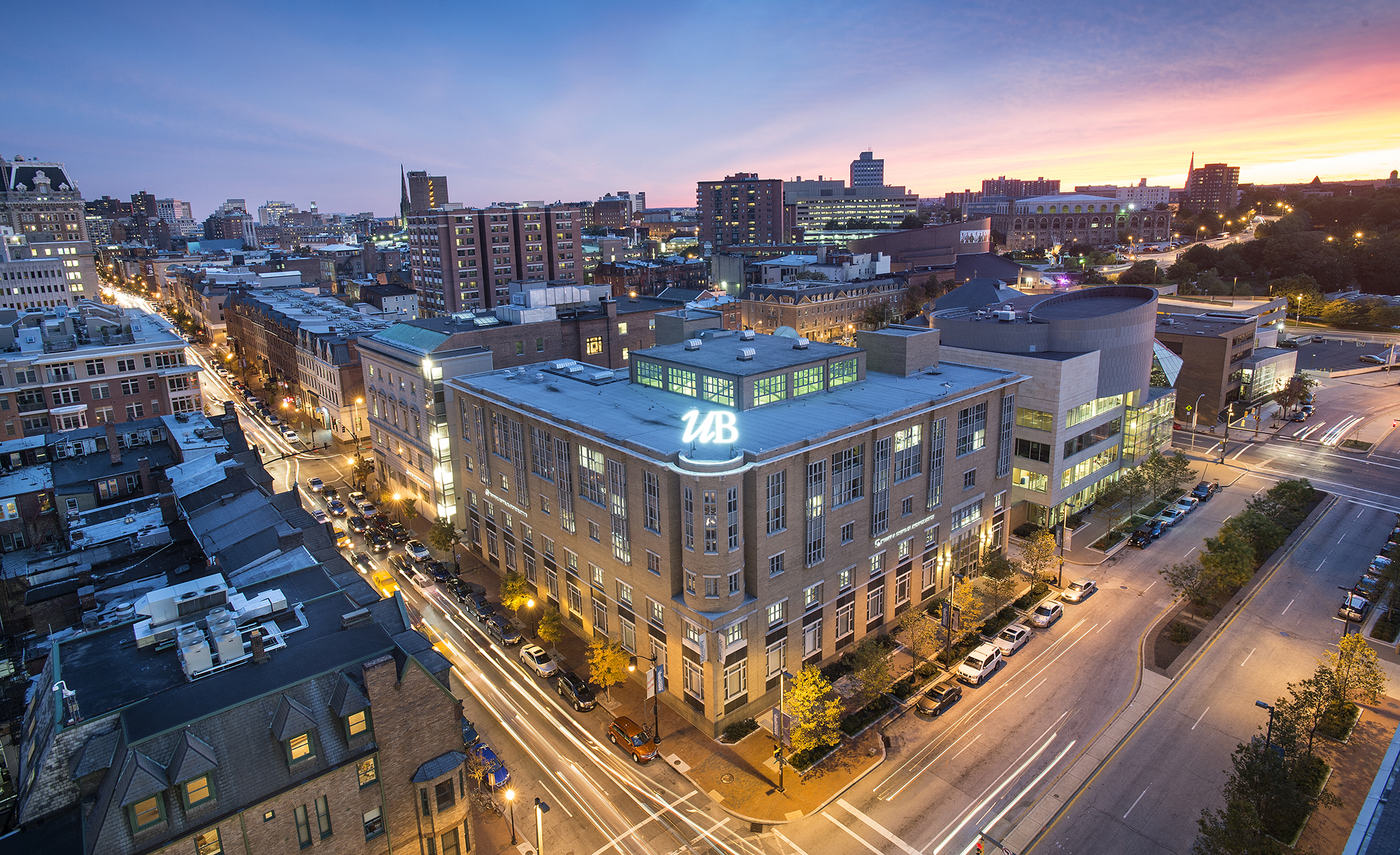
The University of Baltimore operates as a pragmatic urban engine, a public institution laser-focused on turning working adults and career-switchers into professionals. Its identity is defined by a no-frills, downtown Baltimore campus, a curriculum built around business, law, and public affairs, and a student body where the average age skews older and the classroom vibe is more boardroom than dorm room. This is a place for getting a credential, building a network, and landing a job—not for football games or a traditional residential college experience.
Admission requirements
Test-optional — scores considered if submitted
Required
High school transcript
Grade point average
TOEFL (non-native English)
Considered (not required)
Letters of recommendation
Test scores (SAT/ACT)
College-prep program
Source: IPEDS Admissions survey (2022) via Urban Institute. Covers formal factors only — it does not reflect essays, extracurriculars, or other holistic criteria.
More details
Undergrad enrollment
1,133
In-state tuition
$9,992
Out-of-state tuition
$23,984
Popular Majors
Business, Homeland Security, Psychology
Graduation Rate
38%
Median Earnings (10yr)
$61,335
Outcomes & value
Outcomes & value
Median earnings (10 yr)
$61,335
Value (earnings ÷ net price)
4.4×
Median debt at graduation
$23,250
Graduation rate
38%
First-year retention
60%
Reducing loan balance (3 yr)
43%
Pell (lower-income) share
45%
First-gen share (among federal-aid recipients)
40%
Top-earning majors
Median earnings by field of study (highest credential), ~2 years after completion.
Radio, Television, and Digital Communication$45,852
Business/Commerce, General$41,565
Criminal Justice and Corrections$35,060
Information Science/Studies$31,839
Source: U.S. Dept. of Education College Scorecard (field-of-study earnings). Figures cover graduates who received federal aid and lag ~2 years; not all programs report data.
On-campus criminal offenses classed as violent (murder/non-negligent manslaughter, rape, robbery, aggravated assault) for the most recent reported year. Source: U.S. Dept. of Education Campus Safety and Security (Clery Act). Counts reflect what’s reported to the school, and urban campuses often report more partly due to non-student incidents nearby — read alongside campus size and setting, not as a standalone safety verdict.
Climate
Pleasant days / yr
86
Summer high
85°F
Winter low
30°F
Annual rain
61.1"
Annual snow
13.5"
Natural-hazard risk
Relatively High
Pleasant days counts days per year with a mean temperature of 55–75°F, a high at or below 90°F, a low at or above 45°F, and little precipitation — a transparent comfort measure, not a weighting we invented. Computed from Open-Meteo ERA5 daily history (2019–2023). Natural-hazard risk is the county’s composite rating from the FEMA National Risk Index.
Deep dive — research, future-scholar output & economic mobility▾
Research output
Institutional h-index
435
Scholarly works
29,634
Institutional research volume and impact from OpenAlex. The h-index reflects large research universities and will be low for teaching-focused liberal-arts colleges — not a measure of undergraduate quality.
Quick answers
What is the acceptance rate at University of Baltimore?
University of Baltimore's acceptance rate is approximately 79% (Baltimore, MD), based on the most recent figures we compiled from public and primary sources.
What SAT score do you need for University of Baltimore?
Admitted students at University of Baltimore typically score 740–1330 on the SAT (the middle-50% range). Scores outside this band are still admitted, especially with strong applications.
How much does University of Baltimore cost?
At University of Baltimore, the average net price (after aid) is about $13,868 per year. Actual cost varies with financial aid and residency.
How many undergraduates attend University of Baltimore?
University of Baltimore enrolls approximately 1,133 undergraduate students.
Where is University of Baltimore located?
University of Baltimore is located in Baltimore, MD.
Admissions
UBalt's admissions process reflects its mission as an accessible, urban public university serving a non-traditional student population. With a high , the school employs a policy, making SAT or ACT scores a student's choice. The admitted student profile suggests a focus on life experience and career trajectory over standardized metrics alone.
Admissions selectivity data from various sources shows some variance, but the institution's own reporting through the initiative is the primary source for policy. The university's law school, a separate graduate unit, has its own admissions profile with a notably different acceptance rate and median LSAT score.
Selectivity: The university is characterized as "less selective."
Test Policy: The admissions process is test-optional.
Law School Admissions: The University of Baltimore School of Law reports an acceptance rate of 49.5% with a median LSAT of 155 and GPA of 3.45 for its JD program. Its most recent entering class profile showed 55% female, 43% male, and 2% non-binary gender identification.
Yield: Of those accepted to the undergraduate university, approximately 32% end up enrolling, defining its rate.
Application Plans: The Common Data Set outlines standard application plans, including early action, though specific UBalt policies within those frameworks are detailed in their institutional reporting.
Earnings = median of students working ~10 years after entry; debt = median of graduates. Value divides 10-yr earnings by one year’s net price — read it as earnings per dollar of annual cost, not a full lifetime ROI; it favors lower-cost schools. Source: U.S. Dept. of Education College Scorecard. Figures lag ~2 years and reflect all students, not your intended major.
Academics at UBalt are defined by practicality, flexibility, and a direct line to the workforce. The university promotes "accelerated programs, stackable credentials, experiential learning and flexible program delivery" as the core of its learning experience. There is no single, prescribed path; the degree is framed as a tool that "opens doors and unlocks opportunities."
The most popular majors cluster in professionally oriented fields, with Business, Management, Marketing, and Related Support Services leading the way. Other strong areas include Homeland Security, Law Enforcement, Firefighting, Psychology, Animation/Video Graphics, and Human Services. The Yale Gordon College of Arts and Sciences aims to "promote critical thinking, encourage innovation and discovery, and enrich the intellectual lives of its diverse" student body.
The university's reputation, particularly among older students and transfer populations, is for being "very well respected for Business degrees" and as a "respectable college with mature, adult students." Its law school and College of Public Affairs add graduate-level depth to its professional focus. The overall academic culture is less about the traditional liberal arts exploration and more about acquiring immediately applicable skills and credentials.
Student life at UBalt is intrinsically linked to its identity as a commuter and professional school in the heart of Baltimore. The university promotes daily events, community engagement, and many opportunities to get involved, but the vibe is distinctly urban and adult. The campus is non-residential; students seek "Housing Near UBalt's Campus," and the surrounding city becomes an extension of the campus experience.
Festivals like Artscape and the Baltimore Book Festival bring cultural excitement to the area. The Office of Diversity and International Services works to "create a global campus community" where students can engage in dialogue and challenge barriers. Student testimonials, like a campus tour from a first-time undergraduate, provide a ground-level view of the experience. It's a life built around going to class, maybe grabbing a coffee, and then heading to work or home—a far cry from the insulated, residential quad. The dynamic is one of engagement with the city itself, not a cloistered campus bubble.
Outcomes data for UBalt paints a picture of an institution serving a population for whom the traditional four-year graduation timeline is often not the reality. The six-year graduation rate is a key metric, with one state report estimating it at 33.3% for all students. Other sources cite an overall graduation rate of 47%, with a lower rate for female students.
Post-graduation earnings are a central measure of success for its career-focused mission. The median alumni salary is reported around $50,372. The university's own data for specific graduate programs, like the Master of Public Administration, shows variable graduation rates, highlighting the challenges of part-time and professional study.
A broader analysis of post-secondary pathways in Baltimore notes "low rates of degree completion" and "a prevalence of annual earnings below family-supporting wages" in the region, contextualizing the challenges UBalt and its students navigate. For law school graduates, outcomes include BigLaw placement rates and bar passage data, which are tracked separately from undergraduate outcomes.
Affordability is a key part of UBalt's value proposition as a public, urban university. The —the average out-of-pocket cost after scholarships and grants—is a critical figure for its student population. The university provides a Net Price Calculator to help families estimate this cost.
Financial aid comes in the form of need-based scholarships, grants, and loans. The university's financial aid office actively promotes resources like Financial Aid Awareness Week to help students navigate the FAFSA and understand their aid offers. It's important to note that the sources provided do not indicate UBalt has a "no-loan" policy or a guarantee to meet 100% of demonstrated need without loans. The university does offer small, short-term emergency loans of up to $1,000 for qualified students with immediate needs, though these are not available during summer or winter sessions.
The cost structure is per-credit, typical for institutions serving many part-time students, with a listed rate for a 3-credit course.
The University of Baltimore stands out precisely because it doesn't try to be a typical undergraduate college. Its distinctiveness lies in its unapologetic focus on the adult learner and the career-changer. It's a commuter school in a major city where the classroom is filled with people who have work experience, families, and clear professional goals. This creates a serious, focused, and pragmatic intellectual culture worlds away from the stereotypical "college experience."
Its strengths are its professional schools—business, law, and public affairs—which lend weight and networking opportunities to its undergraduate programs. The flexibility of "stackable credentials" and accelerated programs is designed for someone building a career, not just exploring interests. The campus is the city of Baltimore itself, offering real-world immersion but lacking a traditional residential community. For the right student—an independent, driven individual seeking a direct, affordable path to a professional credential—UBalt offers a no-nonsense, effective solution. For someone seeking a classic liberal arts education or a vibrant on-campus social life, it would be a profound mismatch.
University of Baltimore seal · sourceThe University of Baltimore · sourceUniversity of Baltimore - Profile, Rankings and Data | US News Best Colleges · sourceUniversity of Baltimore School of Law - Wikipedia · source