Admit rate has ranged 50%–70% over the last 5 years — notably volatile. Source: IPEDS via Urban Institute.
Acceptance & SAT from Common Data Set / IPEDS; net price, earnings & graduation from the U.S. Dept. of Education College Scorecard. Figures lag ~1–2 years — verify with the school.
The University of Charleston is a private university in West Virginia's capital, offering a practical, career-oriented education with a particular focus on health sciences, business, and leadership. Its riverbank campus fosters a tight-knit community where student life revolves around clubs, service projects, and leadership development. While its graduation rate signals a challenging academic path, the university's test-blind admissions policy and significant scholarship aid aim to open doors for a broad range of students.
Admission requirements
Test-blind — scores not considered
Required
High school transcript
Grade point average
TOEFL (non-native English)
Source: IPEDS Admissions survey (2022) via Urban Institute. Covers formal factors only — it does not reflect essays, extracurriculars, or other holistic criteria.
More details
Undergrad enrollment
2,259
In-state tuition
$33,800
Out-of-state tuition
$33,800
Graduation Rate
46%
Student-Faculty Ratio
15:1
Median Earnings (10yr)
$55,774
First-Year Aid Recipients
94%
Outcomes & value
Outcomes & value
Median earnings (10 yr)
$55,774
Value (earnings ÷ net price)
2.5×
Median debt at graduation
$19,500
Graduation rate
46%
First-year retention
75%
Reducing loan balance (3 yr)
52%
Pell (lower-income) share
31%
First-gen share (among federal-aid recipients)
43%
Financial health
2.9 / 3.0Meets the federal financial-responsibility standard
U.S. Dept. of Education Financial Responsibility Composite Score (FY2022-23). Scale −1.0 to 3.0; ≥1.5 meets the standard. Reported for private nonprofit & for-profit institutions only — public universities are state-backed and not scored, so this is a stability signal, not a ranking.
Top-earning majors
Median earnings by field of study (highest credential), ~2 years after completion.
Registered Nursing, Nursing Administration, Nursing Research and Clinical Nursing$57,564
Allied Health Diagnostic, Intervention, and Treatment Professions$46,321
Business Administration, Management and Operations$44,928
Teacher Education and Professional Development, Specific Levels and Methods$32,569
Sports, Kinesiology, and Physical Education/Fitness$26,353
Campus & location
Campus safety
On-campus violent crimes (2024)
2
Per 1,000 students
0.67
On-campus criminal offenses classed as violent (murder/non-negligent manslaughter, rape, robbery, aggravated assault) for the most recent reported year. Source: U.S. Dept. of Education Campus Safety and Security (Clery Act). Counts reflect what’s reported to the school, and urban campuses often report more partly due to non-student incidents nearby — read alongside campus size and setting, not as a standalone safety verdict.
Climate
Pleasant days / yr
94
Summer high
85°F
Winter low
32°F
Annual rain
51.3"
Annual snow
13.2"
Natural-hazard risk
Relatively High
Pleasant days counts days per year with a mean temperature of 55–75°F, a high at or below 90°F, a low at or above 45°F, and little precipitation — a transparent comfort measure, not a weighting we invented. Computed from Open-Meteo ERA5 daily history (2019–2023). Natural-hazard risk is the county’s composite rating from the FEMA National Risk Index.
Deep dive — research, future-scholar output & economic mobility▾
Research output
Institutional h-index
135
Scholarly works
3,314
Institutional research volume and impact from OpenAlex. The h-index reflects large research universities and will be low for teaching-focused liberal-arts colleges — not a measure of undergraduate quality.
Economic mobility
Mobility rate
1.2%
Bottom → top quintile
11%
From bottom quintile
11%
Mobility rate = the share of students who both start in the bottom household-income quintile and reach the top quintile; bottom → top is that chance conditional on starting at the bottom. Source: Opportunity Insights Mobility Report Cards (Chetty, Friedman, Saez, Turner & Yagan). Reflects 1980–82 birth cohorts, so it’s directional, not current.
Quick answers
What is the acceptance rate at University of Charleston?
University of Charleston's acceptance rate is approximately 62% (Charleston, WV), based on the most recent figures we compiled from public and primary sources.
How much does University of Charleston cost?
At University of Charleston, the average net price (after aid) is about $22,107 per year. Actual cost varies with financial aid and residency.
How many undergraduates attend University of Charleston?
University of Charleston enrolls approximately 2,259 undergraduate students.
Where is University of Charleston located?
University of Charleston is located in Charleston, WV.
Admissions
The University of Charleston employs a test-blind admissions policy, meaning students are not required to submit ACT or SAT scores for general admission consideration, and those scores are not used in the evaluation process. The admissions process is moderately selective. The university does not have an open admission policy. While specific details on application priorities are not provided in the available sources, the admissions office can be contacted directly via phone or email for further information.
Key Admissions Details:
Test Policy: Test-blind for freshman and transfer applicants.
UC offers a range of undergraduate and graduate programs organized into broad disciplinary areas, including Arts & Humanities, Business, Computing & Technology, Education & Social Science, Health Care & Nursing, Leadership, and Pre-Professional Science. The Princeton Review notes the university offers twenty-two undergraduate majors, with specific mentions of interior design, education, pre-pharmacy, and science. The academic environment is characterized by a 15:1 student-to-faculty ratio. The university operates from its main campus in Charleston, West Virginia, with an additional location in Beckley.
Earnings = median of students working ~10 years after entry; debt = median of graduates. Value divides 10-yr earnings by one year’s net price — read it as earnings per dollar of annual cost, not a full lifetime ROI; it favors lower-cost schools. Source: U.S. Dept. of Education College Scorecard. Figures lag ~2 years and reflect all students, not your intended major.
Source: U.S. Dept. of Education College Scorecard (field-of-study earnings). Figures cover graduates who received federal aid and lag ~2 years; not all programs report data.
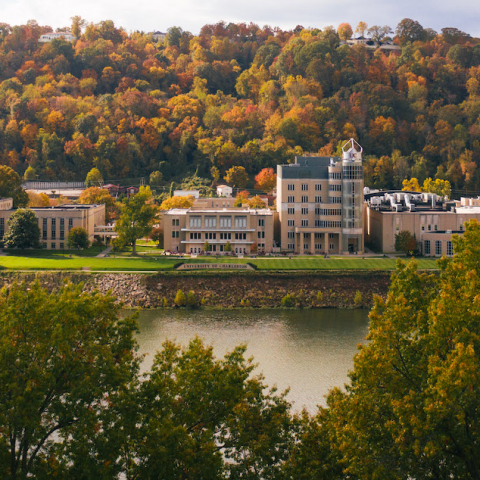
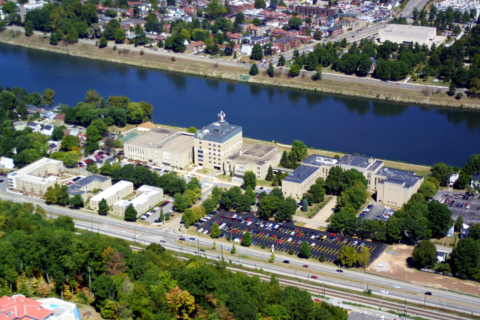
Student life at UC is intentionally designed to foster community and belonging. The university promotes engagement through leadership opportunities, service projects, and a wide array of clubs and organizations. The campus is described as a "beautiful riverbank campus," and extracurricular activities are a central part of the experience. Niche.com highlights the university's diverse community, with students and faculty from various backgrounds and countries, which contributes to a culturally varied environment. A welcome video on the university's YouTube channel provides a visual introduction to campus life.
The University of Charleston's graduation rate is a point of significant data variation among sources, but the canonical figure is 46%. One institutional page cites a four-year graduation rate goal of 62%, with an actual reported rate of 57% for a specific cohort. Post-graduation earnings data also varies; the College Scorecard reports a median earnings figure significantly higher than the canonical figure. The canonical median earnings, 10 years after entry, is $55,774. Research.com places the overall graduation rate in the bottom 30% percentile nationally.
For the 2025-2026 academic year, the published cost sheet lists fixed charges totaling $46,950, which includes tuition ($33,490), housing ($8,320), meals ($4,640), and fees ($500). The university emphasizes that 94% of full-time, first-year undergraduates receive grant or scholarship aid. Prospective students are directed to use the Calculator to estimate their individual costs and potential aid. Financial aid packages can include federal grants, UC scholarships, and loans. The university provides institutional and financial aid information, detailing that aid includes loans (both need-based and non-need-based) and work opportunities.
The University of Charleston carves out its niche through a deliberate, practical focus. Its test-blind policy is a standout feature, removing a traditional barrier to application and signaling a process. The academic structure is unapologetically geared toward direct career pathways, particularly in high-demand fields like health care, nursing, and business. This is not a liberal arts college in the classic sense; it's a place for students with clear professional targets. Furthermore, the university invests heavily in student aid, with nearly all incoming students receiving scholarships or grants, which dramatically lowers the for most. The campus culture, built on a "riverbank" setting, actively cultivates involvement through clubs and leadership roles, aiming to create a cohesive community for its students. It's a university built on access, practical education, and supportive campus engagement.
University of Charleston seal · sourceAbout UC - University of Charleston · sourceHistory - University of Charleston · sourceUniversity of Charleston - Profile, Rankings and Data | US News Best Colleges · source