Admit rate has ranged 66%–92% over the last 5 years — notably volatile, though the latest figure above (57%) falls outside that window. Source: IPEDS via Urban Institute.
Acceptance & SAT from Common Data Set / IPEDS; net price, earnings & graduation from the U.S. Dept. of Education College Scorecard. Figures lag ~1–2 years — verify with the school.
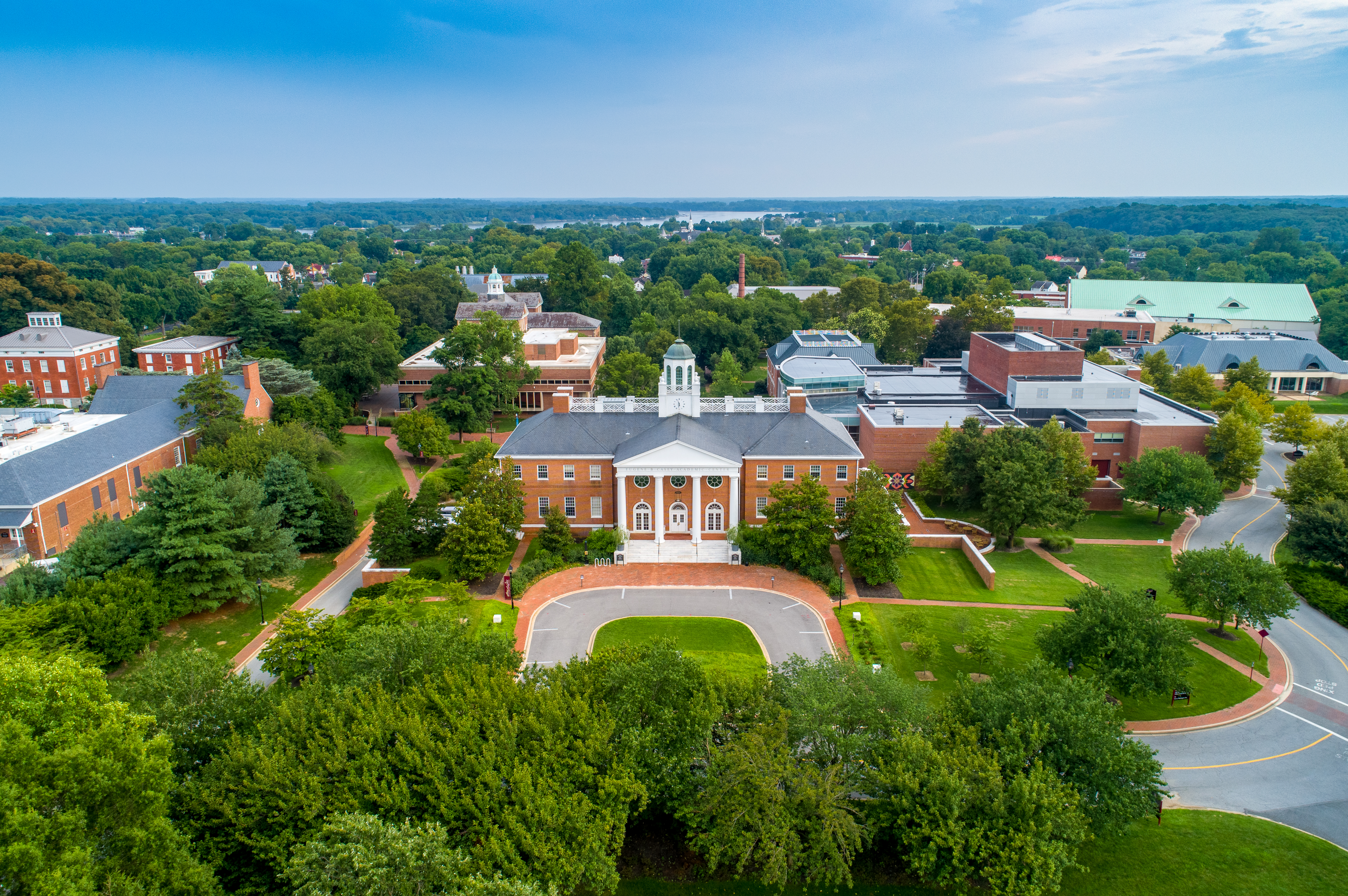
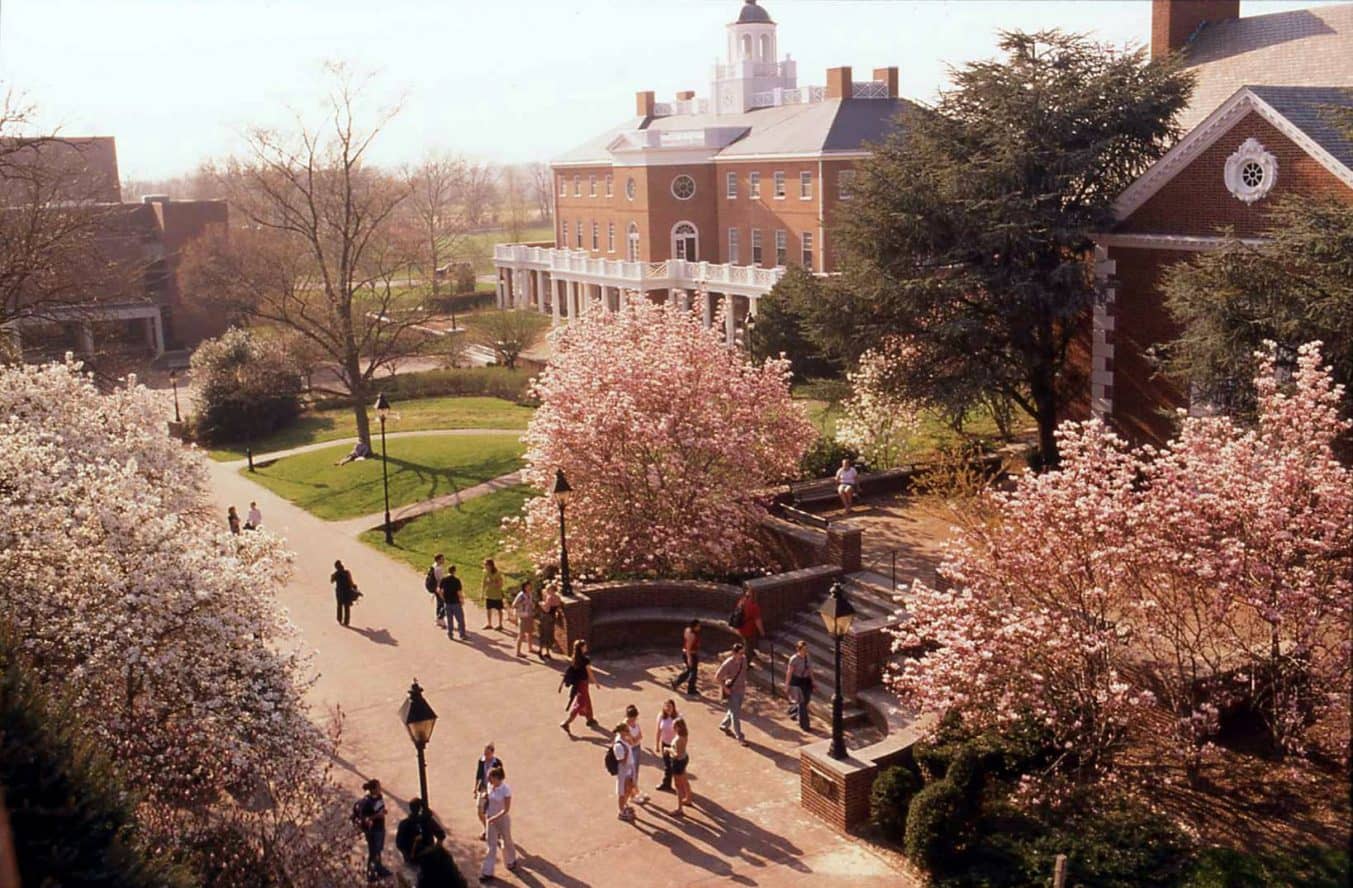
Washington College is a small, historic liberal arts college on Maryland's Eastern Shore where the pace is deliberate and the connections are personal. It's a place where a 9:1 student-faculty ratio isn't just a statistic but a lived reality, translating into a curriculum that emphasizes discussion-based learning and hands-on experience. The school's identity is deeply tied to its location in Chestertown, offering a tight-knit, residential community where student organizations drive a robust social calendar and the nearby Chester River serves as both a laboratory and a refuge.
Admission requirements
Test-optional — scores considered if submitted
Required
High school transcript
Grade point average
Letters of recommendation
College-prep program
Considered (not required)
Class rank
Test scores (SAT/ACT)
TOEFL (non-native English)
Source: IPEDS Admissions survey (2022) via Urban Institute. Covers formal factors only — it does not reflect essays, extracurriculars, or other holistic criteria.
More details
Undergrad enrollment
891
In-state tuition
$55,326
Out-of-state tuition
$55,326
Graduation Rate
65%
Meets Full Need
No
On-Campus Housing
84% of students
Average Class Size
~15 students
First-Year Retention
Not stated in sources
Student-Faculty Ratio
9:1
Median Earnings (10yr)
$65,518
Students Receiving Aid
98%
Early Decision Advantage
Significantly higher acceptance rate
Outcomes & value
Outcomes & value
Median earnings (10 yr)
$65,518
Value (earnings ÷ net price)
2.3×
Median debt at graduation
$26,956
Graduation rate
65%
First-year retention
84%
Reducing loan balance (3 yr)
84%
Pell (lower-income) share
23%
First-gen share (among federal-aid recipients)
16%
Financial health
2.8 / 3.0Meets the federal financial-responsibility standard
U.S. Dept. of Education Financial Responsibility Composite Score (FY2022-23). Scale −1.0 to 3.0; ≥1.5 meets the standard. Reported for private nonprofit & for-profit institutions only — public universities are state-backed and not scored, so this is a stability signal, not a ranking.
Top-earning majors
Median earnings by field of study (highest credential), ~2 years after completion.
Computer Science$63,005
Mathematics$57,318
Business/Commerce, General$53,045
Economics$46,087
Romance Languages, Literatures, and Linguistics$41,565
Liberal Arts and Sciences, General Studies and Humanities$40,188
Campus & location
Campus safety
On-campus violent crimes (2024)
1
On-campus criminal offenses classed as violent (murder/non-negligent manslaughter, rape, robbery, aggravated assault) for the most recent reported year. Source: U.S. Dept. of Education Campus Safety and Security (Clery Act). Counts reflect what’s reported to the school, and urban campuses often report more partly due to non-student incidents nearby — read alongside campus size and setting, not as a standalone safety verdict.
Climate
Pleasant days / yr
89
Summer high
85°F
Winter low
32°F
Annual rain
57.3"
Annual snow
10.1"
Natural-hazard risk
Very Low
Pleasant days counts days per year with a mean temperature of 55–75°F, a high at or below 90°F, a low at or above 45°F, and little precipitation — a transparent comfort measure, not a weighting we invented. Computed from Open-Meteo ERA5 daily history (2019–2023). Natural-hazard risk is the county’s composite rating from the FEMA National Risk Index.
Deep dive — research, future-scholar output & economic mobility▾
Research output
Institutional h-index
111
Scholarly works
4,185
Institutional research volume and impact from OpenAlex. The h-index reflects large research universities and will be low for teaching-focused liberal-arts colleges — not a measure of undergraduate quality.
Economic mobility
Mobility rate
1.2%
Bottom → top quintile
36%
From bottom quintile
3%
Mobility rate = the share of students who both start in the bottom household-income quintile and reach the top quintile; bottom → top is that chance conditional on starting at the bottom. Source: Opportunity Insights Mobility Report Cards (Chetty, Friedman, Saez, Turner & Yagan). Reflects 1980–82 birth cohorts, so it’s directional, not current.
Quick answers
What is the acceptance rate at Washington College?
Washington College's acceptance rate is approximately 57% (Chestertown, MD), based on the most recent figures we compiled from public and primary sources.
What SAT score do you need for Washington College?
Admitted students at Washington College typically score 1140–1390 on the SAT (the middle-50% range). Scores outside this band are still admitted, especially with strong applications.
How much does Washington College cost?
At Washington College, the average net price (after aid) is about $27,898 per year. Actual cost varies with financial aid and residency.
How many undergraduates attend Washington College?
Washington College enrolls approximately 891 undergraduate students.
Where is Washington College located?
Washington College is located in Chestertown, MD.
Admissions
Washington College operates with a moderately selective admissions process, but it offers a significant advantage to students who commit early. The school provides both Early Decision and Regular Decision options, and the data suggests applying ED can meaningfully improve an applicant's odds. While the overall is 57%, external analyses indicate the Early Decision acceptance rate is notably higher—one source cites 93% for ED compared to 58% overall, and another notes that for a recent class, 60% of the enrolled students were admitted through Early Decision, with an ED admission rate of 73% versus 31% for Regular Decision. The middle 50% SAT range for admitted students is 1140–1390. The , which details admissions criteria, is a primary resource for applicants, though the specific ranking of factors like demonstrated interest within Washington College's CDS is not detailed in the provided snippets.
Earnings = median of students working ~10 years after entry; debt = median of graduates. Value divides 10-yr earnings by one year’s net price — read it as earnings per dollar of annual cost, not a full lifetime ROI; it favors lower-cost schools. Source: U.S. Dept. of Education College Scorecard. Figures lag ~2 years and reflect all students, not your intended major.
International Relations and National Security Studies
$37,208
Psychology, General$35,926
Source: U.S. Dept. of Education College Scorecard (field-of-study earnings). Figures cover graduates who received federal aid and lag ~2 years; not all programs report data.
The academic experience at Washington College is defined by its intimate scale and a firm commitment to the liberal arts and sciences. With a 9:1 student-to-faculty ratio, the college promotes a "rigorous, discussion-based learning" environment where small class sizes—reportedly averaging around 15 students—foster direct interaction and personal attention from professors. Students choose from 32 traditional majors and career-oriented programs. Popular majors include Business Administration and Management, Biology/Biological Sciences, and Economics. The curriculum is designed to encourage exploration across disciplines, developing a student's capacity to reason, communicate, and solve problems. Pre-professional tracks in engineering, pre-health, pre-law, and teacher certification are integrated into the liberal arts framework, providing structured pathways for career-minded students without sacrificing breadth.
Life at Washington College is intensely communal and largely campus-centric. A full 84% of students live in college-owned, -operated, or -affiliated housing, creating a residential bubble where the line between academic and social life blurs. The "Washington way" is characterized by extended, informal faculty mentorship—think sitting with a professor for over an hour in a one-on-one conversation. Student organizations are the engine of campus activity, driving everything from formal biannual dances to weekly game nights. The college describes itself as an "entertainment district, a refuge, a home," and students report a "very robust social life" with many campus events and activities. This creates a welcoming, collaborative atmosphere where the small size ensures students are known, but also requires them to generate much of their own fun within the Chestertown community.
Washington College graduates enter the workforce or further education with strong success rates. According to the most recent institutional data, 95% of graduates were either employed or continuing their education within nine months of graduation, with 75% securing full-time or part-time employment. Another source cites a slightly lower but still robust figure, noting that 92% of a recent class were employed, pursuing advanced degrees, or engaged in meaningful opportunities supporting career interests nine months out. The four-year graduation rate is reported as 61% by one source, while others indicate an overall graduation rate of 74%, placing it in the top 20% nationally. The median earnings figure ten years after entry is a canonical $65,518.
Washington College is a high-tuition institution that relies heavily on institutional aid to make attendance feasible. The average after aid—the cost after scholarships and grants are applied—is $27,898. A vast majority of students (98%) receive some form of financial aid, with the average aid package reported as $49,531. The college offers a range of support, including College-sponsored tuition scholarships, tuition grants, work-study, and low-interest loans. It's important for families to note that, according to the college's own FAQ, "meeting full demonstrated need is not the policy of Washington College." This means the financial aid package offered may not cover 100% of the calculated need, and loans may be a component. The college provides a net price calculator for estimates, but stresses that families must complete the FAFSA for a final determination.
Washington College stands out for offering a classic, high-touch liberal arts experience in a setting that feels removed from the pressures of major metropolitan centers. Its singularity lies in the potency of its small scale: a 9:1 ratio that makes profound mentorship the norm, not the exception, and a campus where 84% of students live on-site, forging a self-contained community. It's a college for students who thrive when they are known by name, who want to drive campus life through clubs and organizations, and who appreciate the natural laboratory of the Chester River. While it lacks the billion-dollar endowments and no-loan policies of its elite peers, it compensates with a palpable sense of place and accessibility—evidenced by a significantly higher for students willing to commit via Early Decision. It's the right fit for a student seeking a rigorous education without cutthroat competition, where the journey is as much about building relationships as building a resume.