Admit rate has ranged 71%–82% over the last 5 years — notably volatile, though the latest figure above (68%) falls outside that window. Source: IPEDS via Urban Institute.
Acceptance & SAT from Common Data Set / IPEDS; net price, earnings & graduation from the U.S. Dept. of Education College Scorecard. Figures lag ~1–2 years — verify with the school.
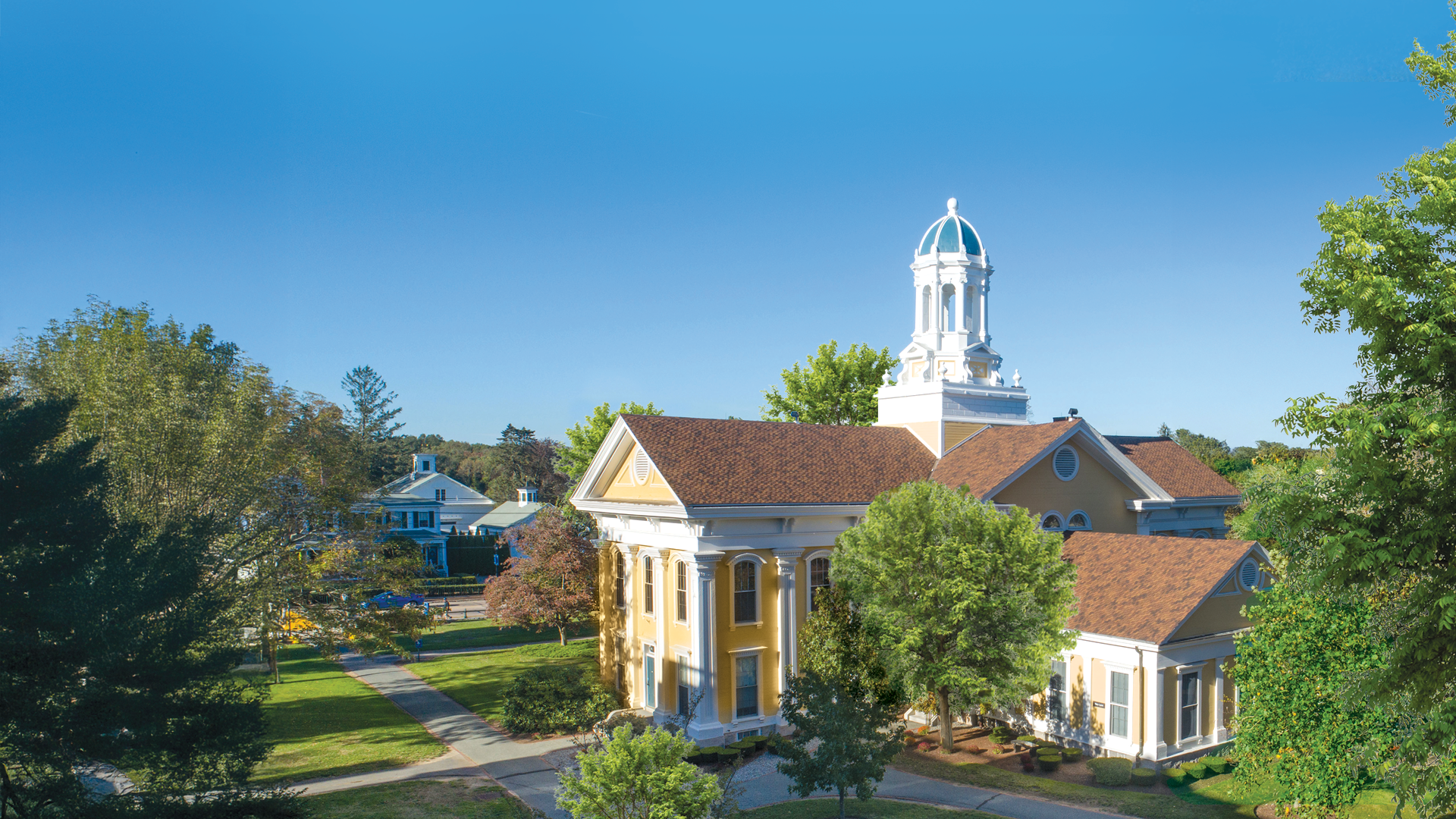
Wheaton College in Norton, Massachusetts, is a small liberal arts college that operates with the energy of a creative workshop rather than a cloistered ivory tower. It's a place where students are described as 'creative, energetic, and have a love for academics,' and where the curriculum—over 100 interdisciplinary programs—is designed for personalization and hands-on application. The campus vibe is active and inclusive, powered by a dense network of student clubs and distinctive traditions, all while maintaining a pragmatic focus on outcomes, with 92% of graduates employed or in grad school within six months.
Admission requirements
Test-optional — scores considered if submitted
Required
High school transcript
Letters of recommendation
College-prep program
TOEFL (non-native English)
Considered (not required)
Grade point average
Class rank
Test scores (SAT/ACT)
Demonstrated competencies
Source: IPEDS Admissions survey (2022) via Urban Institute. Covers formal factors only — it does not reflect essays, extracurriculars, or other holistic criteria.
More details
Undergrad enrollment
1,773
In-state tuition
$63,960
Out-of-state tuition
$63,960
Graduation Rate
73%
Demonstrated Interest
Considered
Median Earnings (10yr)
$67,725
First-Year Retention Rate
82%
Outcomes Success Rate (6 months)
92% employed/enrolled
Students Receiving Financial Aid
99%
Outcomes & value
Outcomes & value
Median earnings (10 yr)
$67,725
Value (earnings ÷ net price)
2.3×
Median debt at graduation
$26,000
Graduation rate
73%
First-year retention
82%
Reducing loan balance (3 yr)
80%
Pell (lower-income) share
22%
First-gen share (among federal-aid recipients)
15%
Top-earning majors
Median earnings by field of study (highest credential), ~2 years after completion.
Computer Science$71,957
Economics$42,682
International Relations and National Security Studies$38,289
Business Administration, Management and Operations$38,289
History$36,134
English Language and Literature, General$33,459
Campus & location
Campus safety
On-campus violent crimes (2024)
3
On-campus criminal offenses classed as violent (murder/non-negligent manslaughter, rape, robbery, aggravated assault) for the most recent reported year. Source: U.S. Dept. of Education Campus Safety and Security (Clery Act). Counts reflect what’s reported to the school, and urban campuses often report more partly due to non-student incidents nearby — read alongside campus size and setting, not as a standalone safety verdict.
Climate
Pleasant days / yr
89
Summer high
81°F
Winter low
26°F
Annual rain
53.9"
Annual snow
27.4"
Natural-hazard risk
Relatively Moderate
Pleasant days counts days per year with a mean temperature of 55–75°F, a high at or below 90°F, a low at or above 45°F, and little precipitation — a transparent comfort measure, not a weighting we invented. Computed from Open-Meteo ERA5 daily history (2019–2023). Natural-hazard risk is the county’s composite rating from the FEMA National Risk Index.
Deep dive — research, future-scholar output & economic mobility▾
Research output
Institutional h-index
79
Scholarly works
1,554
Institutional research volume and impact from OpenAlex. The h-index reflects large research universities and will be low for teaching-focused liberal-arts colleges — not a measure of undergraduate quality.
Quick answers
What is the acceptance rate at Wheaton College (Massachusetts)?
Wheaton College (Massachusetts)'s acceptance rate is approximately 68% (Norton, MA), based on the most recent figures we compiled from public and primary sources.
What SAT score do you need for Wheaton College (Massachusetts)?
Admitted students at Wheaton College (Massachusetts) typically score 1220–1390 on the SAT (the middle-50% range). Scores outside this band are still admitted, especially with strong applications.
How much does Wheaton College (Massachusetts) cost?
At Wheaton College (Massachusetts), the average net price (after aid) is about $29,822 per year. Actual cost varies with financial aid and residency.
How many undergraduates attend Wheaton College (Massachusetts)?
Wheaton College (Massachusetts) enrolls approximately 1,773 undergraduate students.
Where is Wheaton College (Massachusetts) located?
Wheaton College (Massachusetts) is located in Norton, MA.
Admissions
Wheaton's admissions process is characterized by its accessibility and a clear, strategic advantage for early applicants. The college is less selective, with an of 68%. However, applying Early Decision can significantly improve an applicant's odds; the early acceptance rate is 83.6%, a stark contrast to the regular decision pool. This suggests Wheaton values commitment and uses its binding ED round to secure a substantial portion of its incoming class. The process is , accepting the Common Application, and notably, the college considers demonstrated interest as a factor in admissions decisions. For those who submit scores, the middle 50% SAT range for admitted students is 1220–1390. The admissions office reviews a holistic set of factors, and the —the percentage of admitted students who enroll—reflects the college's position in the competitive New England landscape.
Earnings = median of students working ~10 years after entry; debt = median of graduates. Value divides 10-yr earnings by one year’s net price — read it as earnings per dollar of annual cost, not a full lifetime ROI; it favors lower-cost schools. Source: U.S. Dept. of Education College Scorecard. Figures lag ~2 years and reflect all students, not your intended major.
Ethnic, Cultural Minority, Gender, and Group Studies$32,925
Political Science and Government$32,925
Source: U.S. Dept. of Education College Scorecard (field-of-study earnings). Figures cover graduates who received federal aid and lag ~2 years; not all programs report data.
Academics at Wheaton are built on flexibility and interdisciplinary exploration. The college offers more than 100 programs, which are enhanced by a strong emphasis on experiential learning through internships, independent study, and collaborative research. The curriculum is deliberately structured to give students agency; within every major and minor, there is flexibility with elective classes that allow for a 'personalized path' through the program. This approach fosters a student body that peers describe as 'creative, energetic, and have a love for academics.' The academic culture seems less about rigid pre-professional tracks and more about weaving together interests—a student might combine neuroscience with studio art, or political science with creative writing. The breadth is supported by a faculty presumably engaged in close mentorship, given the institutional scale and the prominence of independent projects in the academic model.
Life on Wheaton's Norton campus is densely programmed and student-driven, creating a self-contained, active community. With over 100 student-led clubs, the opportunities for involvement are vast, ranging from academic and cultural groups to special interest organizations. The college fosters this engagement through dedicated spaces like the Marshall Center, which aims to create a 'transformative and inclusive campus environment where all students are empowered to thrive academically, socially and spiritually.'
Campus life is also defined by unique traditions and annual events that build class identity and school spirit. The college actively programs around heritage months and social justice workshops, aiming to enhance the celebration of diverse cultures on campus. This blend of organic student initiative and institutional support for inclusion creates a vibe that is both lively and intentionally welcoming. Students shape their environment, whether through club leadership, participating in campus-wide events, or living in one of the fun theme houses.
Wheaton delivers solid, practical outcomes for its graduates, effectively bridging a liberal arts education with post-college success. The most compelling figure is that 92% of Wheaton College graduates are employed, enrolled in graduate programs, or gaining career-connected experience within six months of graduation. This high 'success rate' underscores the effectiveness of its career services and the marketability of its interdisciplinary approach. The four-year graduation rate is 73%, indicating that most students progress through their personalized academic plans on schedule. For those measuring long-term financial return, the median earnings ten years after entry are $67,725. These numbers paint a picture of a college whose graduates launch successfully, whether directly into the workforce or into further study, with a strong foundation for mid-career earnings growth.
Wheaton's stated comprehensive tuition and fees are $65,700, but the reality for most students is significantly different due to generous financial aid. The average after aid is $29,822. A remarkable 99% of students receive financial aid, with average aid packages reported as high as $53,178. The college offers substantial merit-based scholarships, renewable annually, of up to $46,000, which are awarded regardless of financial need. is also available and is distributed based on demonstrated need from the pool of admitted applicants, with funds awarded on a first-come, first-served basis. It's important for families to use the college's Net Price Calculator for a personalized estimate. While Wheaton meets demonstrated need for many, its policies indicate that if a student declines a loan portion of their package, the college will not replace it with other grants, meaning families must carefully consider the composition of their aid award.
Wheaton College stands out for its potent combination of curricular flexibility and a highly engaged, almost DIY campus culture. It's not a college for passive students. Its signature is empowering undergraduates to design their academic journey through personalized majors and electives, then supporting that intellectual curiosity with hands-on research and internships. This happens within a community that students themselves fuel—through a massive roster of clubs, traditions, and theme houses. The college has shrewdly positioned itself in admissions by offering a huge Early Decision advantage, allowing it to build a committed class while remaining accessible through Regular Decision. Furthermore, it backs its educational model with strong outcomes, ensuring that all this creativity and energy translates into tangible next steps for 92% of its graduates. It’s a liberal arts college that feels less like a traditional lecture hall and more like a collaborative studio or lab, where the project is the student's own education.
Wheaton College (Massachusetts) seal · sourceWheaton College (MA) - Liberal Arts and Sciences College · sourceAbout Wheaton - Wheaton College Massachusetts · sourceGetting to Know Wheaton College (MA) - Educated Quest · source
_Sign.jpg?width=1600)