Admit rate has ranged 68%–77% over the last 5 years — notably volatile. Source: IPEDS via Urban Institute.
Acceptance & SAT from Common Data Set / IPEDS; net price, earnings & graduation from the U.S. Dept. of Education College Scorecard. Figures lag ~1–2 years — verify with the school.
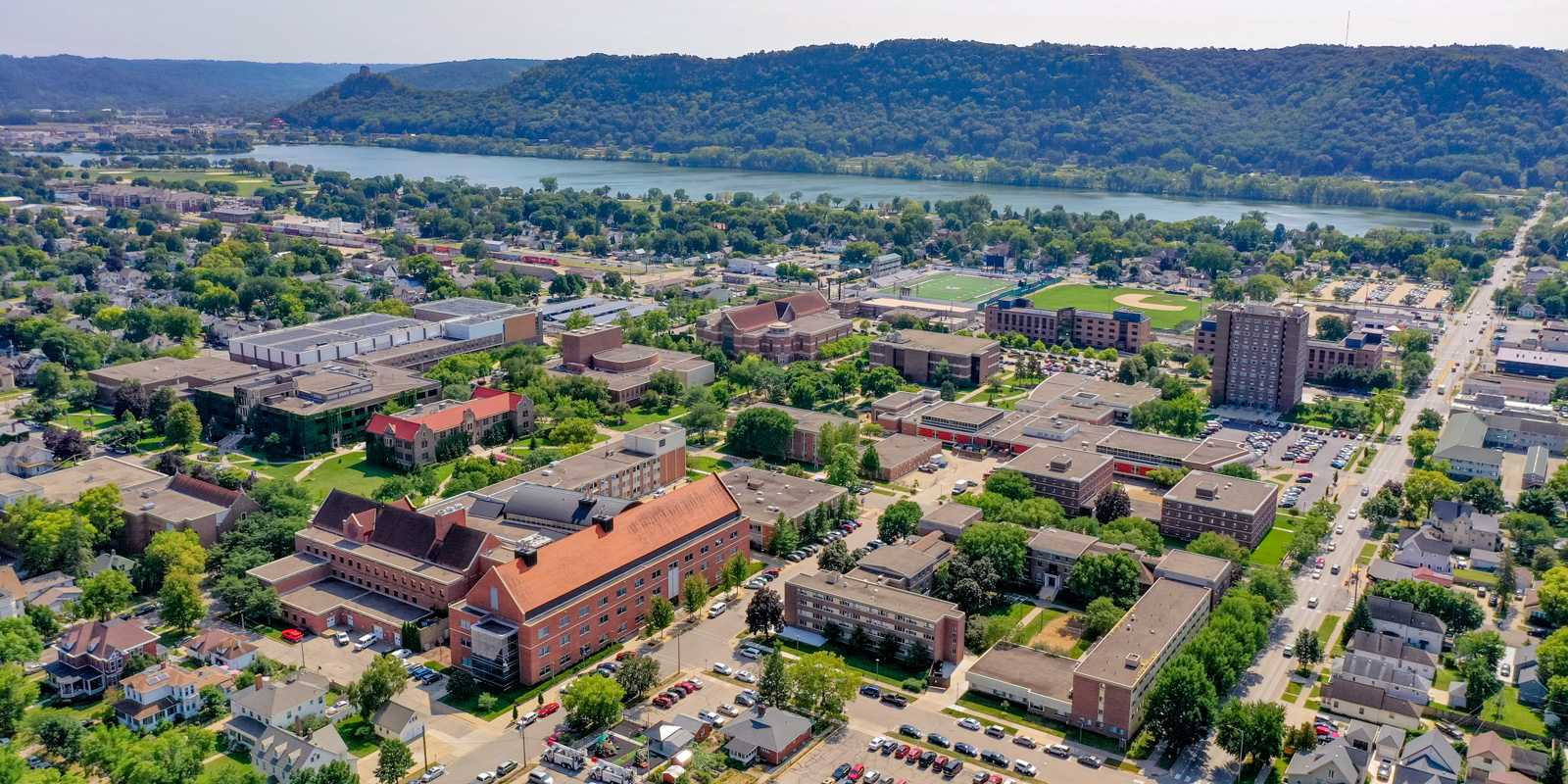
Winona State University is a public Minnesota institution that punches above its weight with a 97% post-graduation employment rate—the highest in the state system—and a nursing program so rigorous it’s nationally recognized. With a 68.5% acceptance rate and test-optional admissions, WSU attracts students who want affordability without sacrificing outcomes, all set against the backdrop of the Mississippi River bluffs and a campus where 30% of students live in university housing.
Admission requirements
Test-optional — scores considered if submitted
Required
High school transcript
Grade point average
College-prep program
TOEFL (non-native English)
Considered (not required)
Class rank
Test scores (SAT/ACT)
Source: IPEDS Admissions survey (2022) via Urban Institute. Covers formal factors only — it does not reflect essays, extracurriculars, or other holistic criteria.
More details
Undergrad enrollment
5,144
In-state tuition
$10,576
Out-of-state tuition
$17,308
Clubs & Orgs
140+
Campus Housing
30% of students
Application Fee
$20
NCLEX Pass Rate
81.7%
Most Popular Major
Nursing
Student-Faculty Ratio
Not stated in sources
Median Earnings (1 Year)
$36,427
Post-Grad Employment Rate
97%
Outcomes & value
Outcomes & value
Median earnings (10 yr)
$58,532
Value (earnings ÷ net price)
3.3×
Median debt at graduation
$21,500
Graduation rate
57%
First-year retention
79%
Reducing loan balance (3 yr)
75%
Pell (lower-income) share
24%
First-gen share (among federal-aid recipients)
21%
Top-earning majors
Median earnings by field of study (highest credential), ~2 years after completion.
Registered Nursing, Nursing Administration, Nursing Research and Clinical Nursing$65,101
Clinical/Medical Laboratory Science/Research and Allied Professions$64,791
Computer Science$63,335
Materials Engineering$63,217
Management Information Systems and Services$58,673
Finance and Financial Management Services
Campus & location
Campus safety
On-campus violent crimes (2024)
4
Per 1,000 students
0.68
On-campus criminal offenses classed as violent (murder/non-negligent manslaughter, rape, robbery, aggravated assault) for the most recent reported year. Source: U.S. Dept. of Education Campus Safety and Security (Clery Act). Counts reflect what’s reported to the school, and urban campuses often report more partly due to non-student incidents nearby — read alongside campus size and setting, not as a standalone safety verdict.
Climate
Pleasant days / yr
95
Summer high
80°F
Winter low
14°F
Annual rain
36.9"
Annual snow
41.9"
Natural-hazard risk
Relatively Low
Pleasant days counts days per year with a mean temperature of 55–75°F, a high at or below 90°F, a low at or above 45°F, and little precipitation — a transparent comfort measure, not a weighting we invented. Computed from Open-Meteo ERA5 daily history (2019–2023). Natural-hazard risk is the county’s composite rating from the FEMA National Risk Index.
Deep dive — research, future-scholar output & economic mobility▾
Research output
Institutional h-index
99
Scholarly works
2,580
Institutional research volume and impact from OpenAlex. The h-index reflects large research universities and will be low for teaching-focused liberal-arts colleges — not a measure of undergraduate quality.
Quick answers
What is the acceptance rate at Winona State University?
Winona State University's acceptance rate is approximately 75% (Winona, MN), based on the most recent figures we compiled from public and primary sources.
How much does Winona State University cost?
At Winona State University, the average net price (after aid) is about $17,503 per year. Actual cost varies with financial aid and residency.
How many undergraduates attend Winona State University?
Winona State University enrolls approximately 5,144 undergraduate students.
Where is Winona State University located?
Winona State University is located in Winona, MN.
Admissions
Winona State’s admissions process is accessible but not a rubber stamp, with a 68.5% ([7], [8]). The university is , guaranteeing admission to applicants with a 3.0+ high school GPA ([9]). Recent data shows 6,642 applicants, 5,014 acceptances, and 5,317 enrolled—a rate suggesting many admitted students choose WSU over competitors ([10]). Mid-50% ACT scores range from 19 to 25 ([8]), while SAT scores typically fall between 980-1250 ([11]). Notably, the $20 application fee is among the lowest in the region ([12]).
WSU offers 200+ programs across five colleges, with nursing standing out as the crown jewel—a major so demanding it’s frequently cited as one of the most rigorous in the region ([17]). Other popular majors include business administration and elementary education ([15]). Small class sizes are the norm, with a student-faculty ratio that fosters close mentorship ([16]). The university emphasizes practical skills, boasting a post-graduation—the best in the Minnesota State system ([14]). With 100+ bachelor’s degrees and 80+ minors, students can mix disciplines like academic bartenders ([13], [16]).
Earnings = median of students working ~10 years after entry; debt = median of graduates. Value divides 10-yr earnings by one year’s net price — read it as earnings per dollar of annual cost, not a full lifetime ROI; it favors lower-cost schools. Source: U.S. Dept. of Education College Scorecard. Figures lag ~2 years and reflect all students, not your intended major.
$51,392
Accounting and Related Services$49,136
Business Administration, Management and Operations$43,928
Source: U.S. Dept. of Education College Scorecard (field-of-study earnings). Figures cover graduates who received federal aid and lag ~2 years; not all programs report data.
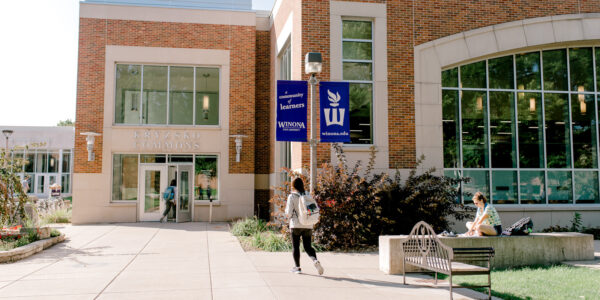
Life at WSU splits between riverfront hikes and campus hustle: 30% of students live in university housing, while 70% opt for off-campus apartments ([22]). The university fosters community through 140+ clubs, including academic groups, Greek life (7% of students join fraternities/sororities), and niche interests like faith-based and diversity organizations ([20], [23]). The Division of Student Life explicitly ties extracurriculars to learning outcomes, framing clubs as extensions of the classroom ([21]). Reviews highlight the balance between outdoor recreation (the bluffs are a student favorite) and campus events, though some note Winona’s small-town vibe isn’t for everyone ([24]).
WSU’s outcomes are its trump card: #1 in graduation rates among Minnesota State schools ([26]) and a 97% employment rate ([14]). Nursing graduates report a median salary of $58,532 a decade post-enrollment, though the NCLEX pass rate (81.7%) suggests the program’s rigor ([28]). Across all majors, median earnings one year post-graduation are $36,427, climbing steadily over time ([29]). The university touts these metrics in rankings, recently moving up in U.S. News’ top public universities list ([25]). Federal data shows WSU graduates out-earn both state and national averages for high school diploma holders ([27]).
WSU’s calculator estimates costs at $17,699 for federal loan recipients ([35]), with first-year students averaging $5,231 in institutional aid ([33]). The university automatically considers applicants for merit scholarships, and the $20 application fee is a fraction of many peers’ ([12], [32]). Public Minnesota pricing keeps tuition manageable, though out-of-state students face higher rates. The financial aid office emphasizes affordability, with tools like the Shopping Sheet to break down expenses ([30], [34]).
Winona State defies the 'just another regional public school' label with best-in-state employment rates and a nursing program that rivals private colleges. Its river-valley campus offers an outdoorsy alternative to urban Minnesota schools, while the 200+ programs—from business to education—deliver unusually strong ROI for the price. The 68.5% makes it accessible, but the 97% employment figure proves it’s no safety school. For students who want rigorous academics without cutthroat competition or Ivy League debt, WSU is a stealth powerhouse.
Winona State University logo · sourceWinona Campus | Winona State University · sourceWinona Campus | Winona State University · sourceVisit Winona State | Winona State University Admissions · source