Loading…
← All schools
American InterContinental University-Houston
Houston, TXprivate forprofitwww.aiuniv.edu/online-campus/campus-locations/houston
Avg net price
$20,249
Earnings (10 yr)
$36,144
Graduation rate
5%
Acceptance & SAT from Common Data Set / IPEDS; net price, earnings & graduation from the U.S. Dept. of Education College Scorecard. Figures lag ~1–2 years — verify with the school.
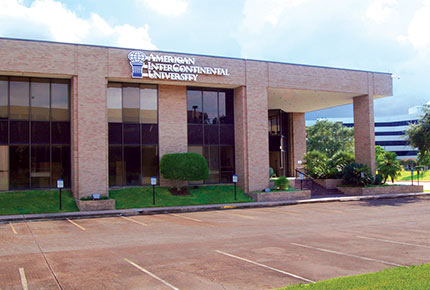
American InterContinental University-Houston is a for-profit, career-oriented institution that operates more like an open-access training ground than a traditional university. With an admissions policy that borders on non-selective, it serves a predominantly adult, working-class student body seeking practical credentials in fields like business, IT, and criminal justice. The campus is a functional hub in Houston, offering flexible schedules and a starkly pragmatic approach to higher education, where the primary focus is on degree completion for non-traditional students, albeit with graduation outcomes that are among the lowest in the nation.
More details
- Undergrad enrollment
- 94
- In-state tuition
- $14,829
- Out-of-state tuition
- $14,829
- Common App?
- Not indicated
- No-Loan Policy
- No
- Early Decision?
- Not indicated
- Graduation Rate
- 5%
- Meets Full Need
- No
- Demonstrated Interest
- Not considered (per general CDS guidance)
- Student-Faculty Ratio
- 15:1
- Median Earnings (10yr)
- $36,144
Outcomes & value
Outcomes & value
- Median earnings (10 yr)
- $36,144
- Value (earnings ÷ net price)
- 1.8×
- Median debt at graduation
- $31,000
- Graduation rate
- 5%
- First-year retention
- 25%
- Reducing loan balance (3 yr)
- 25%
- Pell (lower-income) share
- 69%
- First-gen share (among federal-aid recipients)
- 55%
Earnings = median of students working ~10 years after entry; debt = median of graduates. divides 10-yr earnings by net price — read it as earnings per dollar of annual cost, not a full lifetime ROI; it favors lower-cost schools. Source: U.S. Dept. of Education College Scorecard. Figures lag ~2 years and reflect all students, not your intended major.
Top-earning majors
Median earnings by field of study (highest credential), ~2 years after completion.
- Computer and Information Sciences, General$45,207
- Business Administration, Management and Operations$41,703
- Accounting and Related Services$38,289
- Health and Medical Administrative Services$33,993
- Criminal Justice and Corrections$32,711
Source: U.S. Dept. of Education College Scorecard (field-of-study earnings). Figures cover graduates who received federal aid and lag ~2 years; not all programs report data.
Compare on earnings:
Campus & location
Campus safety
- On-campus violent crimes (2024)
- 0
- Per 1,000 students
- 0.00
On-campus criminal offenses classed as violent (murder/non-negligent manslaughter, rape, robbery, aggravated assault) for the most recent reported year. Source: U.S. Dept. of Education Campus Safety and Security (Clery Act). Counts reflect what’s reported to the school, and urban campuses often report more partly due to non-student incidents nearby — read alongside campus size and setting, not as a standalone safety verdict.
Climate
- Pleasant days / yr
- 97
- Summer high
- 92°F
- Winter low
- 48°F
- Annual rain
- 69.3"
- Natural-hazard risk
- Very High
Pleasant days counts days per year with a mean temperature of 55–75°F, a high at or below 90°F, a low at or above 45°F, and little precipitation — a transparent comfort measure, not a weighting we invented. Computed from Open-Meteo ERA5 daily history (2019–2023). Natural-hazard risk is the county’s composite rating from the FEMA National Risk Index.
Quick answers
- How much does American InterContinental University-Houston cost?
- At American InterContinental University-Houston, the average net price (after aid) is about $20,249 per year. Actual cost varies with financial aid and residency.
- How many undergraduates attend American InterContinental University-Houston?
- American InterContinental University-Houston enrolls approximately 94 undergraduate students.
- Where is American InterContinental University-Houston located?
- American InterContinental University-Houston is located in Houston, TX.
Admissions
AIU-Houston's admissions process is defined by its near-universal acceptance policy, positioning it as an institution of open access rather than selective gatekeeping. Multiple sources report an at or near 100%—Niche and Sallie both cite a 100% rate, while Peterson's lists 94% and FindMyOrbit reports 92.44%—indicating that virtually all applicants who meet basic requirements are admitted. The university does not require SAT or ACT scores for admission, though they are considered if submitted; one source referencing AIU-Atlanta suggests a potential ACT range of 19-24 for admitted students, but this is not specific to the Houston campus. The process is streamlined for speed: after submitting an application, most students receive an admissions decision within 48 hours. This ultra-inclusive approach reflects the school's mission to serve working adults and career-changers seeking accessible entry into higher education, with no indication of an Early Decision program or consideration of demonstrated interest as a factor in admissions.
Compare American InterContinental University-Houston
vs Livingstone Collegevs Huston-Tillotson Universityvs Dillard Universityvs Johnson C Smith University
See colleges similar to American InterContinental University-Houston →Sources
- Common Data Set: Home
- Common Data Set 2024-2025
- Common Data Set Explorer 2026: Compare 100 Colleges
- Common Data Set 2024-25
- Common Data Set: Your Key to Smarter College Decisions
- Where to find Common Data Set (CDS) for college admission statistics
- American InterContinental University-Houston - Tuition and Acceptance ...
- American InterContinental University - Houston
- American InterContinental University-Houston - Sallie
- American InterContinental University-Houston Admissions - (2025-2026)