Admit rate has ranged 66%–76% over the last 5 years — notably volatile. Source: IPEDS via Urban Institute.
Acceptance & SAT from Common Data Set / IPEDS; net price, earnings & graduation from the U.S. Dept. of Education College Scorecard. Figures lag ~1–2 years — verify with the school.
Bryant University is a sharply focused, business-centric campus in Smithfield, Rhode Island, where the mission is unambiguous: to produce career-ready graduates with a practical, interdisciplinary edge. Its identity is built on a distinctive major-minor model, a famously proactive career center, and a tight-knit, residential community that feels more like a corporate training ground than a traditional liberal arts college. The results speak for themselves, with recent graduates commanding record-breaking starting salaries and near-universal employment success.
Admission requirements
Test-optional — scores considered if submitted
Required
High school transcript
Grade point average
Letters of recommendation
College-prep program
TOEFL (non-native English)
Considered (not required)
Class rank
Test scores (SAT/ACT)
Source: IPEDS Admissions survey (2022) via Urban Institute. Covers formal factors only — it does not reflect essays, extracurriculars, or other holistic criteria.
More details
Undergrad enrollment
3,194
In-state tuition
$52,677
Out-of-state tuition
$52,677
No-Loan Policy
No
Graduation Rate
80%
Meets Full Need
No
ED Share of Class
Not stated in sources
First-Year Retention
Not stated in sources
Demonstrated Interest
Not stated in sources
Median Earnings (10yr)
$90,008
Early Decision Advantage
Significant (~65% ED vs. ~45% RD)
Outcomes & value
Outcomes & value
Median earnings (10 yr)
$90,008
Value (earnings ÷ net price)
2.2×
Median debt at graduation
$26,849
Graduation rate
80%
First-year retention
87%
Reducing loan balance (3 yr)
87%
Pell (lower-income) share
13%
First-gen share (among federal-aid recipients)
16%
Financial health
3.0 / 3.0Meets the federal financial-responsibility standard
U.S. Dept. of Education Financial Responsibility Composite Score (FY2022-23). Scale −1.0 to 3.0; ≥1.5 meets the standard. Reported for private nonprofit & for-profit institutions only — public universities are state-backed and not scored, so this is a stability signal, not a ranking.
Top-earning majors
Median earnings by field of study (highest credential), ~2 years after completion.
Applied Mathematics$63,005
Computer and Information Sciences, General$61,516
Finance and Financial Management Services$60,821
Accounting and Related Services$57,995
International Business$57,995
Business Administration, Management and Operations
Campus & location
Campus safety
On-campus violent crimes (2024)
2
Per 1,000 students
0.55
On-campus criminal offenses classed as violent (murder/non-negligent manslaughter, rape, robbery, aggravated assault) for the most recent reported year. Source: U.S. Dept. of Education Campus Safety and Security (Clery Act). Counts reflect what’s reported to the school, and urban campuses often report more partly due to non-student incidents nearby — read alongside campus size and setting, not as a standalone safety verdict.
Climate
Pleasant days / yr
92
Summer high
81°F
Winter low
25°F
Annual rain
52.3"
Annual snow
31.9"
Natural-hazard risk
Relatively Moderate
Pleasant days counts days per year with a mean temperature of 55–75°F, a high at or below 90°F, a low at or above 45°F, and little precipitation — a transparent comfort measure, not a weighting we invented. Computed from Open-Meteo ERA5 daily history (2019–2023). Natural-hazard risk is the county’s composite rating from the FEMA National Risk Index.
Deep dive — research, future-scholar output & economic mobility▾
Research output
Institutional h-index
131
Scholarly works
2,517
Institutional research volume and impact from OpenAlex. The h-index reflects large research universities and will be low for teaching-focused liberal-arts colleges — not a measure of undergraduate quality.
Economic mobility
Mobility rate
1.6%
Bottom → top quintile
54%
From bottom quintile
3%
Mobility rate = the share of students who both start in the bottom household-income quintile and reach the top quintile; bottom → top is that chance conditional on starting at the bottom. Source: Opportunity Insights Mobility Report Cards (Chetty, Friedman, Saez, Turner & Yagan). Reflects 1980–82 birth cohorts, so it’s directional, not current.
Quick answers
What is the acceptance rate at Bryant University?
Bryant University's acceptance rate is approximately 65% (Smithfield, RI), based on the most recent figures we compiled from public and primary sources.
What SAT score do you need for Bryant University?
Admitted students at Bryant University typically score 1190–1330 on the SAT (the middle-50% range). Scores outside this band are still admitted, especially with strong applications.
How much does Bryant University cost?
At Bryant University, the average net price (after aid) is about $41,219 per year. Actual cost varies with financial aid and residency.
How many undergraduates attend Bryant University?
Bryant University enrolls approximately 3,194 undergraduate students.
Where is Bryant University located?
Bryant University is located in Smithfield, RI.
Admissions
Bryant's admissions process is moderately selective, with a clear strategic advantage for those who apply early. The university reports that about 65% of Early Decision applicants are admitted, compared to roughly 45% for Regular Decision, indicating a significant boost for committed candidates. The admitted student profile is solidly above average, with an average GPA of 3.60 and an average SAT score of 1260 (or ACT of 27.0), placing most students in the top 25% of their high school class. The overall is 65%, drawn from a pool of approximately 9,800 applicants. The rate—the percentage of admitted students who enroll—is reported at 17.1%. While the is a standard source for factors like demonstrated interest, the provided sources do not specify Bryant's official stance on it. The Regular Decision deadline is February 1, though some sources also list February 15.
Early Decision Advantage: Applying ED significantly increases admission chances (~65% vs. ~45% RD).
Academic Profile: Admitted students typically have a 3.6 GPA and SAT scores around 1260.
Application Volume: Draws nearly 10,000 applicants annually.
Earnings = median of students working ~10 years after entry; debt = median of graduates. Value divides 10-yr earnings by one year’s net price — read it as earnings per dollar of annual cost, not a full lifetime ROI; it favors lower-cost schools. Source: U.S. Dept. of Education College Scorecard. Figures lag ~2 years and reflect all students, not your intended major.
$54,470
Marketing$53,358
Human Resources Management and Services$51,612
Source: U.S. Dept. of Education College Scorecard (field-of-study earnings). Figures cover graduates who received federal aid and lag ~2 years; not all programs report data.
Bryant’s academic philosophy is intensely pragmatic, built around a unique and required major-minor combination designed to fuse business acumen with broader perspective. Students choose from over 250 major/minor combinations, ensuring nearly every graduate leaves with a blended skill set—think Accounting paired with Data Science, or Marketing with Communication. This interdisciplinary approach is the school's calling card. Unsurprisingly, the student body is heavily concentrated in business fields, with 77% of degrees awarded in Business, Management, Marketing, and Related Support Services. The remaining majors span Social Sciences (6%), Mathematics and Statistics (5%), and Communication, Journalism, and Related Programs. The career-focused ethos is reinforced by what students consistently praise as an "amazing career center," a cornerstone of the Bryant experience that provides extensive support. The university has also been recognized by U.S. News & World Report as an A+ school for undergraduate students.
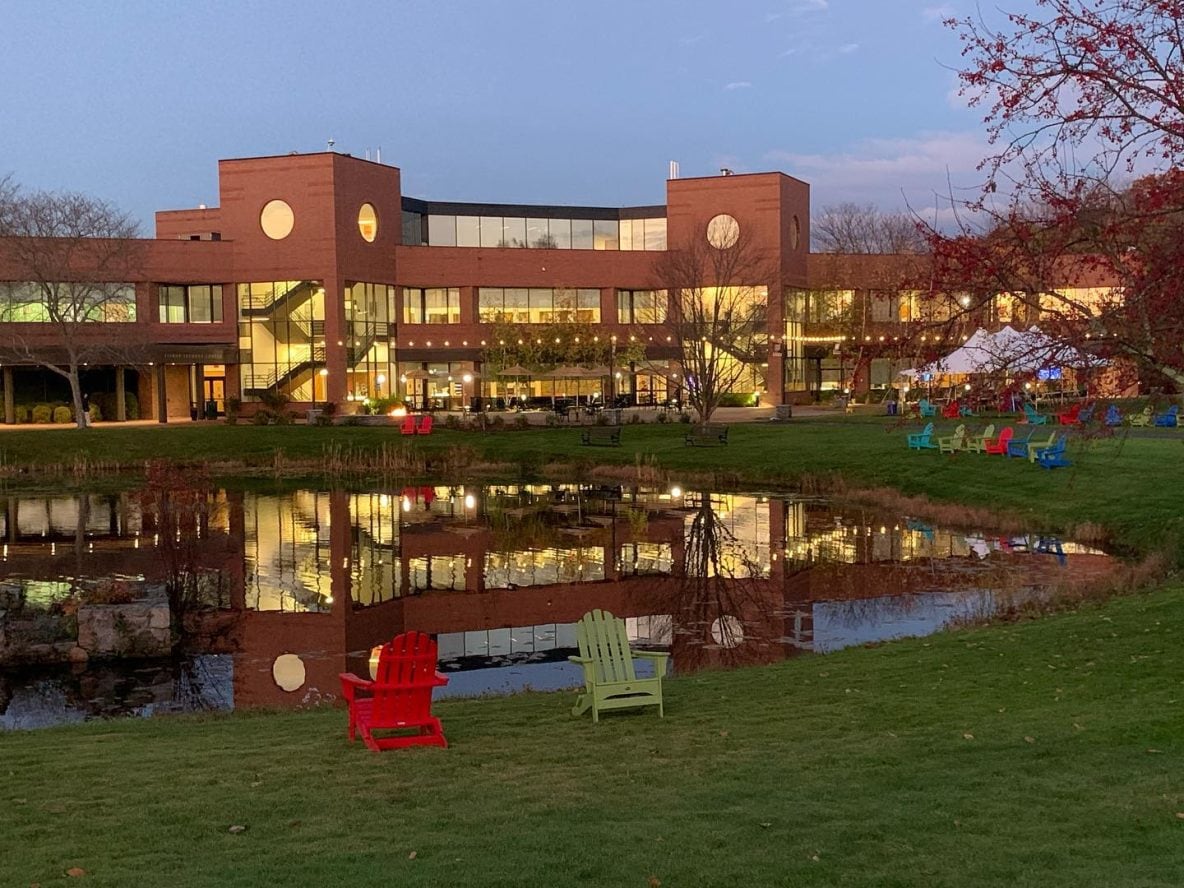
Life at Bryant is defined by a close-knit, predominantly residential community on a manageable campus where everything is within walking distance. The university is committed to fostering a "safe, respectful, and supportive" environment that emphasizes belonging and wellbeing. This vision is articulated in its strategic plan, which aims to build a "vibrant campus where Bryant students live, learn, and thrive." The residential experience is central, with 85% of students living in college-owned, -operated, or -affiliated housing, creating a self-contained, immersive environment. The campus is described as not too large, facilitating easy connections and a shared sense of purpose among students who are similarly driven. This combination of focused academics and integrated living fuels the university's promise of "your best four years."
Bryant’s ROI-focused education delivers strikingly strong results, particularly in immediate employment and starting salaries. For the Class of 2025, a remarkable 98% of graduates were employed or in graduate school within six months of commencement. Their median starting salary hit a university record of $77,000. These figures represent a significant jump, with the median salary increasing by 5% from the previous year. The university also reports a 94% employment rate within three months of graduation for recent classes. The four-year graduation rate is robust, and the median salary for graduates ten years after entry is a solid $90,008. These outcomes validate the institution's heavy investment in career preparation and its major-minor academic model.
Bryant is a private institution with a significant tuition price, but it offers financial aid to a majority of students. The average after aid—the average cost to families after grants and scholarships are applied—is $41,219. Other sources estimate this figure slightly higher, at around $44,873. Just over half of students (51.13%) receive financial aid, with an average aid package of $34,210. The university provides tools like a Net Price Calculator to help families estimate costs. It's important to note that Bryant's official catalog states that while the university recognizes the needs of all applicants, "it is not often possible to award aid to meet full need." This indicates that Bryant does not have a policy of meeting 100% of demonstrated financial need for all admitted students, and the provided sources do not indicate a no-loan policy for lower-income families. Financial aid packages typically include a mix of scholarships, grants, loans, and work-study opportunities.
Bryant University carves out a distinctive niche by refusing to be a generic business school. Its singular identity is built on the mandatory major-minor structure, a pedagogical gamble that forces every student—even the most finance-obsessed—to develop a complementary intellectual lens. This isn't just academic window-dressing; it's the engine behind the graduates who secure record-breaking salaries in a competitive job market. The environment is equally purposeful: a high-density residential campus that functions like a 24/7 professional incubator, backed by a career center so effective it becomes part of the student vernacular. The result is an institution with the clarity of a specialty school but the community of a traditional college, producing graduates who are not just employable, but immediately impactful. For a student certain about a business-oriented path and eager to see a direct line from classroom to career, Bryant offers a focused, high-return alternative to the sprawling university experience.
Bryant University seal · sourceBryant University | Smithfield, RI 02917 · sourceBryant University | College of Distinction · sourceCome see our beautiful campus for yourself! Tours are available Monday-Friday and select Saturdays throughout the summer. Link in bio to register☀️ · source