Admit rate has ranged 64%–69% over the last 5 years. Source: IPEDS via Urban Institute.
Acceptance & SAT from Common Data Set / IPEDS; net price, earnings & graduation from the U.S. Dept. of Education College Scorecard. Figures lag ~1–2 years — verify with the school.
Drake University is a private, mid-sized institution in Des Moines that punches well above its weight, blending a classic liberal arts core with powerhouse professional programs in journalism, business, and law. Its identity is defined by a pragmatic, hands-on ethos—students here are 'doers' who leverage the university's deep connections in Iowa's capital city for internships and careers from day one. With a student-to-faculty ratio of 11:1 and a campus where nearly two-thirds of students live on-site, Drake offers a tight-knit, residential experience within a surprisingly vibrant urban setting.
Admission requirements
Test-optional — scores considered if submitted
Required
High school transcript
Grade point average
TOEFL (non-native English)
Considered (not required)
Letters of recommendation
Test scores (SAT/ACT)
College-prep program
Demonstrated competencies
Source: IPEDS Admissions survey (2022) via Urban Institute. Covers formal factors only — it does not reflect essays, extracurriculars, or other holistic criteria.
More details
Undergrad enrollment
2,543
In-state tuition
$52,130
Out-of-state tuition
$52,130
Graduation Rate
74%
Early Action Plan
Rolling decisions Oct 1-Jan 15
Guaranteed Scholarship
Presidential Scholarship covers 45-66% of tuition
Median Earnings (10yr)
$71,901
Student-to-Faculty Ratio
11:1
First-Year Retention Rate
84%
Outcomes & value
Outcomes & value
Median earnings (10 yr)
$71,901
Value (earnings ÷ net price)
2.5×
Median debt at graduation
$23,000
Graduation rate
74%
First-year retention
84%
Reducing loan balance (3 yr)
84%
Pell (lower-income) share
22%
First-gen share (among federal-aid recipients)
15%
Financial health
2.8 / 3.0Meets the federal financial-responsibility standard
U.S. Dept. of Education Financial Responsibility Composite Score (FY2022-23). Scale −1.0 to 3.0; ≥1.5 meets the standard. Reported for private nonprofit & for-profit institutions only — public universities are state-backed and not scored, so this is a stability signal, not a ranking.
Top-earning majors
Median earnings by field of study (highest credential), ~2 years after completion.
Management Sciences and Quantitative Methods$78,971
Mathematics$65,238
Management Information Systems and Services$64,990
Computer and Information Sciences, General$62,409
Accounting and Related Services$59,485
Finance and Financial Management Services
Campus & location
Campus safety
On-campus violent crimes (2024)
2
Per 1,000 students
0.46
On-campus criminal offenses classed as violent (murder/non-negligent manslaughter, rape, robbery, aggravated assault) for the most recent reported year. Source: U.S. Dept. of Education Campus Safety and Security (Clery Act). Counts reflect what’s reported to the school, and urban campuses often report more partly due to non-student incidents nearby — read alongside campus size and setting, not as a standalone safety verdict.
Climate
Pleasant days / yr
83
Summer high
84°F
Winter low
17°F
Annual rain
34.6"
Annual snow
24.8"
Natural-hazard risk
Relatively Moderate
Pleasant days counts days per year with a mean temperature of 55–75°F, a high at or below 90°F, a low at or above 45°F, and little precipitation — a transparent comfort measure, not a weighting we invented. Computed from Open-Meteo ERA5 daily history (2019–2023). Natural-hazard risk is the county’s composite rating from the FEMA National Risk Index.
Deep dive — research, future-scholar output & economic mobility▾
Research output
Institutional h-index
150
Scholarly works
5,822
Institutional research volume and impact from OpenAlex. The h-index reflects large research universities and will be low for teaching-focused liberal-arts colleges — not a measure of undergraduate quality.
Economic mobility
Mobility rate
1.7%
Bottom → top quintile
48%
From bottom quintile
4%
Mobility rate = the share of students who both start in the bottom household-income quintile and reach the top quintile; bottom → top is that chance conditional on starting at the bottom. Source: Opportunity Insights Mobility Report Cards (Chetty, Friedman, Saez, Turner & Yagan). Reflects 1980–82 birth cohorts, so it’s directional, not current.
Quick answers
What is the acceptance rate at Drake University?
Drake University's acceptance rate is approximately 64% (Des Moines, IA), based on the most recent figures we compiled from public and primary sources.
What SAT score do you need for Drake University?
Admitted students at Drake University typically score 1110–1350 on the SAT (the middle-50% range). Scores outside this band are still admitted, especially with strong applications.
How much does Drake University cost?
At Drake University, the average net price (after aid) is about $29,127 per year. Actual cost varies with financial aid and residency.
How many undergraduates attend Drake University?
Drake University enrolls approximately 2,543 undergraduate students.
Where is Drake University located?
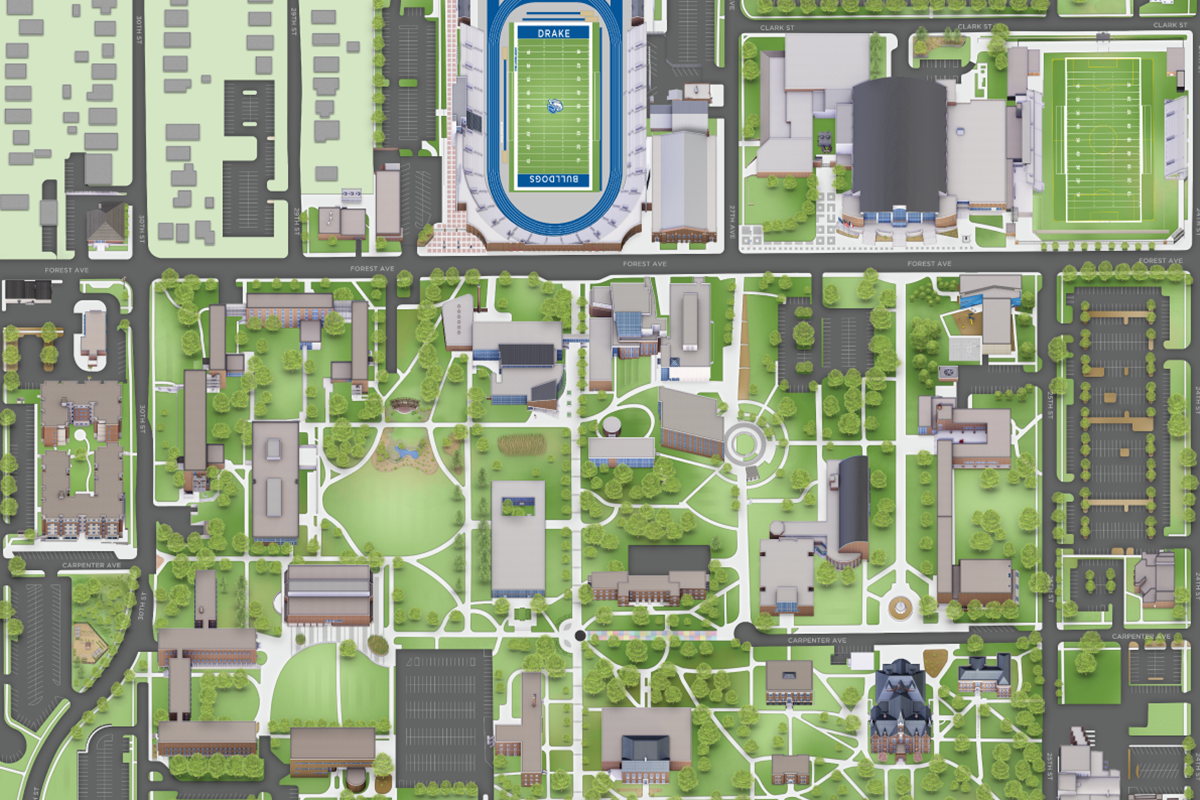
Drake University is located in Des Moines, IA.
Admissions
Drake's admissions process is moderately selective, with a focus on a student's overall academic profile rather than gatekeeping via ultra-low . The university reviews applications on a rolling basis for early action students between October 1 and January 15. The admitted student profile shows solid academic preparation: the median high school GPA is 3.69, and the middle 50% SAT range is 1120–1370 (with a median of 1260), while the ACT mid-range is 24–31 (median 27). While the is the definitive source for detailed policy factors like the importance of demonstrated interest, Drake's public-facing materials emphasize a .
Key Application Notes:
Early Action: Drake offers a non-binding Early Action plan with decisions released on a rolling basis.
Rolling Review: For Early Action applicants, decisions are communicated continuously between October 1 and January 15.
Earnings = median of students working ~10 years after entry; debt = median of graduates. Value divides 10-yr earnings by one year’s net price — read it as earnings per dollar of annual cost, not a full lifetime ROI; it favors lower-cost schools. Source: U.S. Dept. of Education College Scorecard. Figures lag ~2 years and reflect all students, not your intended major.
$57,705
International Business$55,964
Marketing$50,439
Source: U.S. Dept. of Education College Scorecard (field-of-study earnings). Figures cover graduates who received federal aid and lag ~2 years; not all programs report data.
Drake's academic offering is a deliberate hybrid: the intimacy and rigor of a liberal arts college fused with pre-professional programs that have strong regional and national reputations. With over 150 programs of study and a student-to-faculty ratio of 11:1, the classroom experience is characterized by accessibility and engagement. Popular majors span a wide spectrum, reflecting the university's dual identity. Social Sciences, Visual and Performing Arts, Biological and Biomedical Sciences, and Multi/Interdisciplinary Studies are among the top areas of study. However, Drake is particularly known for its strength in specific professional fields; theater, actuarial science, and journalism are repeatedly cited as standout, well-regarded programs. This isn't an institution where students are siloed; the blend ensures that a journalism major gets a broad education, while a philosophy student gains practical insight.
The graduation rate is a point of institutional pride, signaling that students who enroll are well-supported through to completion. The 4-year graduation rate is 68%, with the 6-year rate at 77%.
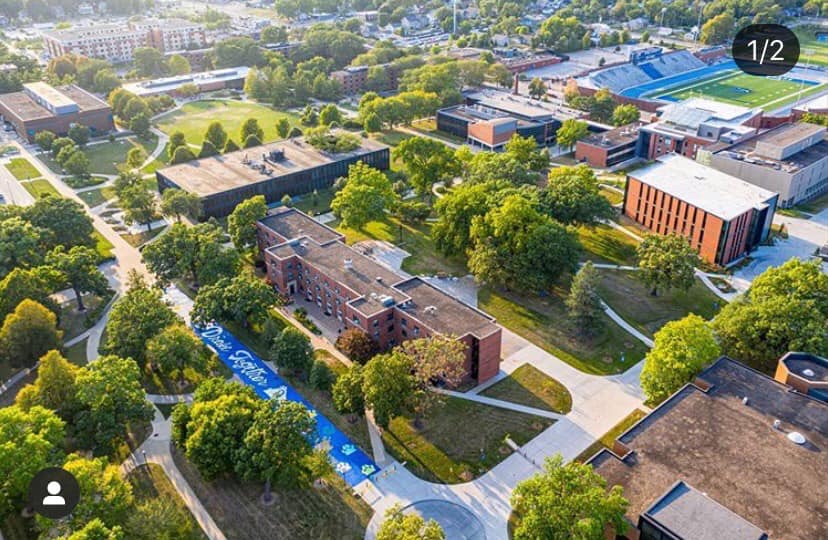
Life at Drake is active, communal, and deeply connected to its Des Moines setting. The campus is residential at its core, with 62% of students living in college-owned, -operated, or -affiliated housing, creating a cohesive on-campus vibe. The university promotes a 'close-knit community' atmosphere, supported by hundreds of clubs and organizations and NCAA Division I athletics (the Bulldogs compete in the Missouri Valley Conference). The Greek life system is a visible part of the social landscape. However, what truly defines the Drake experience is the seamless integration with Iowa's capital city. Des Moines isn't just a backdrop; it's a central part of the curriculum and the college experience, offering internships, cultural events, restaurants, and professional networking opportunities that are literally steps away from campus. This urban setting provides a tangible, career-oriented edge that few small private universities can match. Students are described by the university itself as 'doers' and 'dreamers' who challenge assumptions—a ethos that plays out in both campus activism and practical, city-based projects.
Drake's value proposition is crystallized in its outcomes, which consistently rank highly in the Midwest. The Wall Street Journal ranked Drake the #1 private school in Iowa for the third consecutive year, based in part on a 'Value Added Graduate Salary Score' of $48,308—a metric that attempts to measure the boost a Drake degree provides above expectations. The university reports a remarkable 95.2% 'accomplishment rate' for its graduates, encompassing employment, graduate school, and other meaningful pursuits. Financially, the median earnings for recent graduates are reported at $51,837, with 88% earning more than a typical high school graduate. The strong graduation rate (77% within six years) is a leading indicator of institutional support, and the first-year retention rate of 84% suggests students are satisfied and engaged early on. These numbers paint a picture of an institution that effectively prepares students for tangible, successful next steps, leveraging its Des Moines connections and respected professional programs.
Drake's stated full-time tuition is significant, but the university aggressively uses institutional aid to make attendance feasible for a broad range of students. The key mechanism is the guaranteed Presidential Scholarship, which covers 45-66% of tuition costs for all full-time undergraduate students who qualify. This brings the net tuition range to approximately $17,988–$25,988 per year. The university states that nearly all Drake students receive some form of financial assistance, combining merit and . The average financial aid package is reported as $40,774, with 59.29% of students receiving financial aid. The resulting —the average cost after aid and scholarships—is a critical figure for families. Sources report varying net prices, but the College Scorecard lists an average annual cost of $29,127. Drake provides a Net Price Calculator to offer personalized estimates, emphasizing that the sticker price is far from the norm for most attendees.
Drake University carves out a distinctive niche by refusing to be just one type of school. It's not solely a liberal arts college, nor is it a sprawling research university. Instead, it successfully merges the personalized attention and broad intellectual foundation of the former with the practical, career-oriented focus of the latter. This synthesis is powered by its unique location: being embedded in Des Moines, a mid-sized capital city with a thriving business, government, and cultural scene, provides unparalleled access to internships and professional networks. This 'classroom without walls' is central to the Drake identity.
Its standout programs—like journalism, actuarial science, and theater—aren't just strong departments; they are feeders into regional and national industries. The 11:1 student-to-faculty ratio ensures these opportunities are accessible, not competitive curiosities. Furthermore, Drake's financial model, built around guaranteed presidential scholarships, demonstrates a commitment to accessibility that belies its private school sticker price. The result is a university that produces pragmatic, engaged graduates, as evidenced by its top-ranked outcomes in Iowa and high post-graduate accomplishment rates. Drake is for the student who wants the close community and professor access of a small college but isn't willing to sacrifice real-world immersion and professional head starts.
Drake University seal · sourceMaps & Directions | Drake University · sourceDrake University - Profile, Rankings and Data | US News Best Colleges · sourceGetting to Know Drake University (IA) - Educated Quest · source