Loading…
← All schools
Eastern Connecticut State University
Willimantic, CTpubliceasternct.edu
Acceptance
83%
SAT 25–75
1070–1260
Avg net price
$21,067
Earnings (10 yr)
$56,469
Graduation rate
58%
Admit rate has ranged 64%–81% over the last 5 years — notably volatile, though the latest figure above (83%) falls outside that window. Source: IPEDS via Urban Institute.
Acceptance & SAT from Common Data Set / IPEDS; net price, earnings & graduation from the U.S. Dept. of Education College Scorecard. Figures lag ~1–2 years — verify with the school.
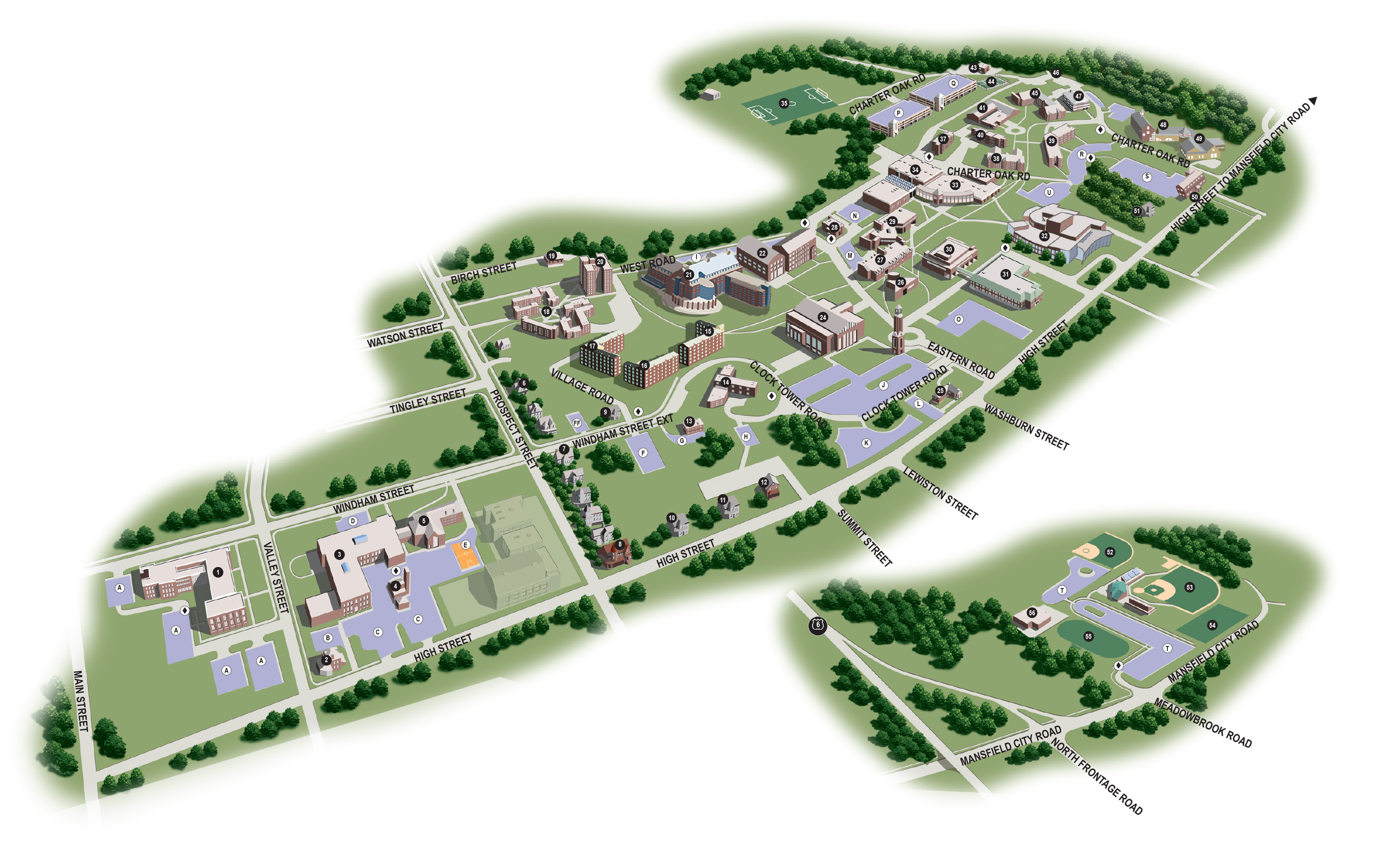
Eastern Connecticut State University is Connecticut's public liberal arts university, a designation that shapes its entire identity. It offers a surprisingly intimate, residential undergraduate experience within the state system, with a focus on developing strong communication and problem-solving skills rather than just professional training. While its admissions are accessible, the campus vibe is active and engaged, anchored by a strong first-year residential requirement and a sprawling list of student clubs.
Admission requirements
Test-optional — scores considered if submitted
Required
- High school transcript
- Grade point average
- Class rank
- Letters of recommendation
- TOEFL (non-native English)
Considered (not required)
- Test scores (SAT/ACT)
Source: IPEDS Admissions survey (2022) via Urban Institute. Covers formal factors only — it does not reflect essays, extracurriculars, or other holistic criteria.
More details
- Undergrad enrollment
- 3,418
- In-state tuition
- $13,928
- Out-of-state tuition
- $17,428
- No-Loan Policy
- No
- Graduation Rate
- 58%
- Meets Full Need
- No
- ED Share of Class
- Not stated in sources
- First-Year Retention
- Not stated in sources
- Demonstrated Interest
- Not considered
- Student-Faculty Ratio
- Not stated in sources
- Median Earnings (10yr)
- $56,469
- First-Year Live On-Campus
- 90%
Outcomes & value
Outcomes & value
- Median earnings (10 yr)
- $56,469
- Value (earnings ÷ net price)
- 2.7×
- Median debt at graduation
- $24,250
- Graduation rate
- 58%
- First-year retention
- 84%
- Reducing loan balance (3 yr)
- 70%
- Pell (lower-income) share
- 29%
- First-gen share (among federal-aid recipients)
- 34%
Top-earning majors
Median earnings by field of study (highest credential), ~2 years after completion.
- Computer and Information Sciences, General$58,479
- Information Science/Studies$53,984
- Finance and Financial Management Services$52,941
- Accounting and Related Services$48,823
- Business/Commerce, General$44,305
- Geological and Earth Sciences/Geosciences
Campus & location
Campus safety
- On-campus violent crimes (2024)
- 2
- Per 1,000 students
- 0.56
On-campus criminal offenses classed as violent (murder/non-negligent manslaughter, rape, robbery, aggravated assault) for the most recent reported year. Source: U.S. Dept. of Education Campus Safety and Security (Clery Act). Counts reflect what’s reported to the school, and urban campuses often report more partly due to non-student incidents nearby — read alongside campus size and setting, not as a standalone safety verdict.
Climate
- Pleasant days / yr
- 89
- Summer high
- 81°F
- Winter low
- 25°F
- Annual rain
- 54.3"
- Annual snow
- 27.4"
Pleasant days counts days per year with a mean temperature of 55–75°F, a high at or below 90°F, a low at or above 45°F, and little precipitation — a transparent comfort measure, not a weighting we invented. Computed from Open-Meteo ERA5 daily history (2019–2023).
Deep dive — research, future-scholar output & economic mobility
Research output
- Institutional h-index
- 80
- Scholarly works
- 2,117
Institutional research volume and impact from OpenAlex. The h-index reflects large research universities and will be low for teaching-focused liberal-arts colleges — not a measure of undergraduate quality.
Economic mobility
- Mobility rate
- 0.9%
- Bottom → top quintile
- 20%
- From bottom quintile
- 4%
Mobility rate = the share of students who both start in the bottom household-income quintile and reach the top quintile; bottom → top is that chance conditional on starting at the bottom. Source: Opportunity Insights Mobility Report Cards (Chetty, Friedman, Saez, Turner & Yagan). Reflects 1980–82 birth cohorts, so it’s directional, not current.
Quick answers
- What is the acceptance rate at Eastern Connecticut State University?
- Eastern Connecticut State University's acceptance rate is approximately 83% (Willimantic, CT), based on the most recent figures we compiled from public and primary sources.
- What SAT score do you need for Eastern Connecticut State University?
- Admitted students at Eastern Connecticut State University typically score 1070–1260 on the SAT (the middle-50% range). Scores outside this band are still admitted, especially with strong applications.
- How much does Eastern Connecticut State University cost?
- At Eastern Connecticut State University, the average net price (after aid) is about $21,067 per year. Actual cost varies with financial aid and residency.
- How many undergraduates attend Eastern Connecticut State University?
- Eastern Connecticut State University enrolls approximately 3,418 undergraduate students.
- Where is Eastern Connecticut State University located?
- Eastern Connecticut State University is located in Willimantic, CT.
Admissions
Eastern's admissions process is straightforward and accessible, prioritizing a over cutthroat selectivity. The university encourages any student with a GPA of 2.5 or higher to apply, though it also considers applicants below that threshold. The process is test-flexible; while submitting SAT or ACT scores is an option, the admissions committee places significant weight on academic GPA, standardized test scores (if submitted), and the application essay. According to its , other factors like class rank, recommendations, extracurricular activities, and character are also considered. Notably, demonstrated interest is not considered in admissions decisions, meaning campus visits or contact with admissions officers won't give an applicant a formal edge. The university does not appear to offer a binding Early Decision program, focusing instead on a regular decision timeline where most applicants receive a decision within two to three weeks.
Academics
True to its public liberal arts mission, Eastern's academic structure is built on a broad foundation designed to cultivate versatile thinkers. The curriculum emphasizes writing across all disciplines, with 100% of students completing writing-intensive courses in their majors. First-year experiences are common (65% of students participate), and service-learning opportunities are integrated into many programs. The university offers a manageable but comprehensive menu of , ranging from traditional liberal arts fields like History and Theatre to professional tracks in Accounting, Nursing, and Applied Data Science. Reviews consistently highlight particularly strong offerings in Education, Social Sciences, Psychology, and Nursing. Graduate programs are limited but focused, including Accounting, Applied Data Science, Education, and Management. The academic philosophy is explicitly about equipping students with 'critical thinking, quantitative reasoning, ethics, communication skills and creativity' for long-term success, not just immediate job placement.
Compare Eastern Connecticut State University
vs CUNY Graduate School and University Centervs Bowie State Universityvs SUNY Brockportvs SUNY at Purchase College
See colleges similar to Eastern Connecticut State University →Sources
- Common Data Set - Eastern Connecticut State University
- Common Data Set - Central Connecticut State University
- Common Data Set - Western Connecticut State University
- [PDF] 2023-24 Data Collection System
- Eastern Connecticut State University - IPEDS
- [PDF] Common Data Set 2024-2025 - Eastern University
- Eastern Connecticut State University Admissions - BigFuture
- Eastern Connecticut State University Admissions
- Eastern Connecticut State University SAT Scores and GPA