Admit rate has ranged 80%–88% over the last 5 years — notably volatile, though the latest figure above (78%) falls outside that window. Source: IPEDS via Urban Institute.
Acceptance & SAT from Common Data Set / IPEDS; net price, earnings & graduation from the U.S. Dept. of Education College Scorecard. Figures lag ~1–2 years — verify with the school.
Georgia College & State University is Georgia's designated public liberal arts university, blending the intimate mentorship of a small college with the resources of a state system. With an acceptance rate hovering around 78%, GCSU attracts students drawn to its strong liberal arts core, hands-on learning ethos, and Greek-heavy social scene in historic Milledgeville. Graduates boast higher-than-average earning potential among Georgia public universities, with median incomes nearing $51,360.
Admission requirements
Test scores required
Required
High school transcript
Grade point average
Test scores (SAT/ACT)
College-prep program
TOEFL (non-native English)
Considered (not required)
Class rank
Letters of recommendation
Source: IPEDS Admissions survey (2022) via Urban Institute. Covers formal factors only — it does not reflect essays, extracurriculars, or other holistic criteria.
More details
Undergrad enrollment
5,947
In-state tuition
$9,186
Out-of-state tuition
$29,512
Student-Faculty Ratio
19:1
4-Year Graduation Rate
50%
Median Alumni Earnings
$51,360
Students Receiving Aid
80%+
Greek Life Participation
Significant (per Niche)
Outcomes & value
Outcomes & value
Median earnings (10 yr)
$58,140
Value (earnings ÷ net price)
2.8×
Median debt at graduation
$22,250
Graduation rate
64%
First-year retention
82%
Reducing loan balance (3 yr)
71%
Pell (lower-income) share
18%
First-gen share (among federal-aid recipients)
20%
Top-earning majors
Median earnings by field of study (highest credential), ~2 years after completion.
Computer/Information Technology Administration and Management$62,012
Registered Nursing, Nursing Administration, Nursing Research and Clinical Nursing$61,096
Computer Science$57,318
Business/Managerial Economics$44,468
Accounting and Related Services$44,170
Business Administration, Management and Operations
Campus & location
Campus safety
On-campus violent crimes (2024)
0
Per 1,000 students
0.00
On-campus criminal offenses classed as violent (murder/non-negligent manslaughter, rape, robbery, aggravated assault) for the most recent reported year. Source: U.S. Dept. of Education Campus Safety and Security (Clery Act). Counts reflect what’s reported to the school, and urban campuses often report more partly due to non-student incidents nearby — read alongside campus size and setting, not as a standalone safety verdict.
Climate
Pleasant days / yr
109
Summer high
91°F
Winter low
42°F
Annual rain
44.7"
Natural-hazard risk
Relatively Low
Pleasant days counts days per year with a mean temperature of 55–75°F, a high at or below 90°F, a low at or above 45°F, and little precipitation — a transparent comfort measure, not a weighting we invented. Computed from Open-Meteo ERA5 daily history (2019–2023). Natural-hazard risk is the county’s composite rating from the FEMA National Risk Index.
Deep dive — research, future-scholar output & economic mobility▾
Research output
Institutional h-index
143
Scholarly works
7,124
Institutional research volume and impact from OpenAlex. The h-index reflects large research universities and will be low for teaching-focused liberal-arts colleges — not a measure of undergraduate quality.
Economic mobility
Mobility rate
1.1%
Bottom → top quintile
19%
From bottom quintile
6%
Mobility rate = the share of students who both start in the bottom household-income quintile and reach the top quintile; bottom → top is that chance conditional on starting at the bottom. Source: Opportunity Insights Mobility Report Cards (Chetty, Friedman, Saez, Turner & Yagan). Reflects 1980–82 birth cohorts, so it’s directional, not current.
Quick answers
What is the acceptance rate at Georgia College & State University?
Georgia College & State University's acceptance rate is approximately 78% (Milledgeville, GA), based on the most recent figures we compiled from public and primary sources.
What SAT score do you need for Georgia College & State University?
Admitted students at Georgia College & State University typically score 1070–1230 on the SAT (the middle-50% range). Scores outside this band are still admitted, especially with strong applications.
How much does Georgia College & State University cost?
At Georgia College & State University, the average net price (after aid) is about $20,686 per year. Actual cost varies with financial aid and residency.
How many undergraduates attend Georgia College & State University?
Georgia College & State University enrolls approximately 5,947 undergraduate students.
Where is Georgia College & State University located?
Georgia College & State University is located in Milledgeville, GA.
Admissions
GCSU maintains a moderately selective admissions process with a 78% ([9], [7]), though early applicants enjoy an 81.3% acceptance rate ([9]). The middle 50% of admitted students score between 1080-1220 on the SAT (EBRW + Math) or 22-26 on the ACT ([7], [8]). Notably, 38% of enrollees have GPAs of 3.75+ ([7]), and the university remains through at least Fall 2026 ([11]). Applications are due April 1 for regular decision ([7]).
As Georgia's public liberal arts flagship, GCSU offers 40+ majors ([13], [15]) with particular strength in Journalism (6% of degrees), Biology (6%), Accounting (5%), and Exercise Science (5%) ([14]). The faculty is heavily credentialed—80% hold PhDs from top universities ([13])—and the Princeton Review praises its 'total liberal arts college experience' ([17]). The curriculum emphasizes hands-on learning and undergraduate mentorship across disciplines from business to health sciences ([15]).
Earnings = median of students working ~10 years after entry; debt = median of graduates. Value divides 10-yr earnings by one year’s net price — read it as earnings per dollar of annual cost, not a full lifetime ROI; it favors lower-cost schools. Source: U.S. Dept. of Education College Scorecard. Figures lag ~2 years and reflect all students, not your intended major.
$43,658
Marketing$40,945
Special Education and Teaching$40,140
Source: U.S. Dept. of Education College Scorecard (field-of-study earnings). Figures cover graduates who received federal aid and lag ~2 years; not all programs report data.
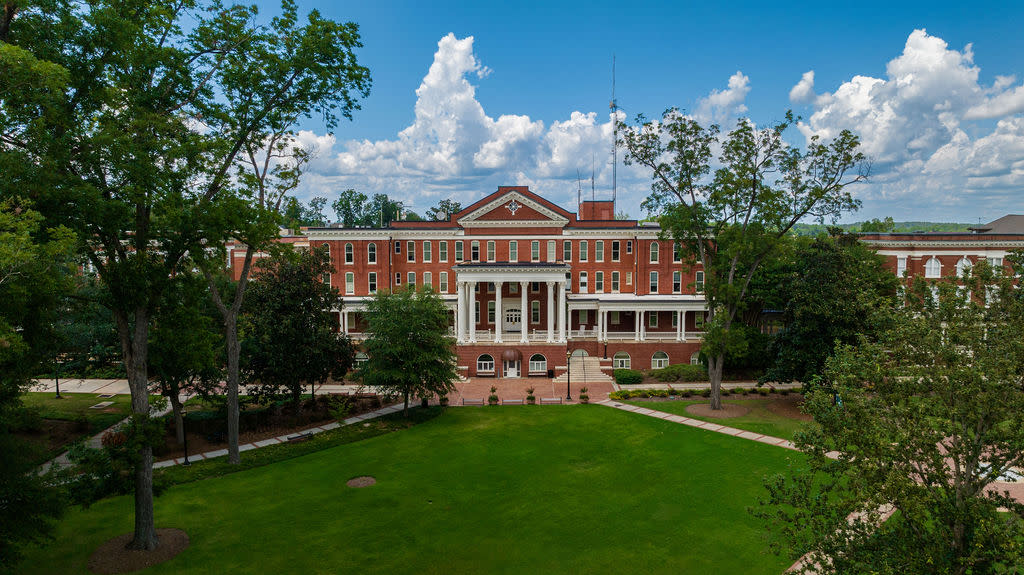
Milledgeville's historic charm provides the backdrop for a classic Southern college experience. Greek life dominates the social scene ([22]), while the Division of Student Life organizes 200+ annual events ([20]). Instagram posts showcase a picturesque campus with antebellum architecture ([23]), and students describe a 'small town feel' ([17]). The university actively promotes campus engagement through residence life programs and leadership opportunities ([19], [21]).
GCSU graduates outperform state averages, with a median annual income of $51,360—nearly $20K above typical Georgia earnings ([26]). The four-year graduation rate sits at 50%, climbing to 62% within six years ([25], [29]). First-year retention is strong at 84% ([25]), suggesting students find early academic footing. Alumni earnings one year post-graduation average $46,362 ([27]), with particularly strong outcomes for liberal arts and business graduates.
In-state tuition runs $9,282 annually, while out-of-state students pay $30,950 ([32], [35]). Over 80% of undergraduates receive financial aid ([31]), with average packages totaling $8,673 ([32]). After aid, the drops to $20,443 for many students ([33]). The university provides a detailed cost calculator ([30]) and emphasizes work-study opportunities alongside traditional grants and scholarships ([31]).
GCSU carves a unique niche as Georgia's only public liberal arts university—a designation that brings small classes (average 19 students) and undergraduate research opportunities typically found at private colleges. Its historic campus and Greek-centric social life deliver a quintessential Southern college experience, while strong outcomes (top 3 earnings among GA public universities [26]) validate its academic rigor. The blend of accessibility (78% acceptance) and strong ROI makes it a smart choice for students seeking personal attention without sacrificing state-school resources.
Georgia College & State University logo · sourceVisit Georgia College & State University | Georgia College & State University · sourceGeorgia College & State University · sourceOur Heritage & History - About Georgia College & State University | Georgia College & State University · source