Admit rate has ranged 25%–49% over the last 5 years — notably volatile. Source: IPEDS via Urban Institute.
Acceptance & SAT from Common Data Set / IPEDS; net price, earnings & graduation from the U.S. Dept. of Education College Scorecard. Figures lag ~1–2 years — verify with the school.
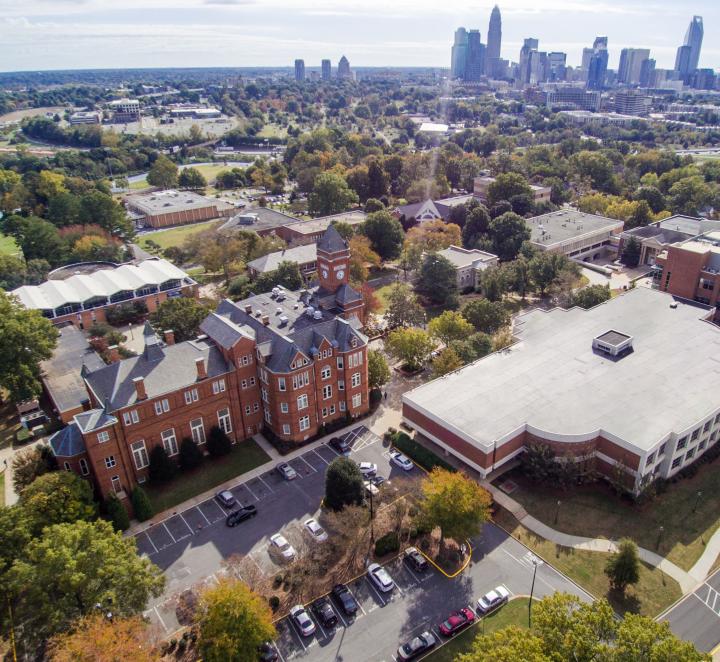
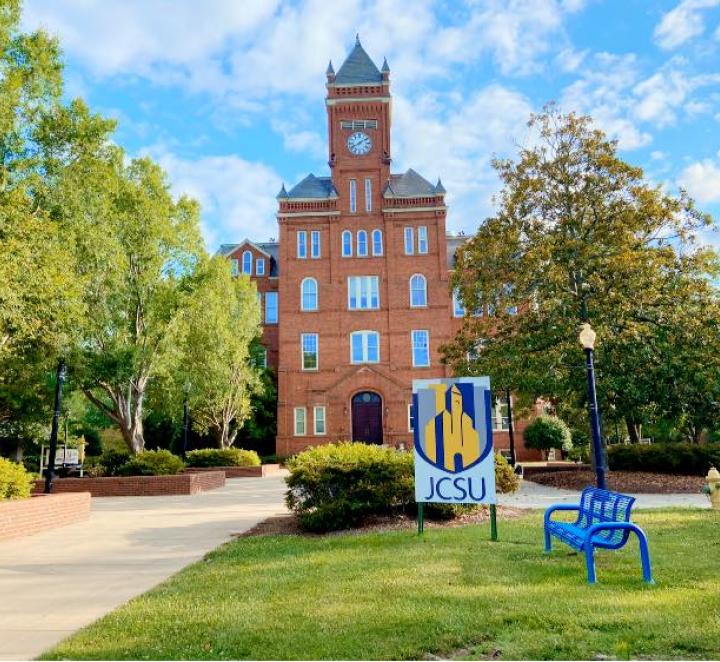
Johnson C. Smith University is a historically Black institution in Charlotte that has, since 1867, served as a beacon of access to higher education. It offers a career-focused, intimate academic environment with an 11:1 student-faculty ratio, leveraging its deep Charlotte connections to transform students into professionals. The campus experience is defined by a tight-knit HBCU community and year-round activities, though its graduation rates and post-graduate earnings reflect the significant challenges many of its students overcome.
Admission requirements
Test-blind — scores not considered
Required
High school transcript
Grade point average
College-prep program
TOEFL (non-native English)
Considered (not required)
Class rank
Source: IPEDS Admissions survey (2022) via Urban Institute. Covers formal factors only — it does not reflect essays, extracurriculars, or other holistic criteria.
More details
Undergrad enrollment
1,244
In-state tuition
$21,300
Out-of-state tuition
$21,300
Graduation Rate
34%
First-Year Retention
71%
Student-Faculty Ratio
11:1
Median Earnings (10yr)
$42,680
Outcomes & value
Outcomes & value
Median earnings (10 yr)
$42,680
Value (earnings ÷ net price)
2.0×
Median debt at graduation
$30,000
Graduation rate
34%
First-year retention
71%
Reducing loan balance (3 yr)
26%
Pell (lower-income) share
69%
First-gen share (among federal-aid recipients)
36%
Top-earning majors
Median earnings by field of study (highest credential), ~2 years after completion.
Computer and Information Sciences, General$39,741
Business Administration, Management and Operations$30,277
Social Work$26,933
Liberal Arts and Sciences, General Studies and Humanities$24,421
Psychology, General$24,421
Criminology$24,035
Campus & location
Campus safety
On-campus violent crimes (2024)
4
Per 1,000 students
3.09
On-campus criminal offenses classed as violent (murder/non-negligent manslaughter, rape, robbery, aggravated assault) for the most recent reported year. Source: U.S. Dept. of Education Campus Safety and Security (Clery Act). Counts reflect what’s reported to the school, and urban campuses often report more partly due to non-student incidents nearby — read alongside campus size and setting, not as a standalone safety verdict.
Climate
Pleasant days / yr
104
Summer high
88°F
Winter low
37°F
Annual rain
44.6"
Annual snow
1.8"
Natural-hazard risk
Relatively High
Pleasant days counts days per year with a mean temperature of 55–75°F, a high at or below 90°F, a low at or above 45°F, and little precipitation — a transparent comfort measure, not a weighting we invented. Computed from Open-Meteo ERA5 daily history (2019–2023). Natural-hazard risk is the county’s composite rating from the FEMA National Risk Index.
Deep dive — research, future-scholar output & economic mobility▾
Research output
Institutional h-index
47
Scholarly works
624
Institutional research volume and impact from OpenAlex. The h-index reflects large research universities and will be low for teaching-focused liberal-arts colleges — not a measure of undergraduate quality.
Quick answers
What is the acceptance rate at Johnson C Smith University?
Johnson C Smith University's acceptance rate is approximately 45% (Charlotte, NC), based on the most recent figures we compiled from public and primary sources.
How much does Johnson C Smith University cost?
At Johnson C Smith University, the average net price (after aid) is about $20,894 per year. Actual cost varies with financial aid and residency.
How many undergraduates attend Johnson C Smith University?
Johnson C Smith University enrolls approximately 1,244 undergraduate students.
Where is Johnson C Smith University located?
Johnson C Smith University is located in Charlotte, NC.
Admissions
Johnson C. Smith University operates with a moderately selective admissions process. The university is for most applicants, except for those competing for a Presidential Scholarship, where ACT or SAT scores are required. While the provides the official framework for admissions data, external sources report ranging from 42.87% to 58%, with an enrollment of 12.8%. The university's own admissions page emphasizes a , stating students are not required to apply under a specific admission plan. Demonstrated interest—a factor some colleges weigh heavily—is not explicitly addressed in the provided JCSU sources, though general resources note its potential importance elsewhere. The admissions office provides data for external reports like the Common Data Set and U.S. News through its Office of Accreditation, Data Analytics, and Transformation.
Earnings = median of students working ~10 years after entry; debt = median of graduates. Value divides 10-yr earnings by one year’s net price — read it as earnings per dollar of annual cost, not a full lifetime ROI; it favors lower-cost schools. Source: U.S. Dept. of Education College Scorecard. Figures lag ~2 years and reflect all students, not your intended major.
Sports, Kinesiology, and Physical Education/Fitness$22,192
Biology, General$21,964
Source: U.S. Dept. of Education College Scorecard (field-of-study earnings). Figures cover graduates who received federal aid and lag ~2 years; not all programs report data.
JCSU promotes a career-focused, interdisciplinary education within a supportive HBCU environment. The university boasts an intimate 11:1 student-faculty ratio, allowing for close mentorship. Its undergraduate programs span the arts, humanities, social sciences, and sciences, with notable strength in pre-professional fields. Popular majors include Business, Psychology, Social Work, Mass Communication/Media Studies, and Computer and Information Sciences. The biology program advertises that majors can "work with just about any life form — from humans and animals to plants and parasites." This practical, hands-on approach is a hallmark, designed to leverage the university's location in Charlotte to create successful professionals. The academic structure encourages students to pursue their passions through a diverse array of programs.
Life at JCSU is characterized by an active, close-knit campus community rooted in its HBCU identity. The student experience "goes beyond the classroom," with year-round activities, celebrations, and events. The Office of Student Leadership and Engagement (SLE) is central to this vibrancy, providing services and programs related to student leadership, involvement, and multicultural affairs. Its official Instagram presence focuses on school pride and what's new on campus. Since its founding in 1867, the university has served as a beacon of access and community for Black students. The campus environment is designed to be engaging and supportive, ensuring students find connection and opportunity outside of their academic work.
Post-graduation outcomes at JCSU present a mixed picture, reflecting both the transformative mission of the institution and the significant hurdles its student population often faces. The university's own data shows six-year completion rates historically ranging from 42.9% to 49.5%, which it notes are below national comparison rates of 75.6% to 76.3%. Other sources report a four-year graduation rate of 22% and a six-year rate of 55%. Earnings data varies by source: one reports median earnings five years after graduation at $43,653, while another cites an alumni salary of approximately $31,047 one year out. Biology graduates are reported to earn roughly $22,000 annually early in their careers. The first-year retention rate is 71%. These figures underscore the university's role in providing access while highlighting the ongoing challenge of translating that access into high completion rates and strong early-career earnings.
The of attending JCSU—the cost after scholarships and grants—is reported differently across sources, with figures ranging from $19,326 to $31,418. The university provides a Net Price Calculator to help families estimate their actual cost, which includes tuition, fees, books, supplies, and room and board. Financial aid packages average around $14,694. A significant portion of the student body receives Pell Grants. The Office of Financial Aid administers policies, including a pro-rata return of aid for students who withdraw before the 60% point of a semester. The provided sources do not contain explicit information from JCSU stating it meets 100% of demonstrated financial need or has a no-loan policy for low-income students; general articles about such policies at other institutions are present but not specific to JCSU.
Johnson C. Smith University stands out for its unwavering historical mission as an HBCU "beacon of access" in a major Southern city, coupled with a deliberately intimate, career-oriented academic model. Its 11:1 student-faculty ratio fosters close mentorship, while its location in Charlotte is actively leveraged to provide professional pathways—a combination not always found at small, private liberal arts institutions. The campus culture is proudly and actively communal, driven by a dedicated Office of Student Leadership and Engagement that ensures a vibrant, year-round slate of events. However, JCSU's profile is also defined by a stark honesty: it serves a population facing significant barriers, as reflected in graduation rates that it openly acknowledges lag behind national averages. This creates a distinct identity—a place of genuine opportunity and support that is clear-eyed about the challenges its students carry and the work required to help them succeed.
Johnson C Smith University seal · sourceCampus Map | Johnson C. Smith University · sourceVisit JCSU | Johnson C. Smith University · sourceContact | Johnson C. Smith University · source