Admit rate has ranged 76%–84% over the last 5 years, though the latest figure above (75%) falls outside that window. Source: IPEDS via Urban Institute.
Acceptance & SAT from Common Data Set / IPEDS; net price, earnings & graduation from the U.S. Dept. of Education College Scorecard. Figures lag ~1–2 years — verify with the school.
Loyola University Maryland blends Jesuit tradition with a tight-knit, academically rigorous liberal arts experience—think small classes where professors know your name, a 99% graduate placement rate, and a Baltimore location that offers urban energy without sacrificing campus community. With acceptance rates hovering around 75%, it’s selective but accessible, and its business and biology programs draw students who want both intellectual depth and real-world ROI.
Admission requirements
Test-optional — scores considered if submitted
Required
High school transcript
Grade point average
Letters of recommendation
College-prep program
TOEFL (non-native English)
Considered (not required)
Test scores (SAT/ACT)
Source: IPEDS Admissions survey (2022) via Urban Institute. Covers formal factors only — it does not reflect essays, extracurriculars, or other holistic criteria.
More details
Undergrad enrollment
3,869
In-state tuition
$57,150
Out-of-state tuition
$57,150
On-Campus Housing
77% of students
Student-Faculty Ratio
12:1
4-Year Graduation Rate
73%
Average Need-Based Aid Package
$42,640
Median Earnings (6 Years Post-Grad)
$64,453
Outcomes & value
Outcomes & value
Median earnings (10 yr)
$82,652
Value (earnings ÷ net price)
2.7×
Median debt at graduation
$27,000
Graduation rate
79%
First-year retention
87%
Reducing loan balance (3 yr)
82%
Pell (lower-income) share
20%
First-gen share (among federal-aid recipients)
13%
Financial health
2.4 / 3.0Meets the federal financial-responsibility standard
U.S. Dept. of Education Financial Responsibility Composite Score (FY2022-23). Scale −1.0 to 3.0; ≥1.5 meets the standard. Reported for private nonprofit & for-profit institutions only — public universities are state-backed and not scored, so this is a stability signal, not a ranking.
Top-earning majors
Median earnings by field of study (highest credential), ~2 years after completion.
Accounting and Related Services$64,865
Engineering, General$61,516
Computer Science$58,673
Business Administration, Management and Operations$55,286
Economics$54,713
Teacher Education and Professional Development, Specific Levels and Methods$42,682
Applicants here also applied to
The schools that most often appear alongside Loyola University Maryland on applicants’ lists, from our self-reported outcomes corpus.
Co-application frequency from self-reported results — directional peer discovery, not a recommendation.
Campus & location
Campus safety
On-campus violent crimes (2024)
8
Per 1,000 students
1.64
On-campus criminal offenses classed as violent (murder/non-negligent manslaughter, rape, robbery, aggravated assault) for the most recent reported year. Source: U.S. Dept. of Education Campus Safety and Security (Clery Act). Counts reflect what’s reported to the school, and urban campuses often report more partly due to non-student incidents nearby — read alongside campus size and setting, not as a standalone safety verdict.
Climate
Pleasant days / yr
86
Summer high
85°F
Winter low
30°F
Annual rain
61.1"
Annual snow
13.5"
Natural-hazard risk
Relatively High
Pleasant days counts days per year with a mean temperature of 55–75°F, a high at or below 90°F, a low at or above 45°F, and little precipitation — a transparent comfort measure, not a weighting we invented. Computed from Open-Meteo ERA5 daily history (2019–2023). Natural-hazard risk is the county’s composite rating from the FEMA National Risk Index.
Deep dive — research, future-scholar output & economic mobility▾
Research output
Institutional h-index
178
Scholarly works
6,250
Institutional research volume and impact from OpenAlex. The h-index reflects large research universities and will be low for teaching-focused liberal-arts colleges — not a measure of undergraduate quality.
Economic mobility
Mobility rate
0.7%
Bottom → top quintile
40%
From bottom quintile
2%
Mobility rate = the share of students who both start in the bottom household-income quintile and reach the top quintile; bottom → top is that chance conditional on starting at the bottom. Source: Opportunity Insights Mobility Report Cards (Chetty, Friedman, Saez, Turner & Yagan). Reflects 1980–82 birth cohorts, so it’s directional, not current.
Quick answers
What is the acceptance rate at Loyola University Maryland?
Loyola University Maryland's acceptance rate is approximately 75% (Baltimore, MD), based on the most recent figures we compiled from public and primary sources.
What SAT score do you need for Loyola University Maryland?
Admitted students at Loyola University Maryland typically score 1200–1370 on the SAT (the middle-50% range). Scores outside this band are still admitted, especially with strong applications.
How much does Loyola University Maryland cost?
At Loyola University Maryland, the average net price (after aid) is about $30,574 per year. Actual cost varies with financial aid and residency.
How many undergraduates attend Loyola University Maryland?
Loyola University Maryland enrolls approximately 3,869 undergraduate students.
Where is Loyola University Maryland located?
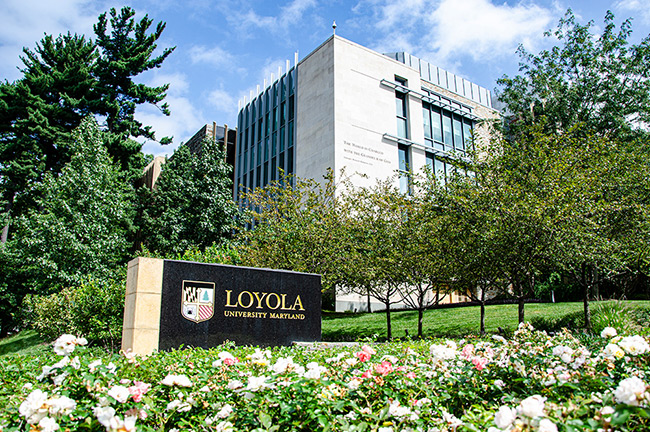
Loyola University Maryland is located in Baltimore, MD.
Admissions
Loyola’s admissions process is moderately selective, with an around 75% (sources vary between 69.85% and 75.5%). The mid-50% SAT range for admitted students is 1250–1380, while ACT scores typically fall between 28–32. About 66% of applicants apply . GPA stats are strong, with the middle half of admitted students boasting a 3.57–4.0 unweighted average. The regular decision deadline is January 15, and the university emphasizes a process that goes beyond numbers.
Earnings = median of students working ~10 years after entry; debt = median of graduates. Value divides 10-yr earnings by one year’s net price — read it as earnings per dollar of annual cost, not a full lifetime ROI; it favors lower-cost schools. Source: U.S. Dept. of Education College Scorecard. Figures lag ~2 years and reflect all students, not your intended major.
Romance Languages, Literatures, and Linguistics$42,682
Communication and Media Studies$41,751
Source: U.S. Dept. of Education College Scorecard (field-of-study earnings). Figures cover graduates who received federal aid and lag ~2 years; not all programs report data.
Loyola offers over 100 majors and minors grounded in Jesuit liberal arts traditions, with business and biological sciences as the most popular programs. Small class sizes are a hallmark—students frequently cite professors who know them personally. The curriculum emphasizes ethical leadership and interdisciplinary learning, with rigorous programs designed to produce 'well-rounded scholars.' A YouTube student testimonial highlights the accessibility of faculty and the balance between challenge and support.
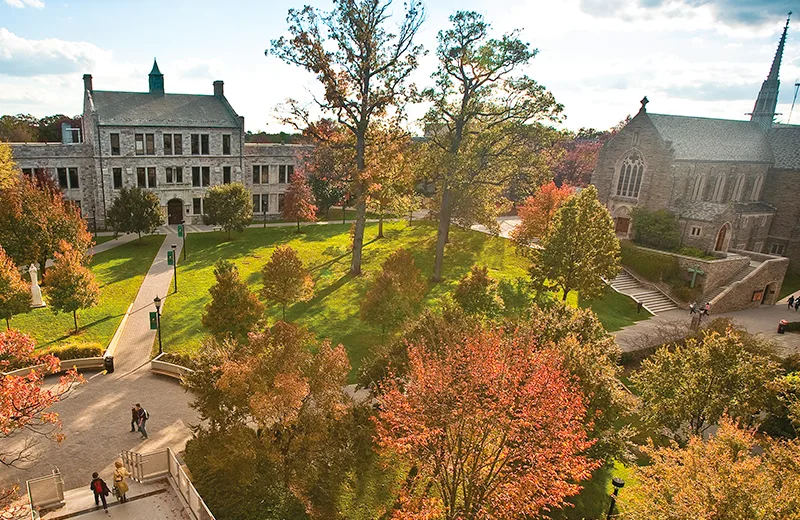
Life at Loyola revolves around a residential campus (77% of students live on-site) and a strong emphasis on community service and ethical engagement. The university promotes a 'transformative' experience through clubs, intramural sports, and Baltimore’s cultural offerings. Student testimonials describe a welcoming vibe where involvement—whether in campus ministry, Greek life, or research—shapes identity. The Jesuit commitment to 'socially conscious' development is woven into programming, from dorm life to volunteer opportunities.
Loyola boasts a 99% placement rate for graduates, with median earnings of $64,453 six years post-graduation (some sources cite higher figures, like $83,000 for recent grads). It ranks in the top 2% for long-term ROI and top 10% for value nationally. The four-year graduation rate is 73%, well above the national average. Alumni often credit the university’s career services and Jesuit network for their success in fields like business, healthcare, and education.
Tuition is steep, but Loyola mitigates costs aggressively: 99% of students receive some financial aid, with an average need-based package of $42,640 for first-years. The average is $34,711, and 98% get Loyola-funded scholarships or grants. The university’s net price calculator helps families estimate costs, which often drop significantly after aid. Notably, 68% of first-years receive , making Loyola more accessible than its sticker price suggests.
Loyola’s blend of Jesuit values and practical outcomes sets it apart. Students get the close-knit feel of a liberal arts college (with a 12:1 student-faculty ratio) plus the career traction of a larger university. Its Baltimore location offers internships and culture without the urban overwhelm. The 99% placement rate and top-tier ROI metrics prove its education pays off—literally. For students seeking a community that balances intellectual curiosity, service, and post-grad success, Loyola delivers.