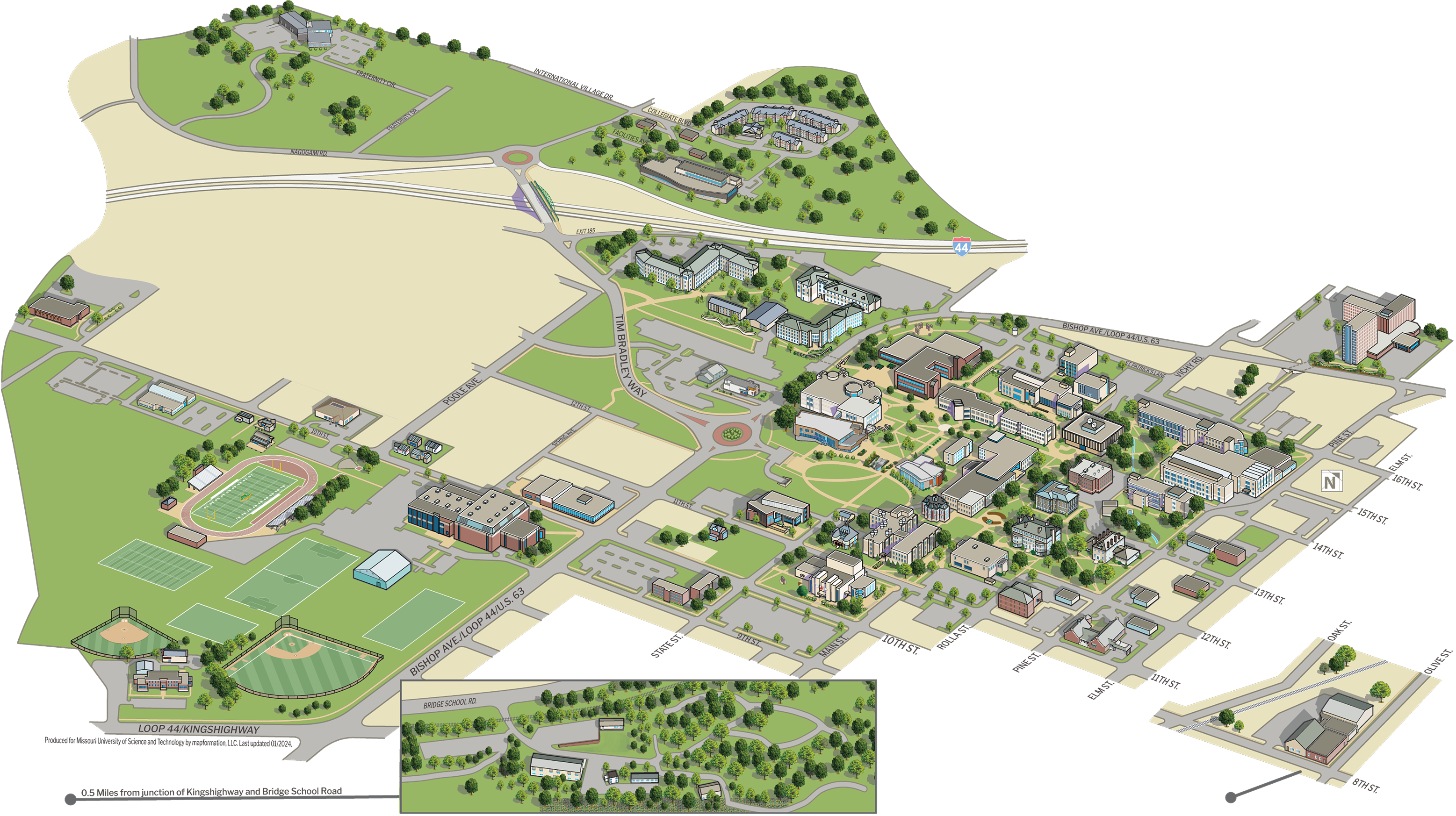
Admit rate has ranged 73%–85% over the last 5 years — notably volatile, though the latest figure above (73%) falls outside that window. Source: IPEDS via Urban Institute.
Acceptance & SAT from Common Data Set / IPEDS; net price, earnings & graduation from the U.S. Dept. of Education College Scorecard. Figures lag ~1–2 years — verify with the school.
Missouri University of Science and Technology (Missouri S&T) is a STEM powerhouse where engineering and applied sciences dominate the academic landscape. Known for its rigorous programs and strong industry ties, this public university in Rolla, Missouri, delivers high-value outcomes—graduates consistently land top-tier salaries in fields like petroleum engineering and computer science. With a tight-knit, geek-friendly campus culture and a 73% acceptance rate, it’s a pragmatic choice for students who want a no-nonsense education with serious earning potential.
Admission requirements
Test-optional — scores considered if submitted
Required
High school transcript
Grade point average
Class rank
College-prep program
TOEFL (non-native English)
Considered (not required)
Letters of recommendation
Test scores (SAT/ACT)
Source: IPEDS Admissions survey (2022) via Urban Institute. Covers formal factors only — it does not reflect essays, extracurriculars, or other holistic criteria.
More details
Undergrad enrollment
5,521
In-state tuition
$14,984
Out-of-state tuition
$33,248
Percent Receiving Aid
51.3%
Student-Faculty Ratio
17:1
6-Year Graduation Rate
64%
Median Early-Career Salary
$93,514
Outcomes & value
Outcomes & value
Median earnings (10 yr)
$82,957
Value (earnings ÷ net price)
5.1×
Median debt at graduation
$23,250
Graduation rate
64%
First-year retention
87%
Reducing loan balance (3 yr)
81%
Pell (lower-income) share
23%
First-gen share (among federal-aid recipients)
22%
Top-earning majors
Median earnings by field of study (highest credential), ~2 years after completion.
Metallurgical Engineering$74,200
Electrical, Electronics, and Communications Engineering$73,358
Computer Engineering$73,112
Petroleum Engineering$72,214
Mining and Mineral Engineering$69,338
Economics$69,338
Campus & location
Campus safety
On-campus violent crimes (2024)
10
Per 1,000 students
1.40
On-campus criminal offenses classed as violent (murder/non-negligent manslaughter, rape, robbery, aggravated assault) for the most recent reported year. Source: U.S. Dept. of Education Campus Safety and Security (Clery Act). Counts reflect what’s reported to the school, and urban campuses often report more partly due to non-student incidents nearby — read alongside campus size and setting, not as a standalone safety verdict.
Climate
Pleasant days / yr
88
Summer high
87°F
Winter low
28°F
Annual rain
46.2"
Annual snow
14.5"
Natural-hazard risk
Relatively Low
Pleasant days counts days per year with a mean temperature of 55–75°F, a high at or below 90°F, a low at or above 45°F, and little precipitation — a transparent comfort measure, not a weighting we invented. Computed from Open-Meteo ERA5 daily history (2019–2023). Natural-hazard risk is the county’s composite rating from the FEMA National Risk Index.
Deep dive — research, future-scholar output & economic mobility▾
Research output
Institutional h-index
388
Scholarly works
35,925
Institutional research volume and impact from OpenAlex. The h-index reflects large research universities and will be low for teaching-focused liberal-arts colleges — not a measure of undergraduate quality.
Quick answers
What is the acceptance rate at Missouri University of Science and Technology?
Missouri University of Science and Technology's acceptance rate is approximately 73% (Rolla, MO), based on the most recent figures we compiled from public and primary sources.
What SAT score do you need for Missouri University of Science and Technology?
Admitted students at Missouri University of Science and Technology typically score 1190–1420 on the SAT (the middle-50% range). Scores outside this band are still admitted, especially with strong applications.
How much does Missouri University of Science and Technology cost?
At Missouri University of Science and Technology, the average net price (after aid) is about $16,298 per year. Actual cost varies with financial aid and residency.
How many undergraduates attend Missouri University of Science and Technology?
Missouri University of Science and Technology enrolls approximately 5,521 undergraduate students.
Where is Missouri University of Science and Technology located?
Missouri University of Science and Technology is located in Rolla, MO.
Admissions
Missouri S&T is moderately selective, with an hovering around 73% (sources vary slightly between 72.5% and 79.2%). The middle 50% of admitted students score between 1190–1420 on the SAT or 25–31 on the ACT. While test scores aren’t strictly required, the university emphasizes a minimum 2.50 GPA and considers class rank. Rolling admissions mean applications are accepted until July 1, but early submission is encouraged for scholarship consideration. Superscoring is allowed for both ACT and SAT.
Earnings = median of students working ~10 years after entry; debt = median of graduates. Value divides 10-yr earnings by one year’s net price — read it as earnings per dollar of annual cost, not a full lifetime ROI; it favors lower-cost schools. Source: U.S. Dept. of Education College Scorecard. Figures lag ~2 years and reflect all students, not your intended major.
Chemical Engineering
$69,170
Computer and Information Sciences, General$69,140
Source: U.S. Dept. of Education College Scorecard (field-of-study earnings). Figures cover graduates who received federal aid and lag ~2 years; not all programs report data.
This is an R1 research university where STEM reigns supreme—engineering, computer science, and applied sciences dominate the curriculum. With a 17:1 student-faculty ratio, 40.4% of classes have fewer than 20 students. The catalog includes 31 bachelor’s programs, from aerospace engineering to technical communication, plus niche offerings like explosives engineering. Missouri S&T is classified as 'STEM-dominant' with 'very high research spending,' particularly in energy and materials science. Students praise the modern facilities (including recent construction projects) but note the workload is intense—this isn’t a school for academic coasting.
Rolla isn’t a college town—it’s a college campus. With 86% of students living on-site, the community is tight-knit and self-contained. Greek life plays a major role (19% of men join fraternities, 24% of women join sororities), but the vibe skews more toward hackathons than ragers. Traditions include St. Pat’s celebrations (the school’s unofficial mascot is a leprechaun) and a notorious ‘Rolla calculus’ culture where students bond over shared academic struggles. The university actively promotes involvement through 200+ clubs, including a competitive robotics team and mining engineering competitions.
Missouri S&T delivers on the ROI promise. The six-year graduation rate is 64%, and median earnings for recent grads hit $93,514—well above the national average. Petroleum engineering alumni reportedly earn $120K–200K+, while computer engineering grads pull in $90K–175K+. The Wall Street Journal ranks the school top 10 nationally for graduate salaries. About 23% of students take on debt (median $23,250), but the payoff is swift—the aerospace engineering program, for example, boasts near-100% job placement within six months.
The after aid averages $14,023, with 51.3% of students receiving financial assistance. Need-based scholarships average $15,659, and the university offers a robust program—automatic scholarships range up to $10,000/year for high-achieving applicants. Out-of-state students pay roughly double the in-state tuition ($14,098 vs. $30,120), but the school’s 'Scholarship Calculator' tool helps estimate package sizes upfront. Notably, 45% of students graduate with no debt at all.
Missouri S&T is the anti-Ivy: no pretensions, just pragmatic excellence. Where else can you major in explosives engineering, join a concrete canoe team, and land a six-figure job before graduation? The school’s singular focus on applied STEM—backed by serious research firepower—means every lab and lecture connects directly to industry needs. It’s a place where ‘geek’ isn’t an insult but a badge of honor, and where the ROI is so strong that even Wall Street Journal analysts take notice.
Missouri University of Science and Technology logo · sourceApply to Missouri University of Science and Technology · sourceAbout S&T – Missouri University of Science and Technology | Missouri S&T · sourceCampus Map – Missouri University of Science and Technology | Missouri S&T · source


.jpg)