Admit rate has ranged 63%–74% over the last 5 years — notably volatile. Source: IPEDS via Urban Institute.
Acceptance & SAT from Common Data Set / IPEDS; net price, earnings & graduation from the U.S. Dept. of Education College Scorecard. Figures lag ~1–2 years — verify with the school.
New England Institute of Technology is a career-focused technical school that operates with the urgency of a trade academy and the resources of a modern college. Its entire identity is built on an immersive, hands-on curriculum designed to get students into the workforce as quickly as possible, a mission reflected in its accelerated programs, high post-graduation employment rates, and a campus life oriented around collaborative, practical work. This is not a place for abstract liberal arts exploration; it's for students who want to build, fix, code, and diagnose, and see a direct line from their education to a paycheck.
Admission requirements
Test-optional — scores considered if submitted
Required
Grade point average
TOEFL (non-native English)
Considered (not required)
High school transcript
Letters of recommendation
Test scores (SAT/ACT)
College-prep program
Source: IPEDS Admissions survey (2022) via Urban Institute. Covers formal factors only — it does not reflect essays, extracurriculars, or other holistic criteria.
More details
Undergrad enrollment
1,718
In-state tuition
$37,275
Out-of-state tuition
$37,275
Graduation Rate
60%
Student-Faculty Ratio
12:1
Median Earnings (10yr)
$48,684
Students Receiving Grant Aid
90%
In-Field Employment Rate (1yr)
95%
Outcomes & value
Outcomes & value
Median earnings (10 yr)
$48,684
Value (earnings ÷ net price)
1.3×
Median debt at graduation
$16,668
Graduation rate
60%
First-year retention
74%
Reducing loan balance (3 yr)
52%
Pell (lower-income) share
43%
First-gen share (among federal-aid recipients)
41%
Financial health
3.0 / 3.0Meets the federal financial-responsibility standard
U.S. Dept. of Education Financial Responsibility Composite Score (FY2022-23). Scale −1.0 to 3.0; ≥1.5 meets the standard. Reported for private nonprofit & for-profit institutions only — public universities are state-backed and not scored, so this is a stability signal, not a ranking.
Top-earning majors
Median earnings by field of study (highest credential), ~2 years after completion.
Registered Nursing, Nursing Administration, Nursing Research and Clinical Nursing$83,546
Computer/Information Technology Administration and Management$55,036
Mechanical Engineering Related Technologies/Technicians$54,252
Campus & location
Campus safety
On-campus violent crimes (2024)
0
Per 1,000 students
0.00
On-campus criminal offenses classed as violent (murder/non-negligent manslaughter, rape, robbery, aggravated assault) for the most recent reported year. Source: U.S. Dept. of Education Campus Safety and Security (Clery Act). Counts reflect what’s reported to the school, and urban campuses often report more partly due to non-student incidents nearby — read alongside campus size and setting, not as a standalone safety verdict.
Climate
Pleasant days / yr
95
Summer high
81°F
Winter low
27°F
Annual rain
55"
Annual snow
25.6"
Natural-hazard risk
Relatively Low
Pleasant days counts days per year with a mean temperature of 55–75°F, a high at or below 90°F, a low at or above 45°F, and little precipitation — a transparent comfort measure, not a weighting we invented. Computed from Open-Meteo ERA5 daily history (2019–2023). Natural-hazard risk is the county’s composite rating from the FEMA National Risk Index.
Deep dive — research, future-scholar output & economic mobility▾
Research output
Institutional h-index
17
Scholarly works
81
Institutional research volume and impact from OpenAlex. The h-index reflects large research universities and will be low for teaching-focused liberal-arts colleges — not a measure of undergraduate quality.
Economic mobility
Mobility rate
1.9%
Bottom → top quintile
16%
From bottom quintile
12%
Mobility rate = the share of students who both start in the bottom household-income quintile and reach the top quintile; bottom → top is that chance conditional on starting at the bottom. Source: Opportunity Insights Mobility Report Cards (Chetty, Friedman, Saez, Turner & Yagan). Reflects 1980–82 birth cohorts, so it’s directional, not current.
Quick answers
What is the acceptance rate at New England Institute of Technology?
New England Institute of Technology's acceptance rate is approximately 67% (East Greenwich, RI), based on the most recent figures we compiled from public and primary sources.
How much does New England Institute of Technology cost?
At New England Institute of Technology, the average net price (after aid) is about $36,483 per year. Actual cost varies with financial aid and residency.
How many undergraduates attend New England Institute of Technology?
New England Institute of Technology enrolls approximately 1,718 undergraduate students.
Where is New England Institute of Technology located?
New England Institute of Technology is located in East Greenwich, RI.
Admissions
Admissions at NEIT are characterized by accessibility and a focus on readiness for its intensive technical programs rather than on ultra-selective academic metrics. The school is less selective, with an of 67%. In a recent cycle, 2,747 students applied, 1,833 were accepted, and 1,718 enrolled, indicating a relatively high rate where a significant portion of those admitted choose to attend. The process is test-flexible for most programs: SAT and ACT scores are not required for admission for many majors, though if submitted, they may be used for course placement instead of the school's own placement exams. An important exception is for applicants to Health Sciences majors, where a minimum SAT composite score of 1100 is required. The average GPA of admitted students tends to be in the 2.9 to 3.0 range, and only about 12% of first-time enrollees submit SAT scores with their applications, underscoring the reality for most. The admissions office does not appear to heavily emphasize or track demonstrated interest in the same way a liberal arts college might, focusing instead on academic preparedness for a technical curriculum.
Earnings = median of students working ~10 years after entry; debt = median of graduates. Value divides 10-yr earnings by one year’s net price — read it as earnings per dollar of annual cost, not a full lifetime ROI; it favors lower-cost schools. Source: U.S. Dept. of Education College Scorecard. Figures lag ~2 years and reflect all students, not your intended major.
Business Administration, Management and Operations$49,136
Computer Software and Media Applications$48,432
Source: U.S. Dept. of Education College Scorecard (field-of-study earnings). Figures cover graduates who received federal aid and lag ~2 years; not all programs report data.
The academic experience at NEIT is singularly pragmatic, structured around accelerated, hands-on learning with the explicit goal of fast-tracking graduates into the workforce. The school offers over 50 majors across 12 areas of study, with programs heavily concentrated in fields like Information Technology, Engineering, Automotive, Construction, and Health Sciences. The pedagogical approach is defined by small class sizes and personalized support, fostering an environment where theory is immediately applied in labs and workshops. A 12:1 faculty-to-student ratio supports this immersive model. There is no pretense of a traditional liberal arts core; the curriculum is intensely focused on building the specific technical knowledge and skills demanded by employers. This focus on career readiness is the school's primary academic selling point, with all students considered for merit-based scholarships based on criteria like academic strength, leadership, or community service.
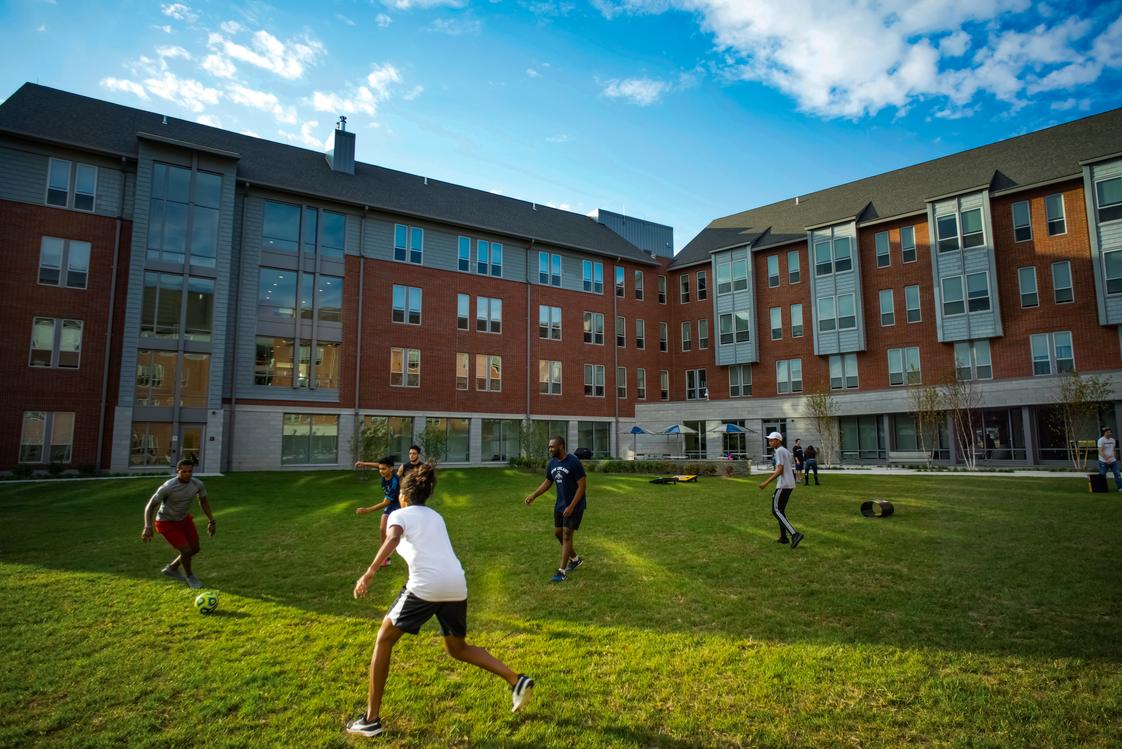
Campus life at NEIT is built to support its career-focused student body, offering modern amenities that facilitate both collaboration and downtime. The campus features inviting residence halls, collaborative spaces, a state-of-the-art Student Center, and a fitness facility. Student life promotions highlight a welcoming Student Center, a state-of-the-art Fitness Center, and the support of Caring Resident Advisors (RAs). Reviews describe having "a good gym, great library, and awesome labs," which perfectly encapsulates the priorities: wellness, study, and practical work. While the school offers clubs and activities, the social scene is likely more subdued and professionally oriented than at a residential liberal arts college. The vibe is that of a dedicated technical community where students share a common drive to gain expertise and launch careers.
Outcomes are NEIT's ultimate report card, and the data points to strong success in its core mission: employment. The school boasts that 95% of graduates are employed in their field within one year of completing their degrees. The median earnings for graduates ten years after entry is $48,684. The six-year graduation rate is 60%, a figure that, while not elite nationally, must be considered in the context of its non-traditional, career-focused student population and accelerated program options. This graduation rate places it roughly in the middle range nationally. The high employment-in-field rate is the most telling metric, validating the school's immersive, industry-aligned curriculum.
NEIT is a private institution with a significant price tag, but it works to offset costs through widespread aid distribution. The average after grants and scholarships is $36,483. 90% of full-time beginning undergraduates receive grant or scholarship aid. The average aid package awarded is $23,642, with the average need-based scholarship or grant award being $13,520. Financial aid comes from a variety of sources including non-repayable grants, scholarships, work-study programs, and student loans. The school offers need-based grants determined by institutional guidelines and emphasizes that students with high GPAs (3.8+), leadership roles, or unique talents can often secure $20,000–$40,000+ in merit aid. While the school provides substantial aid, it is not listed among the elite group of institutions that meet 100% of demonstrated financial need with a no-loan policy; families should expect to utilize federal loan programs as part of most financial aid packages.
New England Institute of Technology stands out for its unwavering, no-nonsense commitment to career education. It has no identity crisis; it is a technical institute, not a university trying to be all things to all people. This clarity of purpose manifests in several distinctive ways:
The Acceleration Principle: The entire academic model is built on "getting you into the workforce quickly." Programs are streamlined, avoiding gen-ed fluff, and focus intensely on hands-on, industry-relevant skills from day one.
Employment as the Core Metric: Success isn't measured by graduate school placements or Rhodes Scholarships, but by the stunning 95% in-field employment rate within a year of graduation. This outcome validates the entire educational approach.
A Campus for Makers: The campus infrastructure—"awesome labs," collaborative spaces, a modern student center—is designed for people who work with their hands and minds to build and fix things. The vibe is practical and professional.
Accessible but Demanding: With a 67% and policies for many majors, NEIT opens its doors to a wide range of students. However, the intensity of its accelerated, hands-on programs demands focus and dedication, creating a culture of serious, goal-oriented peers.
For a student who knows exactly what technical career they want and is impatient to start it, NEIT offers a direct, efficient, and highly effective path that most traditional colleges cannot match.
New England Institute of Technology seal · sourceNew England Institute of Technology - Wikipedia · sourceNew England Institute of Technology - East Greenwich, RI · sourcePresident Gouse announces $120 million campus expansion - NEIT · source