Admit rate has ranged 45%–78% over the last 5 years — notably volatile, though the latest figure above (80%) falls outside that window. Source: IPEDS via Urban Institute.
Acceptance & SAT from Common Data Set / IPEDS; net price, earnings & graduation from the U.S. Dept. of Education College Scorecard. Figures lag ~1–2 years — verify with the school.
North Carolina Wesleyan University (NCWU) is a small, private liberal arts college in Rocky Mount that punches above its weight with an 80% acceptance rate and a scrappy, community-focused ethos. Known for its 'WesWay' orientation and test-blind admissions, it leans heavily into criminal justice and business programs while grappling with a 40% six-year graduation rate. The school's $15,000 Wesleyan Scholarship and $19K net price make it a pragmatic choice for students seeking a tight-knit, no-frills undergraduate experience.
Admission requirements
Test-blind — scores not considered
Required
TOEFL (non-native English)
Source: IPEDS Admissions survey (2022) via Urban Institute. Covers formal factors only — it does not reflect essays, extracurriculars, or other holistic criteria.
More details
Undergrad enrollment
1,214
In-state tuition
$35,736
Out-of-state tuition
$35,736
Top Majors
Criminal Justice, Business, Psychology
6-Year Grad Rate
40%
Median Earnings (1yr)
$36,427
Signature Scholarship
Wesleyan Scholarship ($15K/year)
Greek Life Participation
5%
Outcomes & value
Outcomes & value
Median earnings (10 yr)
$45,873
Value (earnings ÷ net price)
2.6×
Median debt at graduation
$25,000
Graduation rate
42%
First-year retention
59%
Reducing loan balance (3 yr)
37%
Pell (lower-income) share
50%
First-gen share (among federal-aid recipients)
47%
Top-earning majors
Median earnings by field of study (highest credential), ~2 years after completion.
Computer and Information Sciences, General$42,123
Accounting and Related Services$41,937
Business Administration, Management and Operations$40,222
Marketing$39,369
Psychology, General$31,773
Criminal Justice and Corrections$31,133
Campus & location
Campus safety
On-campus violent crimes (2024)
1
Per 1,000 students
0.73
On-campus criminal offenses classed as violent (murder/non-negligent manslaughter, rape, robbery, aggravated assault) for the most recent reported year. Source: U.S. Dept. of Education Campus Safety and Security (Clery Act). Counts reflect what’s reported to the school, and urban campuses often report more partly due to non-student incidents nearby — read alongside campus size and setting, not as a standalone safety verdict.
Climate
Pleasant days / yr
106
Summer high
88°F
Winter low
38°F
Annual rain
47.8"
Annual snow
2.7"
Natural-hazard risk
Relatively Low
Pleasant days counts days per year with a mean temperature of 55–75°F, a high at or below 90°F, a low at or above 45°F, and little precipitation — a transparent comfort measure, not a weighting we invented. Computed from Open-Meteo ERA5 daily history (2019–2023). Natural-hazard risk is the county’s composite rating from the FEMA National Risk Index.
Quick answers
What is the acceptance rate at North Carolina Wesleyan University?
North Carolina Wesleyan University's acceptance rate is approximately 80% (Rocky Mount, NC), based on the most recent figures we compiled from public and primary sources.
How much does North Carolina Wesleyan University cost?
At North Carolina Wesleyan University, the average net price (after aid) is about $17,432 per year. Actual cost varies with financial aid and residency.
How many undergraduates attend North Carolina Wesleyan University?
North Carolina Wesleyan University enrolls approximately 1,214 undergraduate students.
Where is North Carolina Wesleyan University located?
North Carolina Wesleyan University is located in Rocky Mount, NC.
Admissions
NCWU operates with a test-blind policy, meaning ACT/SAT scores aren't considered even if submitted—a rarity among regional colleges. With an 80% acceptance rate (1,488 admits from 1,854 applicants in recent data), it's accessible but not a rubber stamp. The middle 50% of enrolled students score between 860–1120 on the SAT or 15–21 on the ACT, though these figures are self-reported and not used for admissions decisions. The school emphasizes , with no disclosed minimum GPA requirements. Notably, 67% of first-years receive need-based aid, averaging $34K per recipient.
NCWU’s curriculum is liberal arts core-heavy, but its academic identity is defined by vocational programs. dominates (69 degrees awarded annually), followed by and . The school markets its 'management skills' focus across majors, with niche offerings in parks/recreation (17 degrees) and protective services. Classes are small—the Instagram-hyped 'community' vibe translates to close faculty contact—but resources appear lean: no graduate programs exist to divert undergraduate attention. The academic experience is pragmatic rather than prestige-driven, with no mention of honors colleges or undergraduate research centers in official materials.
Earnings = median of students working ~10 years after entry; debt = median of graduates. Value divides 10-yr earnings by one year’s net price — read it as earnings per dollar of annual cost, not a full lifetime ROI; it favors lower-cost schools. Source: U.S. Dept. of Education College Scorecard. Figures lag ~2 years and reflect all students, not your intended major.
Sports, Kinesiology, and Physical Education/Fitness$21,052
Source: U.S. Dept. of Education College Scorecard (field-of-study earnings). Figures cover graduates who received federal aid and lag ~2 years; not all programs report data.
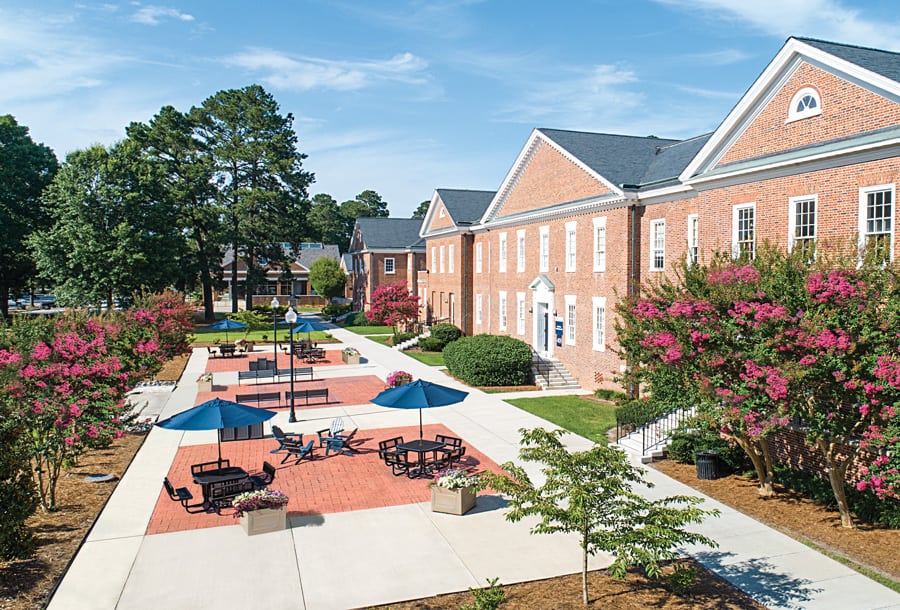
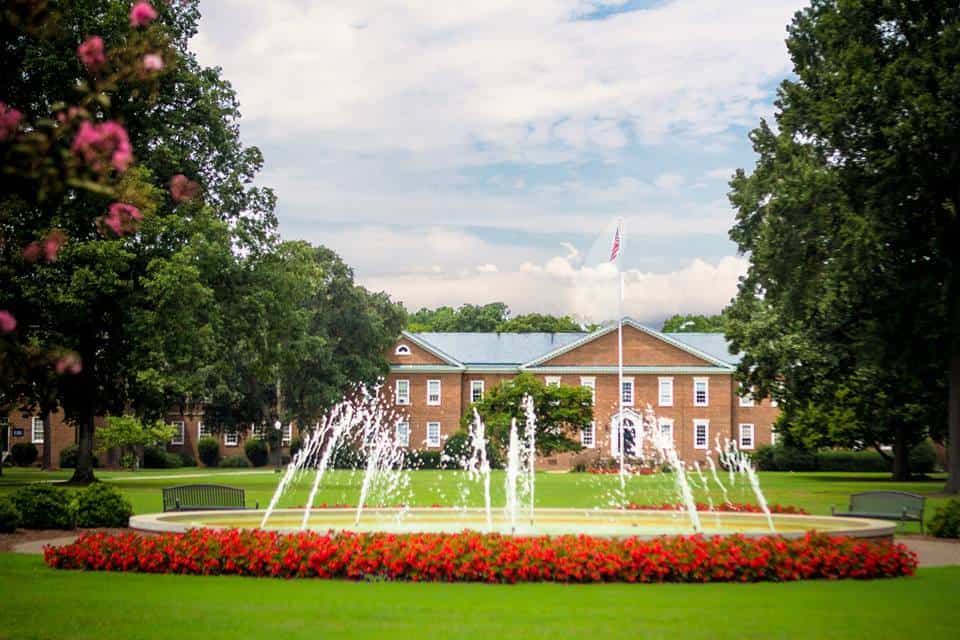
The WesWay orientation program sets the tone for a campus culture that’s heavy on tradition (Bishop mascot, Wesleyan 'way of life' rhetoric) and light on Greek life—only 5% of students join sororities/fraternities. Housing is standard-issue dormitory style, with no luxury accommodations advertised. Athletics (NCAA Division III) and spiritual life programs provide structure, but the real glue seems to be the school’s small size: Instagram posts tout a 'place where differences bring us together,' suggesting an emphasis on interpersonal connections over flashy amenities. Rocky Mount’s rural location means limited off-campus distractions, reinforcing the insular community feel.
The numbers tell a sobering story: 40% six-year graduation rate (2017 cohort), with median earnings of $36,427 one year post-graduation—$5K below national benchmarks for similar institutions. Only 39% finish in six years across all cohorts, per federal data. Criminal justice grads likely drive the $35K early-career average, though the school doesn’t publish major-specific outcomes. The low completion rates suggest academic support may be under-resourced, but the silver lining is cost: with at $19K, even modest earnings represent a better ROI than pricier peers.
NCWU’s $19,111 net price (after aid) is its strongest selling point. The Wesleyan Scholarship guarantees $15K annually for students with a 2.5+ GPA, and 67% of first-years get averaging $34K. The school’s calculator suggests total COA (tuition, fees, room/board) hovers near $40K, but most students pay half that. Notably, only 5% of grads earn significantly more than high school diploma holders, per U.S. News—so while costs are controlled, the wage premium is modest. For regional students eyeing a private college experience without six-figure debt, it’s a calculated bet.
NCWU is the anti-sticker-shock liberal arts college: test-blind admissions, a sub-$20K , and a no-nonsense focus on employable majors (criminal justice, business) make it a pragmatic choice for and cost-conscious students. The WesWay communal ethos compensates for modest facilities, and its 40% graduation rate—while low nationally—actually outperforms many regional peers. It’s not for prestige seekers, but as a low-risk, high-engagement option in eastern North Carolina, it fills a niche.
North Carolina Wesleyan University logo · sourceCampus Snapshot | North Carolina Wesleyan University · sourceCampus Snapshot | North Carolina Wesleyan University · sourceNorth Carolina Wesleyan College Map · source