Admit rate has ranged 68%–86% over the last 5 years — notably volatile, though the latest figure above (63%) falls outside that window. Source: IPEDS via Urban Institute.
Acceptance & SAT from Common Data Set / IPEDS; net price, earnings & graduation from the U.S. Dept. of Education College Scorecard. Figures lag ~1–2 years — verify with the school.
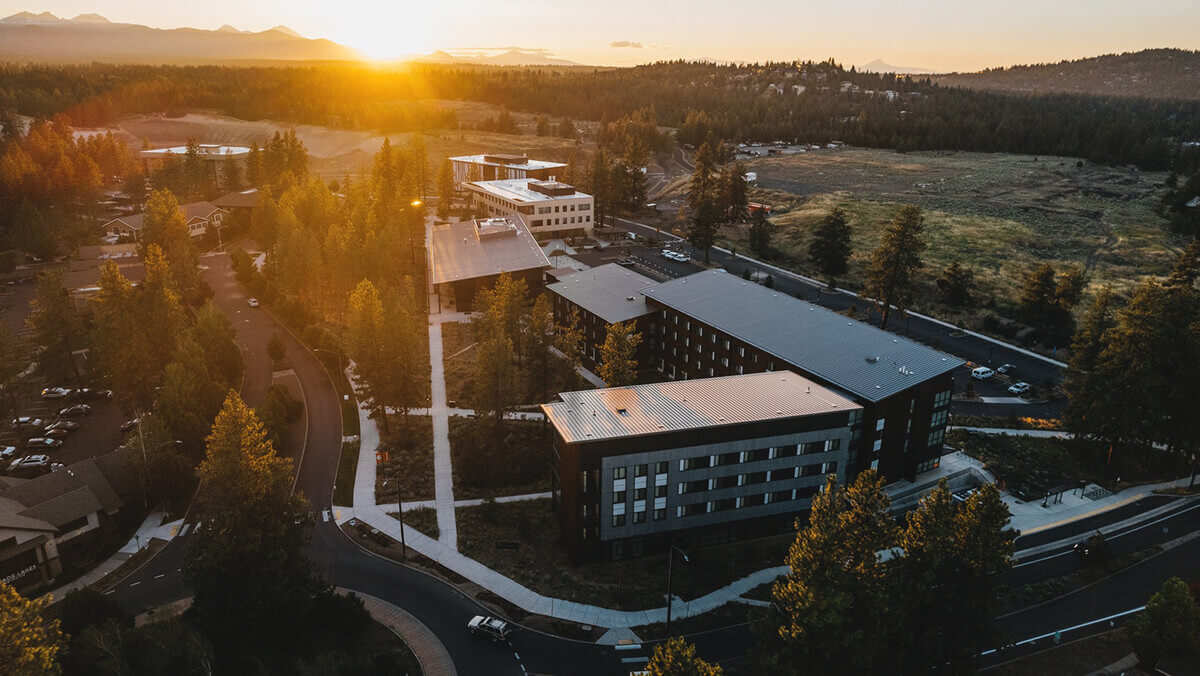
Oregon State University-Cascades Campus is not your typical state university branch. It's a purpose-built, small-scale public research university planted in the high desert of Bend, Oregon, offering the full weight of an Oregon State degree in a setting where classes average just 20 students. The campus serves a distinctly older, career-focused student body—the average graduate is 28—with programs laser-targeted at Central Oregon's economy in fields like computer science, energy systems engineering, and hospitality. Think of it as a pragmatic, outdoorsy alternative to the massive lecture hall experience, where the vibe is more startup than sprawling quad.
Admission requirements
Test-blind — scores not considered
Required
High school transcript
Grade point average
College-prep program
TOEFL (non-native English)
Considered (not required)
Class rank
Demonstrated competencies
Source: IPEDS Admissions survey (2022) via Urban Institute. Covers formal factors only — it does not reflect essays, extracurriculars, or other holistic criteria.
More details
Undergrad enrollment
1,044
In-state tuition
$13,566
Out-of-state tuition
$37,356
Graduation Rate
56%
Average Class Size
20 students
Average Graduate Age
28
Demonstrated Interest
Not considered
Median Earnings (10yr)
$64,010
Students Receiving Aid
93%
Outcomes & value
Outcomes & value
Median earnings (10 yr)
$64,010
Value (earnings ÷ net price)
3.5×
Median debt at graduation
$21,221
Graduation rate
56%
First-year retention
75%
Reducing loan balance (3 yr)
67%
Pell (lower-income) share
27%
First-gen share (among federal-aid recipients)
31%
Top-earning majors
Median earnings by field of study (highest credential), ~2 years after completion.
Computer Science$73,446
Electrical, Electronics, and Communications Engineering$73,035
Construction Engineering$71,295
Manufacturing Engineering$69,338
Industrial Engineering$67,420
Engineering, Other$64,493
Campus & location
Campus safety
On-campus violent crimes (2024)
0
Per 1,000 students
0.00
On-campus criminal offenses classed as violent (murder/non-negligent manslaughter, rape, robbery, aggravated assault) for the most recent reported year. Source: U.S. Dept. of Education Campus Safety and Security (Clery Act). Counts reflect what’s reported to the school, and urban campuses often report more partly due to non-student incidents nearby — read alongside campus size and setting, not as a standalone safety verdict.
Climate
Pleasant days / yr
93
Summer high
80°F
Winter low
27°F
Annual rain
22.8"
Annual snow
54.9"
Natural-hazard risk
Relatively Moderate
Pleasant days counts days per year with a mean temperature of 55–75°F, a high at or below 90°F, a low at or above 45°F, and little precipitation — a transparent comfort measure, not a weighting we invented. Computed from Open-Meteo ERA5 daily history (2019–2023). Natural-hazard risk is the county’s composite rating from the FEMA National Risk Index.
Quick answers
What is the acceptance rate at Oregon State University-Cascades Campus?
Oregon State University-Cascades Campus's acceptance rate is approximately 63% (Bend, OR), based on the most recent figures we compiled from public and primary sources.
What SAT score do you need for Oregon State University-Cascades Campus?
Admitted students at Oregon State University-Cascades Campus typically score 1143–1318 on the SAT (the middle-50% range). Scores outside this band are still admitted, especially with strong applications.
How much does Oregon State University-Cascades Campus cost?
At Oregon State University-Cascades Campus, the average net price (after aid) is about $18,048 per year. Actual cost varies with financial aid and residency.
How many undergraduates attend Oregon State University-Cascades Campus?
Oregon State University-Cascades Campus enrolls approximately 1,044 undergraduate students.
Where is Oregon State University-Cascades Campus located?
Oregon State University-Cascades Campus is located in Bend, OR.
Admissions
Admissions at OSU-Cascades are somewhat selective, with a 63% . The process is for applicants who have already graduated high school, meaning SAT or ACT scores are not required for admission review. For those who do submit scores, the middle 50% SAT range for admitted students is 1143–1318. The rate—the percentage of admitted students who enroll—is low, reported at 11% for one cycle. The university does not appear to have a binding Early Decision program; sources reference early action and early decision in the context of the broader Oregon State University system, but no specific Early Decision acceptance rate or share of the class filled via ED is provided for the Cascades campus. Demonstrated interest is not a formal factor in admissions decisions, as indicated by practices where schools that do not consider it mark it as "not considered."
Recent enrollment trends show modest growth, with a 2% increase in undergraduate students and a 3% increase in new freshmen reported in a preliminary fall enrollment report.
Earnings = median of students working ~10 years after entry; debt = median of graduates. Value divides 10-yr earnings by one year’s net price — read it as earnings per dollar of annual cost, not a full lifetime ROI; it favors lower-cost schools. Source: U.S. Dept. of Education College Scorecard. Figures lag ~2 years and reflect all students, not your intended major.
Chemical Engineering
$63,600
Civil Engineering$63,430
Source: U.S. Dept. of Education College Scorecard (field-of-study earnings). Figures cover graduates who received federal aid and lag ~2 years; not all programs report data.
OSU-Cascades delivers an Oregon State University degree in an intentionally small, personal setting. It is the only university in Central Oregon offering both baccalaureate and graduate programs. The academic experience is defined by small class sizes, with an average of just 20 students. This creates a focused environment starkly different from the large lecture halls of the main campus.
The academic portfolio is strategically designed to reflect and serve Central Oregon's vibrant economy and abundant natural resources. Degree programs are built to meet industry and economic needs in key areas:
Innovation and entrepreneurship
Natural ecosystems
Health and wellness
Arts and sciences
Specific high-demand programs include computer science, energy systems engineering, and hospitality management. The university also offers professional pathways and certificates. While students praise the strengths in teaching and community, some note the trade-off: limited class offerings and majors compared to larger universities. The curriculum is pragmatic, aiming to directly connect classroom learning with regional career opportunities.
Student life at OSU-Cascades is centralized through the Office of Student Life, which fosters community on a commuter-friendly campus with a significant population of older, non-traditional students. The office encompasses student government (Associated Students of the Cascades Campus), the Student Fee Committee, Student Organizations, an Events Council, and recreation programs like Cascades Adventures and intramurals. A key hub is "The Bridge," a space dedicated to student connection.
Student clubs are considered an essential part of campus life, providing opportunities for educational, cultural, social, and recreational development. The Office of Student Life's Instagram presence highlights a focus on DEI (Diversity, Equity, and Inclusion) events and student CARE resources. The overall atmosphere is one of building community from the ground up, with organized activities aiming to create an inclusive and engaging environment for a student body that may not live directly on campus. Reviews suggest the campus life experience is actively constructed through these organizations and events.
OSU-Cascades serves a population where traditional four-year graduation timelines are less common, reflecting its older student demographic. The average age of the graduating class is 28. Recent data showed the largest graduating class in campus history, with 380 degrees awarded. The majority (78%) of graduates are from Oregon, underscoring the campus's regional mission.
Graduation rates vary by source and timeframe. One source reports a 66% graduation rate, while others show more detailed progression: 32.8% of students graduate within 4 years, 48.4% within 5 years, and 54.7% within 6 years. Post-graduation earnings also show progression. Early career median earnings one year after graduation are reported at $47,459. This grows significantly to $65,204 per year five years after graduation. Some programs, like Construction Engineering, report higher early earnings, around $73,542. The outcomes paint a picture of a university serving students who often balance education with other life responsibilities, leading to longer time-to-degree but solid earning growth post-graduation.
The average after aid for students at OSU-Cascades is $18,048 per year. This cost includes tuition, living costs, books, and supplies. Financial aid is a critical component for most students, with 93% of students receiving some form of aid, and the average aid amount reported as $11,046. Aid comes in the form of grants, scholarships, federal work-study, and federal loans.
The university encourages all students to complete the Free Application for Federal Student Aid (FAFSA) to be considered for financial assistance. Oregon State University as a whole has almost $12 million in scholarship funds available across its campuses. Students have the right to know what financial assistance is available, including all federal, state, and institutional programs. The university also offers short-term emergency loans of up to $350 per term to help students with unexpected financial hardships. There is no indication in the provided sources of a no-loans financial aid policy that replaces loans with grants for low-income students.
OSU-Cascades stands out for its deliberate, almost contrarian model: it's a public research university that rejects the scale of its parent institution in favor of hyper-local relevance and personal scale. It is not a satellite campus but a distinct entity offering full degrees in Bend, the only four-year university in Central Oregon to do so. Its identity is forged from three unique elements.
First, its academic model is regionally engineered. Programs in computer science, energy systems engineering, and hospitality aren't just offered—they're built in direct response to Central Oregon's economic landscape, creating a tight feedback loop between classroom and career.
Second, it serves a non-traditional core demographic. With an average graduate age of 28, the campus is designed for career-changers, returning adults, and students weaving education into complex lives. This shapes everything from class schedules to student support services.
Finally, it offers a specific trade: the prestige and resources of Oregon State University (a leading public research institution) are delivered in a package where a student is a face, not a number. The 20-student average class size is the defining academic promise. For a student seeking the credential of a major state university but the attention of a small college, all within the outdoor-centric lifestyle of Bend, OSU-Cascades presents a compelling and singular option.
.jpg?width=1600)