Admit rate has ranged 71%–80% over the last 5 years — notably volatile. Source: IPEDS via Urban Institute.
Acceptance & SAT from Common Data Set / IPEDS; net price, earnings & graduation from the U.S. Dept. of Education College Scorecard. Figures lag ~1–2 years — verify with the school.
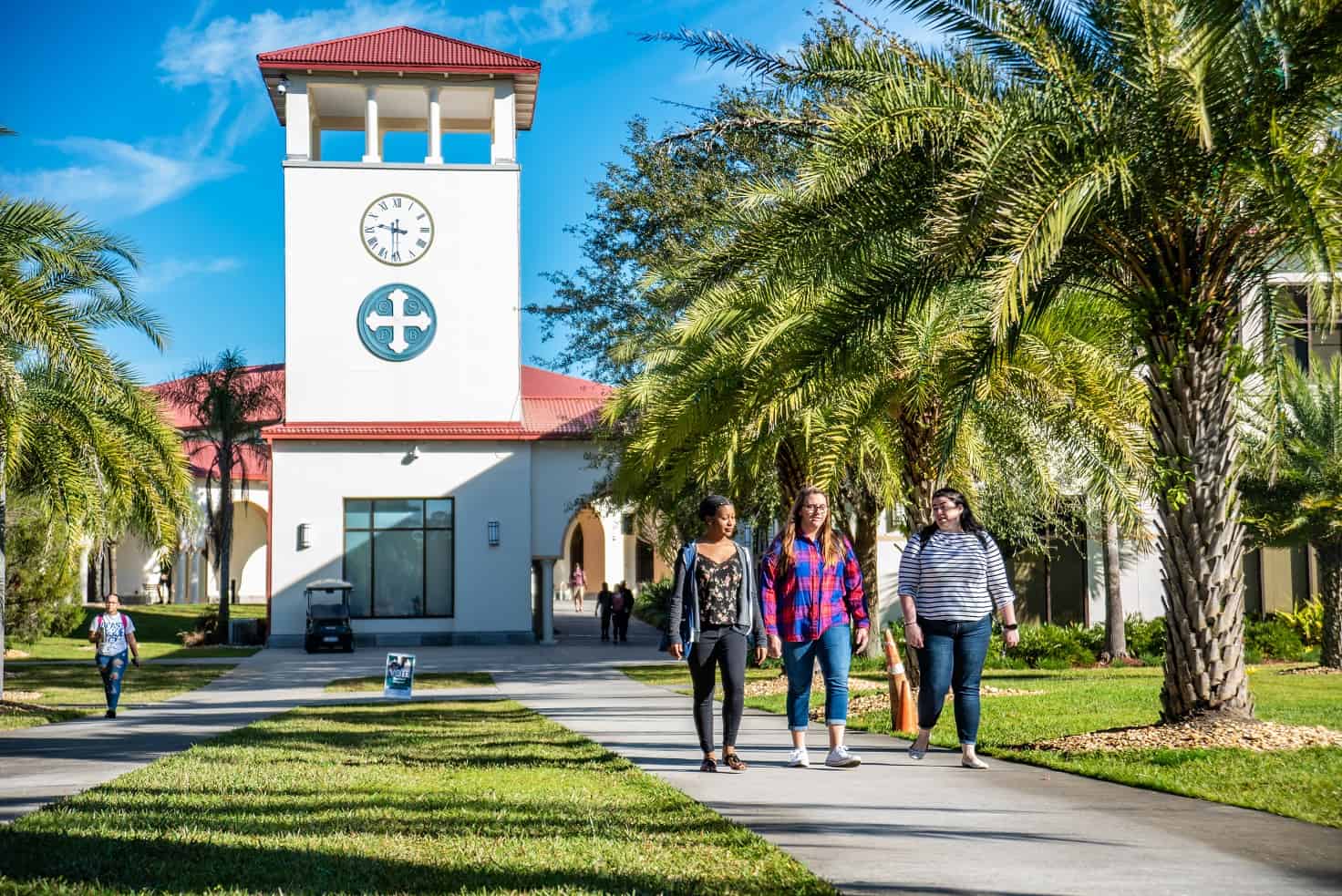
Saint Leo University carves out a distinct niche as a small, values-driven Catholic university on a sprawling, resort-style campus in central Florida. It operates with a dual identity: a tight-knit, traditional residential liberal arts college for its roughly 2,000 on-campus undergraduates, and a sprawling online and education center network serving thousands more. The school is lightly selective, test-optional, and emphasizes a supportive, community-focused environment, though its graduation outcomes present a significant challenge.
Admission requirements
Test-optional — scores considered if submitted
Required
High school transcript
Grade point average
TOEFL (non-native English)
Considered (not required)
Letters of recommendation
Test scores (SAT/ACT)
College-prep program
Demonstrated competencies
Source: IPEDS Admissions survey (2022) via Urban Institute. Covers formal factors only — it does not reflect essays, extracurriculars, or other holistic criteria.
More details
Undergrad enrollment
6,721
In-state tuition
$30,000
Out-of-state tuition
$30,000
Campus Setting
Resort-style
Popular Majors
Criminal Justice, Psychology, Accounting
Graduation Rate
45%
Social Mobility Rank
#10 in the South (U.S. News)
Median Earnings (10yr)
$48,364
Total Applicants (Fall 2023)
6,631
Outcomes & value
Outcomes & value
Median earnings (10 yr)
$48,364
Value (earnings ÷ net price)
2.3×
Median debt at graduation
$25,278
Graduation rate
45%
First-year retention
59%
Reducing loan balance (3 yr)
36%
Pell (lower-income) share
32%
First-gen share (among federal-aid recipients)
49%
Financial health
2.5 / 3.0Meets the federal financial-responsibility standard
U.S. Dept. of Education Financial Responsibility Composite Score (FY2022-23). Scale −1.0 to 3.0; ≥1.5 meets the standard. Reported for private nonprofit & for-profit institutions only — public universities are state-backed and not scored, so this is a stability signal, not a ranking.
Top-earning majors
Median earnings by field of study (highest credential), ~2 years after completion.
Computer and Information Sciences, General$55,770
Accounting and Related Services$48,883
Business/Commerce, General$46,852
Business Administration, Management and Operations$44,728
Human Resources Management and Services$44,276
Homeland Security
Campus & location
Campus safety
On-campus violent crimes (2024)
5
Per 1,000 students
0.56
On-campus criminal offenses classed as violent (murder/non-negligent manslaughter, rape, robbery, aggravated assault) for the most recent reported year. Source: U.S. Dept. of Education Campus Safety and Security (Clery Act). Counts reflect what’s reported to the school, and urban campuses often report more partly due to non-student incidents nearby — read alongside campus size and setting, not as a standalone safety verdict.
Climate
Pleasant days / yr
130
Summer high
89°F
Winter low
53°F
Annual rain
60.6"
Natural-hazard risk
Relatively High
Pleasant days counts days per year with a mean temperature of 55–75°F, a high at or below 90°F, a low at or above 45°F, and little precipitation — a transparent comfort measure, not a weighting we invented. Computed from Open-Meteo ERA5 daily history (2019–2023). Natural-hazard risk is the county’s composite rating from the FEMA National Risk Index.
Deep dive — research, future-scholar output & economic mobility▾
Research output
Institutional h-index
47
Scholarly works
947
Institutional research volume and impact from OpenAlex. The h-index reflects large research universities and will be low for teaching-focused liberal-arts colleges — not a measure of undergraduate quality.
Economic mobility
Mobility rate
3.6%
Bottom → top quintile
19%
From bottom quintile
19%
Mobility rate = the share of students who both start in the bottom household-income quintile and reach the top quintile; bottom → top is that chance conditional on starting at the bottom. Source: Opportunity Insights Mobility Report Cards (Chetty, Friedman, Saez, Turner & Yagan). Reflects 1980–82 birth cohorts, so it’s directional, not current.
Quick answers
What is the acceptance rate at Saint Leo University?
Saint Leo University's acceptance rate is approximately 78% (Saint Leo, FL), based on the most recent figures we compiled from public and primary sources.
How much does Saint Leo University cost?
At Saint Leo University, the average net price (after aid) is about $21,293 per year. Actual cost varies with financial aid and residency.
How many undergraduates attend Saint Leo University?
Saint Leo University enrolls approximately 6,721 undergraduate students.
Where is Saint Leo University located?
Saint Leo University is located in Saint Leo, FL.
Admissions
Saint Leo's admissions process is designed to be accessible. The university is test-optional for undergraduate applicants, meaning SAT or ACT scores are not required as part of the admission application. The process is described as 'somewhat selective,' with a high . For the fall 2023 cycle, the university received 6,631 applications and admitted 5,223 students. The admitted student profile shows a focus on academic performance in high school: among enrolled freshmen, 3% had a GPA of 4.0 or above, 12% had a GPA between 3.75 and 3.99, and another cohort fell in the 3.50 to 3.74 range. The university does not publish an Early Decision acceptance rate, and its policy on 'demonstrated interest'—tracking campus visits, contacts, etc.—is not explicitly stated in the provided resources, which are the primary source for such a determination.
Earnings = median of students working ~10 years after entry; debt = median of graduates. Value divides 10-yr earnings by one year’s net price — read it as earnings per dollar of annual cost, not a full lifetime ROI; it favors lower-cost schools. Source: U.S. Dept. of Education College Scorecard. Figures lag ~2 years and reflect all students, not your intended major.
$44,055
Criminal Justice and Corrections$41,601
Health and Medical Administrative Services$40,209
Source: U.S. Dept. of Education College Scorecard (field-of-study earnings). Figures cover graduates who received federal aid and lag ~2 years; not all programs report data.
Saint Leo offers a transformative liberal arts education rooted in values and academic excellence, according to its official materials. Students can browse more than 60 major and minor programs. The curriculum spans traditional arts and sciences—including biology, education, English, global studies, history, mathematics, political science, religion, and sociology—alongside professional tracks. Popular majors, as indicated by external sources, include Criminal Justice/Safety Studies, Psychology, General, and Accounting. The university also promotes accelerated combined degree pathways, such as a Computer Science/Cybersecurity 3+1 (BS/MS) program and Management 3+1 (BA/MBA) and Marketing 3+1 (BA/MBA) options. Saint Leo offers degrees up to the doctoral level. U.S. News & World Report has recognized it as a Top Performer on Social Mobility (#10 in the South) and included it among Best National Universities.
Life on Saint Leo's main campus is defined by its close-knit, inclusive community and its physical setting. The university describes its 2,000+ on-campus students as part of a 'tight-knit oasis' that offers a safe and secure learning environment. The campus itself is repeatedly characterized as beautiful and resort-style, with the university's social media showcasing its environment as a 'backyard' for students. This atmosphere facilitates strong connections between students, professors, and staff, aided by small class sizes. The total undergraduate enrollment (including online and center students) was 7,603 as of fall 2023. The campus experience includes diverse activities, modern facilities, comfortable residential options, and a supportive community aimed at personal and academic growth.
Graduation outcomes are a point of focus and challenge for Saint Leo. The university states its threshold is to maintain a minimum 45% graduation rate. Reported rates vary by source and cohort: one internal report cites a 71% six-year graduation rate for a specific group, while other sources list overall rates of 33%, 45%, 46%, 48%, 49%, and 53%. The university's own 2024 Student Achievement report notes a 49% divisional graduation rate. Data also shows that 38% of students graduate within the normal time, 47% within 150% of normal time, and 49% within 200% of normal time. Post-graduation earnings data shows median earnings of $47,100 one year after graduation and $55,370 five years after graduation.
The published for Saint Leo is $53,656, which includes $30,250 for tuition and fees and $16,250 for room and board. However, the —the average cost after aid and scholarships—is significantly lower. Various sources report an average net price of $19,478, $20,390, and $21,293. The university states that 100% of undergraduate students receive financial aid. This aid may include scholarships, grants, loans, and work-study opportunities. Specifically, the university awards Federal Pell Grants to undergraduate students who demonstrate exceptional financial need, are Pell Grant eligible, and have not earned a bachelor's degree; in one year, 4,330 students received this grant. For students with financial need who meet eligibility requirements, subsidized loans may be awarded. The university encourages students to use its Net Price Calculator and contact Student Financial Services for personalized planning.
Saint Leo University stands out for its pronounced duality and its environment. It is simultaneously a small, values-based Catholic liberal arts college with a picturesque, resort-style Florida campus fostering a tight-knit community, and a large, modern provider of online and extended education serving a non-traditional, geographically dispersed student body. This gives it a unique character: the on-campus student gets the classic small-college experience with personalized attention, while the institution's scale allows for a wide array of academic programs, including accelerated 3+1 bachelor's/master's tracks. Its recognition as a Top Performer on Social Mobility hints at a mission to serve students from diverse backgrounds. However, this very mission is tested by graduation rates that, while meeting the university's internal benchmark, lag behind national averages, presenting a clear point of contrast between its supportive community ethos and its ultimate student outcomes.
Saint Leo University seal · sourceCampus Experience | Saint Leo University · sourceSaint Leo University - Profile, Rankings and Data | US News Best Colleges · sourceSaint Leo University Ready to Welcome Record 1,001 New Students - Diocese of Saint Petersburg · source