Admit rate has ranged 75%–84% over the last 5 years — notably volatile, though the latest figure above (69%) falls outside that window. Source: IPEDS via Urban Institute.
Acceptance & SAT from Common Data Set / IPEDS; net price, earnings & graduation from the U.S. Dept. of Education College Scorecard. Figures lag ~1–2 years — verify with the school.
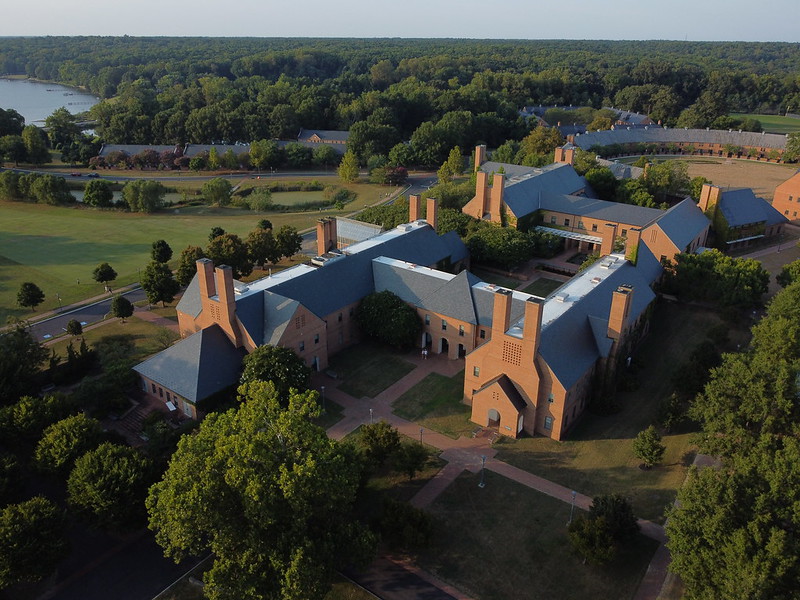
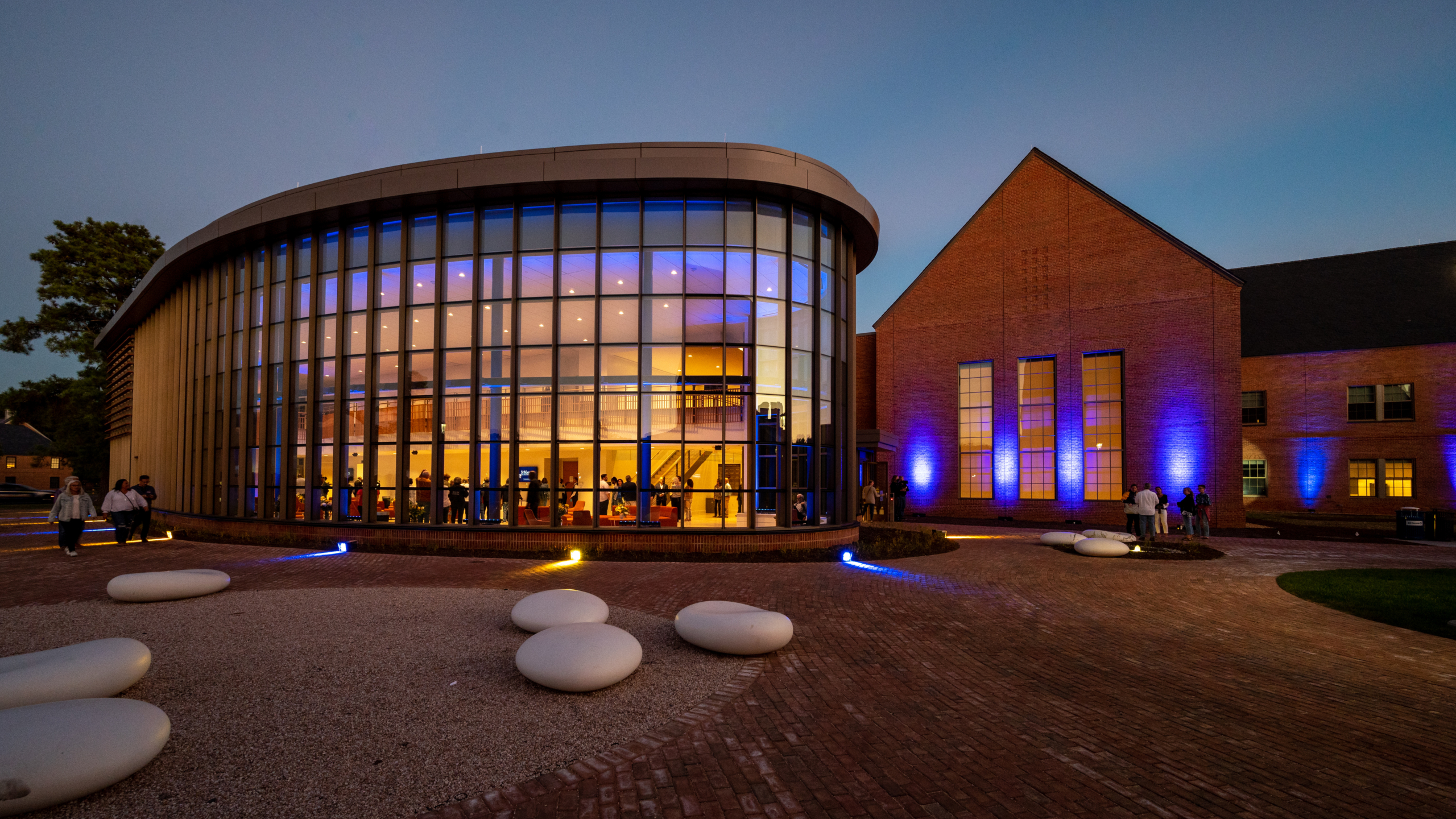
St. Mary's College of Maryland is a singular public liberal arts college that feels like a private honors college, set on a historic peninsula where the St. Mary's River meets the Chesapeake Bay. It offers a high-touch, intellectually rigorous education—where 31% of graduates major in STEM—within a quirky, outdoorsy, and self-directed campus culture. Students trade the bustle of a large university for bonfires at 'the Point,' a climbing wall, and professors who know their names, all at a public-institution price tag.
Admission requirements
Test-optional — scores considered if submitted
Required
High school transcript
Grade point average
Letters of recommendation
TOEFL (non-native English)
Considered (not required)
Class rank
Test scores (SAT/ACT)
College-prep program
Source: IPEDS Admissions survey (2022) via Urban Institute. Covers formal factors only — it does not reflect essays, extracurriculars, or other holistic criteria.
More details
Undergrad enrollment
1,603
In-state tuition
$15,298
Out-of-state tuition
$31,374
Graduation Rate
70%
Median Earnings (10yr)
$60,110
STEM Graduates (Class of 2025)
31%
Students Receiving Grant/Scholarship Aid
98%
Outcomes & value
Outcomes & value
Median earnings (10 yr)
$60,110
Value (earnings ÷ net price)
3.3×
Median debt at graduation
$21,000
Graduation rate
70%
First-year retention
86%
Reducing loan balance (3 yr)
80%
Pell (lower-income) share
21%
First-gen share (among federal-aid recipients)
23%
Top-earning majors
Median earnings by field of study (highest credential), ~2 years after completion.
Computer and Information Sciences, General$59,124
Economics$41,565
Public Policy Analysis$39,648
English Language and Literature, General$33,281
Sociology$31,839
Political Science and Government$31,314
Campus & location
Campus safety
On-campus violent crimes (2024)
7
Per 1,000 students
4.33
On-campus criminal offenses classed as violent (murder/non-negligent manslaughter, rape, robbery, aggravated assault) for the most recent reported year. Source: U.S. Dept. of Education Campus Safety and Security (Clery Act). Counts reflect what’s reported to the school, and urban campuses often report more partly due to non-student incidents nearby — read alongside campus size and setting, not as a standalone safety verdict.
Climate
Pleasant days / yr
99
Summer high
84°F
Winter low
36°F
Annual rain
45.6"
Annual snow
7.1"
Natural-hazard risk
Very Low
Pleasant days counts days per year with a mean temperature of 55–75°F, a high at or below 90°F, a low at or above 45°F, and little precipitation — a transparent comfort measure, not a weighting we invented. Computed from Open-Meteo ERA5 daily history (2019–2023). Natural-hazard risk is the county’s composite rating from the FEMA National Risk Index.
Deep dive — research, future-scholar output & economic mobility▾
Research output
Institutional h-index
101
Scholarly works
1,954
Institutional research volume and impact from OpenAlex. The h-index reflects large research universities and will be low for teaching-focused liberal-arts colleges — not a measure of undergraduate quality.
Quick answers
What is the acceptance rate at St. Mary's College of Maryland?
St. Mary's College of Maryland's acceptance rate is approximately 69% (St. Mary's City, MD), based on the most recent figures we compiled from public and primary sources.
What SAT score do you need for St. Mary's College of Maryland?
Admitted students at St. Mary's College of Maryland typically score 1143–1340 on the SAT (the middle-50% range). Scores outside this band are still admitted, especially with strong applications.
How much does St. Mary's College of Maryland cost?
At St. Mary's College of Maryland, the average net price (after aid) is about $18,441 per year. Actual cost varies with financial aid and residency.
How many undergraduates attend St. Mary's College of Maryland?
St. Mary's College of Maryland enrolls approximately 1,603 undergraduate students.
Where is St. Mary's College of Maryland located?
St. Mary's College of Maryland is located in St. Mary's City, MD.
Admissions
Admissions at St. Mary's College are moderately selective, with a process that emphasizes academic preparation over hooks or demonstrated interest. The college accepts a significant majority of its applicants, but those who enroll are academically solid, with a strong focus on high school GPA and rigor.
The regular decision deadline is January 15. While the does not specify an Early Decision program, sources indicate the existence of an early acceptance option with a significantly higher of 80.8%. The admitted student profile is academically focused: 37% of enrolled first-years had a high school GPA of 3.75 or higher, and 21% had a GPA between 3.50 and 3.74. Standardized test scores are considered but not required for all applicants; for those who submit, the middle 50% SAT range is 1143–1340, and the ACT range is 26–31. The college receives ACT scores from only about 5% of accepted students. The admissions office can be reached at 240-895-5000 or [email protected].
St. Mary's delivers an intensive, private liberal arts-style education through a public institution, a model encapsulated in its designation as Maryland's public honors college. The academic experience is defined by close faculty mentorship and a curriculum that, while not exhaustive in its major offerings, provides depth in core liberal arts and sciences. The college reports that 31% of all graduates from the Class of 2025 majored in a STEM field. Popular majors include English Language and Literature (6% of degrees), Computer and Information Sciences (5%), and History (4%).
Earnings = median of students working ~10 years after entry; debt = median of graduates. Value divides 10-yr earnings by one year’s net price — read it as earnings per dollar of annual cost, not a full lifetime ROI; it favors lower-cost schools. Source: U.S. Dept. of Education College Scorecard. Figures lag ~2 years and reflect all students, not your intended major.
Multi/Interdisciplinary Studies, Other
$31,038
Psychology, General$29,322
Source: U.S. Dept. of Education College Scorecard (field-of-study earnings). Figures cover graduates who received federal aid and lag ~2 years; not all programs report data.
The college structures its academic calendar around a 4-1-4 system, which includes a January term for focused study, internships, or research. Student feedback consistently highlights the accessibility and dedication of professors, who are noted for spending significant time with students and facilitating internship and research opportunities. The education department, for example, offers a 10-month Master of Arts in Teaching program designed to give students a strong foundation in child and adolescent development.
Life at St. Mary's is actively shaped by its breathtaking, somewhat remote waterfront location and a student body that creates its own fun. The campus vibe is casual, outdoorsy, and collaborative, with students frequently seen skateboarding, playing sports, riding bikes, and gathering for bonfires at a campus spot known as 'the Point.' According to student reviews, there's 'never a dull moment' thanks to an extremely active campus life, though the potential for getaways to nearby Washington, D.C., or Baltimore is a valued perk.
The college supports over 100 student clubs and organizations, which range from cultural advocacy groups to unique recreational offerings like a climbing wall and fly fishing classes. The Division of Student Affairs oversees a comprehensive slate of campus life, career services, student involvement, and residence life programs. The small student population—just over 2,100—fosters a tight-knit community where it's easy to get involved and be known.
St. Mary's prepares graduates for a wide range of next steps, with a strong track record of employment and further education. The college reports that 90% of its students are employed, continuing their education, in a gap year program, or in military service within a short time after graduation. The four-year graduation rate has seen some fluctuation, with one source noting a rate of 52.5% for the 2019 cohort, down from 60.6% for the 2018 cohort. The six-year graduation rate has also seen a decline from a recent high of 73%.
Earnings for graduates grow substantially over time. Early career earnings (approximately one year out) are around $30,856 to $36,427. This figure jumps to about $56,385 per year five years after graduation. One national scorecard places the median salary for graduates six years after entry at $52,286.
Positioning itself as offering the value of a public institution, St. Mary's is proactive with financial aid, ensuring most students do not pay the full sticker price. A overwhelming 98% of full-time beginning undergraduates receive grant or scholarship aid. The average financial aid package is $21,796. After accounting for scholarships and grants, the average —the actual cost students pay—is $18,441.
The college provides a Net Price Calculator to help families estimate their financial assistance options, which consist of scholarships, grants, and loans. The only way to determine official eligibility for need-based financial assistance is to submit the Free Application for Federal Student Aid (FAFSA). The Office of Student Financial Assistance administers all aid and can be contacted for guidance.
St. Mary's College of Maryland stands out as a compelling anomaly in American higher education: a public institution with the soul, scale, and pedagogical intensity of a premier private liberal arts college. Its identity is forged from three distinct elements. First is its status as Maryland's designated public honors college, a mandate that attracts academically driven students and resources a rigorous, faculty-focused education. Second is its irreplaceable location on the historic St. Mary's City peninsula, where the campus doubles as an archaeological site and a waterfront playground, fostering a unique, outdoorsy, and self-reliant campus culture centered around places like 'the Point.'
Finally, it delivers this package at a public-university net price, making a high-contact liberal arts education—where 31% of graduates emerge with STEM degrees—accessible to a broader population. It's not for students seeking a vast urban campus or an endless menu of majors, but for those who thrive in a close-knit, intellectually charged community where professors are mentors and the Chesapeake Bay is the backyard, St. Mary's offers a singular and transformative experience.
St. Mary's College of Maryland seal · sourceOur Location – About St. Mary's | SMCM · sourceOur Location – About St. Mary's | SMCM · sourceSt. Mary's College of Maryland Campus Tour · source