Admit rate has ranged 73%–80% over the last 5 years. Source: IPEDS via Urban Institute.
Acceptance & SAT from Common Data Set / IPEDS; net price, earnings & graduation from the U.S. Dept. of Education College Scorecard. Figures lag ~1–2 years — verify with the school.
SUNY Maritime College isn't your typical state school—it's a specialized, regimented, and intensely career-focused institution perched on the Throggs Neck waterfront. Think of it as a hybrid: part rigorous engineering and business college, part maritime academy where students can earn a U.S. Coast Guard license alongside their degree. The culture is defined by discipline, a stunning but insular campus, and an almost guaranteed path to high-paying jobs in shipping, logistics, and engineering, reflected in its standout graduate earnings.
Admission requirements
Test-optional — scores considered if submitted
Required
High school transcript
Grade point average
TOEFL (non-native English)
Considered (not required)
Letters of recommendation
Test scores (SAT/ACT)
College-prep program
Source: IPEDS Admissions survey (2022) via Urban Institute. Covers formal factors only — it does not reflect essays, extracurriculars, or other holistic criteria.
More details
Undergrad enrollment
1,285
In-state tuition
$8,589
Out-of-state tuition
$19,159
Graduation Rate
64%
On-Campus Housing
81%
Job Placement Rate
Over 90%
Most Popular Majors
Transportation, Engineering, Business
Demonstrated Interest
Not considered
Median Earnings (10yr)
$95,951
U.S. Coast Guard License
Integrated into many majors
Outcomes & value
Outcomes & value
Median earnings (10 yr)
$95,951
Value (earnings ÷ net price)
4.3×
Median debt at graduation
$23,250
Graduation rate
64%
First-year retention
83%
Reducing loan balance (3 yr)
80%
Pell (lower-income) share
22%
First-gen share (among federal-aid recipients)
21%
Top-earning majors
Median earnings by field of study (highest credential), ~2 years after completion.
Mechanical Engineering$87,973
Naval Architecture and Marine Engineering$81,997
Industrial Engineering$79,081
Marine Transportation$73,446
Electrical, Electronics, and Communications Engineering$68,219
Business, Management, Marketing, and Related Support Services, Other
Campus & location
Campus safety
On-campus violent crimes (2024)
0
Per 1,000 students
0.00
On-campus criminal offenses classed as violent (murder/non-negligent manslaughter, rape, robbery, aggravated assault) for the most recent reported year. Source: U.S. Dept. of Education Campus Safety and Security (Clery Act). Counts reflect what’s reported to the school, and urban campuses often report more partly due to non-student incidents nearby — read alongside campus size and setting, not as a standalone safety verdict.
Climate
Pleasant days / yr
93
Summer high
83°F
Winter low
29°F
Annual rain
54.6"
Annual snow
19"
Natural-hazard risk
Relatively High
Pleasant days counts days per year with a mean temperature of 55–75°F, a high at or below 90°F, a low at or above 45°F, and little precipitation — a transparent comfort measure, not a weighting we invented. Computed from Open-Meteo ERA5 daily history (2019–2023). Natural-hazard risk is the county’s composite rating from the FEMA National Risk Index.
Deep dive — research, future-scholar output & economic mobility▾
Research output
Institutional h-index
24
Scholarly works
404
Institutional research volume and impact from OpenAlex. The h-index reflects large research universities and will be low for teaching-focused liberal-arts colleges — not a measure of undergraduate quality.
Economic mobility
Mobility rate
2.3%
Bottom → top quintile
52%
From bottom quintile
4%
Mobility rate = the share of students who both start in the bottom household-income quintile and reach the top quintile; bottom → top is that chance conditional on starting at the bottom. Source: Opportunity Insights Mobility Report Cards (Chetty, Friedman, Saez, Turner & Yagan). Reflects 1980–82 birth cohorts, so it’s directional, not current.
Quick answers
What is the acceptance rate at SUNY Maritime College?
SUNY Maritime College's acceptance rate is approximately 72% (Throggs Neck, NY), based on the most recent figures we compiled from public and primary sources.
What SAT score do you need for SUNY Maritime College?
Admitted students at SUNY Maritime College typically score 1123–1288 on the SAT (the middle-50% range). Scores outside this band are still admitted, especially with strong applications.
How much does SUNY Maritime College cost?
At SUNY Maritime College, the average net price (after aid) is about $22,367 per year. Actual cost varies with financial aid and residency.
How many undergraduates attend SUNY Maritime College?
SUNY Maritime College enrolls approximately 1,285 undergraduate students.
Where is SUNY Maritime College located?
SUNY Maritime College is located in Throggs Neck, NY.
Admissions
Admissions at SUNY Maritime are moderately selective but offer a clear strategic advantage for committed applicants. The overall is 72%, but applying Early Decision significantly boosts an applicant's odds, with an Early Decision acceptance rate reported at 92%. The middle 50% SAT range for admitted students is 1123–1288, and the middle 50% ACT range is 22–28. The college reviews applications holistically, considering the strength of the high school curriculum, standardized test scores (if submitted), extracurricular activities, and one letter of recommendation. Notably, while many factors are considered, the college's (which outlines the importance of various application factors) suggests that demonstrated interest is not a primary consideration in admissions decisions. For the 2024-2025 cycle, the college received 1,769 applications and admitted 1,281 students.
Earnings = median of students working ~10 years after entry; debt = median of graduates. Value divides 10-yr earnings by one year’s net price — read it as earnings per dollar of annual cost, not a full lifetime ROI; it favors lower-cost schools. Source: U.S. Dept. of Education College Scorecard. Figures lag ~2 years and reflect all students, not your intended major.
$52,107
Atmospheric Sciences and Meteorology$47,260
Source: U.S. Dept. of Education College Scorecard (field-of-study earnings). Figures cover graduates who received federal aid and lag ~2 years; not all programs report data.
The academic experience is singularly practical and industry-driven. The most popular majors cluster around high-demand maritime fields: Transportation and Materials Moving, Engineering, and Business. A defining feature is that many degree programs allow students to simultaneously pursue a U.S. Coast Guard deck or engine license, a credential that qualifies them to work onboard commercial vessels and is a direct pipeline to the merchant marine. Graduate programs are designed to prepare students for leadership roles in the maritime industry, logistics, and naval policy. The curriculum is explicitly career-focused, aiming to prepare graduates for immediate success in fields like engineering, business, and environmental science. This isn't a liberal arts college; it's a professional training ground where the line between classroom and career is deliberately thin.
Life at Maritime is regimented and distinct from a typical residential college. The campus culture is described as "generally low key" due to the structured lifestyle and a strictly enforced dry campus policy regarding alcohol and drugs. The vast majority of students (81%) live in college-owned, -operated, or -affiliated housing, creating a tight-knit, insular community on the stunning waterfront campus in Throggs Neck. Despite the discipline, there are over 50 clubs and activities where students can engage in everything from practicing a new language to volunteering with local charities. Sports and social activities exist, but the overall vibe is more focused and less raucous than at many other schools, shaped by the professional expectations and the unique demands of the maritime programs.
This is where SUNY Maritime truly separates itself from the pack. The college boasts over 90% job placement, and the financial return on investment is nationally ranked. Earnings for graduates are exceptionally high: one year after graduation, the average earnings are $78,584, which jumps to $102,795 five years after graduation. The median earnings ten years after entry are a robust $95,951. A mobility report card indicates that SUNY Maritime graduates experience significant economic mobility, with 93% earning more than a high school graduate. The graduation rate is a solid 64%, well above the average for four-year colleges. In short, a Maritime degree is a near-guaranteed ticket to a stable, high-paying career, whether on land or at sea.
As a public SUNY school, Maritime offers a relatively affordable entry point for in-state students, with undergraduate in-state tuition listed at $7,070. The average after aid is $22,367. Financial aid is widely available, with 46-48% of first-year students receiving , and the average need-based scholarship or grant awarded to first-years is $4,462. The Office of Financial Aid assists students in securing federal and state funds, including scholarships, grants, loans, and work-study. Students are advised to complete the FAFSA and are strongly cautioned against taking out private loans, with the recommendation that "Federal loans are the only loan you should take out." The school does not advertise a formal "no-loan" policy for meeting full need.
SUNY Maritime College is a niche powerhouse. It doesn't try to be all things to all students; it excels at one very specific thing: turning out licensed, highly employable professionals for the global maritime industry and related engineering fields. Its character is defined by this focus—the regimented lifestyle, the waterfront campus, the integration of Coast Guard licensing into academic majors—which creates a culture more akin to a military academy or a specialized trade school than a conventional college. The payoff is undeniable: exceptional job placement rates and graduate earnings that rival those of elite private universities. For a student certain about a hands-on, technical career path with a clear ROI, Maritime offers a unique, no-nonsense education that is virtually unmatched within the public university system.
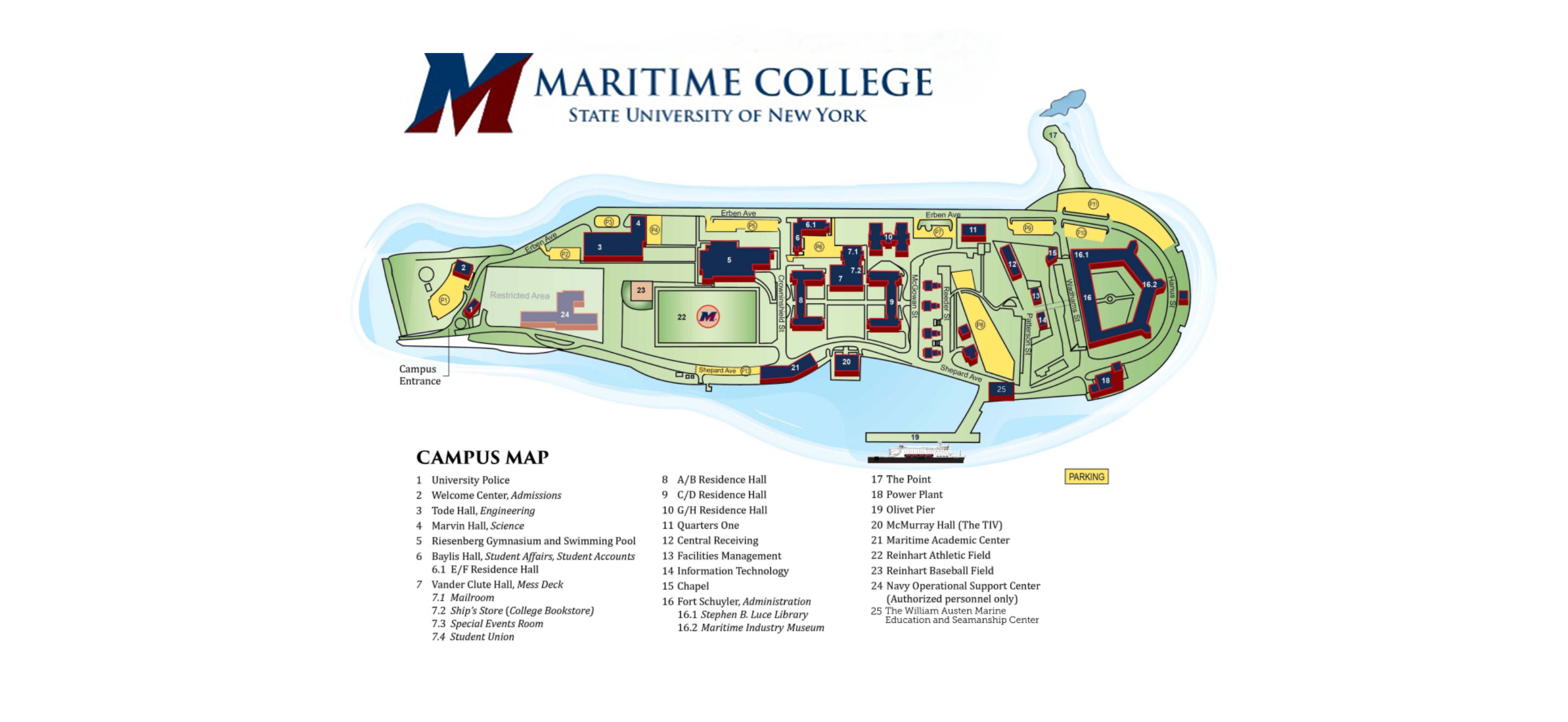
SUNY Maritime College seal · sourceCampus Map | SUNY Maritime College · sourceCampus Tours · sourceSUNY Maritime College - Profile, Rankings and Data | US News Best Colleges · source