Admit rate has ranged 56%–73% over the last 5 years — notably volatile. Source: IPEDS via Urban Institute.
Acceptance & SAT from Common Data Set / IPEDS; net price, earnings & graduation from the U.S. Dept. of Education College Scorecard. Figures lag ~1–2 years — verify with the school.
SUNY Oneonta is a public, four-year university in Central New York that enrolls about 5,500 students, offering a classic, well-rounded state-school experience with a particular focus on teacher education and the liberal arts. It’s a place where students find their path through more than 50 bachelor’s programs, a bustling campus life with over 150 clubs, and a strong emphasis on learning by doing. With an acceptance rate of 70%, it occupies a space in the SUNY system as a moderately selective, accessible institution that delivers solid outcomes, especially for future educators, managers, and artists.
Admission requirements
Test-optional — scores considered if submitted
Required
High school transcript
Grade point average
Letters of recommendation
College-prep program
TOEFL (non-native English)
Considered (not required)
Class rank
Test scores (SAT/ACT)
Source: IPEDS Admissions survey (2022) via Urban Institute. Covers formal factors only — it does not reflect essays, extracurriculars, or other holistic criteria.
Median earnings by field of study (highest credential), ~2 years after completion.
Accounting and Related Services$55,286
Computer and Information Sciences, General$45,696
Teacher Education and Professional Development, Specific Subject Areas$44,542
Business/Managerial Economics$43,426
Family and Consumer Sciences/Human Sciences, General$40,017
Geological and Earth Sciences/Geosciences
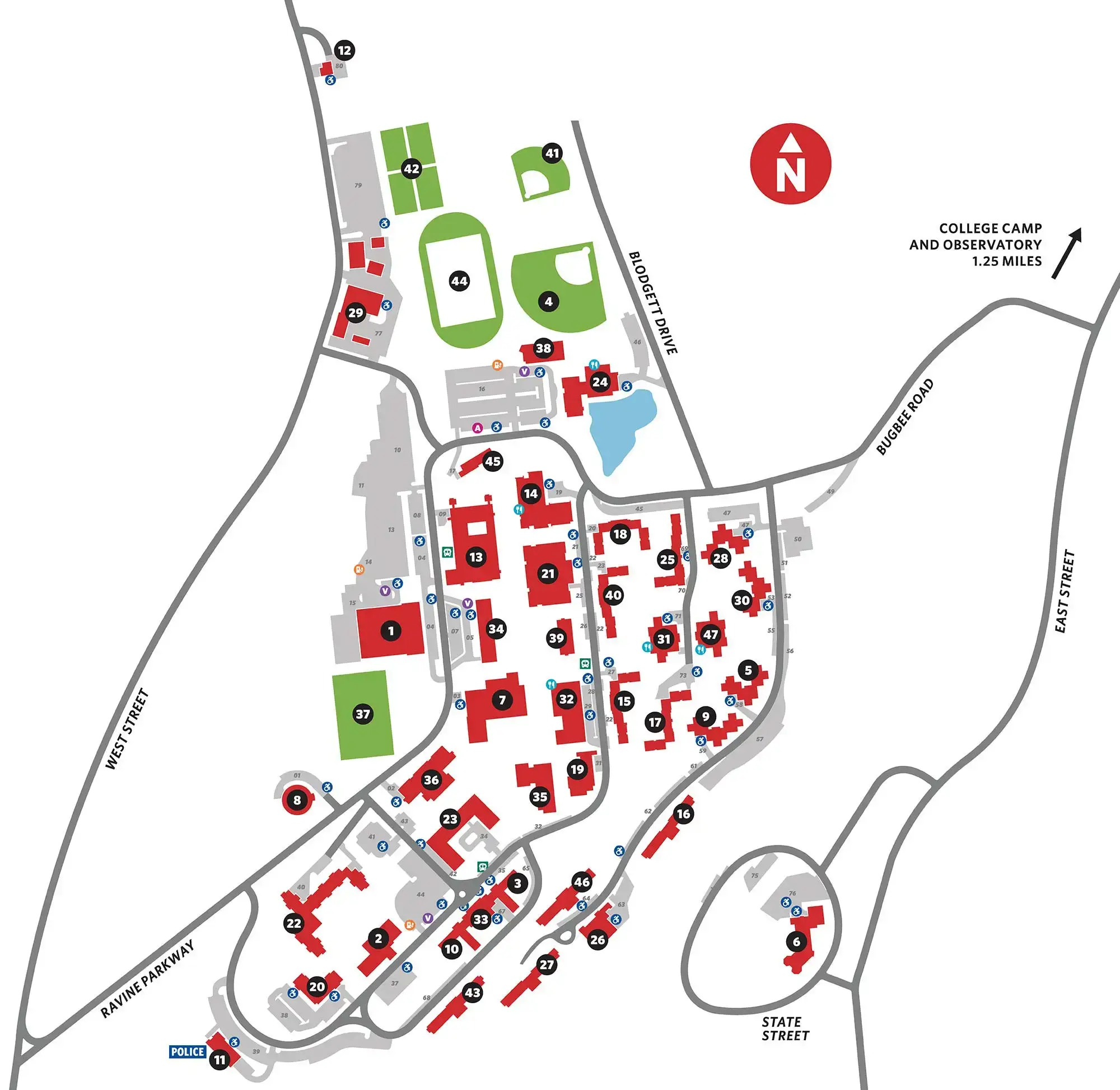
Campus & location
Campus safety
On-campus violent crimes (2024)
3
Per 1,000 students
0.57
On-campus criminal offenses classed as violent (murder/non-negligent manslaughter, rape, robbery, aggravated assault) for the most recent reported year. Source: U.S. Dept. of Education Campus Safety and Security (Clery Act). Counts reflect what’s reported to the school, and urban campuses often report more partly due to non-student incidents nearby — read alongside campus size and setting, not as a standalone safety verdict.
Climate
Pleasant days / yr
87
Summer high
76°F
Winter low
19°F
Annual rain
50.1"
Annual snow
57.4"
Natural-hazard risk
Relatively Low
Pleasant days counts days per year with a mean temperature of 55–75°F, a high at or below 90°F, a low at or above 45°F, and little precipitation — a transparent comfort measure, not a weighting we invented. Computed from Open-Meteo ERA5 daily history (2019–2023). Natural-hazard risk is the county’s composite rating from the FEMA National Risk Index.
Deep dive — research, future-scholar output & economic mobility▾
Research output
Institutional h-index
111
Scholarly works
2,691
Institutional research volume and impact from OpenAlex. The h-index reflects large research universities and will be low for teaching-focused liberal-arts colleges — not a measure of undergraduate quality.
Quick answers
What is the acceptance rate at SUNY Oneonta?
SUNY Oneonta's acceptance rate is approximately 70% (Oneonta, NY), based on the most recent figures we compiled from public and primary sources.
What SAT score do you need for SUNY Oneonta?
Admitted students at SUNY Oneonta typically score 1120–1310 on the SAT (the middle-50% range). Scores outside this band are still admitted, especially with strong applications.
How much does SUNY Oneonta cost?
At SUNY Oneonta, the average net price (after aid) is about $19,158 per year. Actual cost varies with financial aid and residency.
How many undergraduates attend SUNY Oneonta?
SUNY Oneonta enrolls approximately 4,643 undergraduate students.
Where is SUNY Oneonta located?
SUNY Oneonta is located in Oneonta, NY.
Admissions
SUNY Oneonta's admissions process is classified as somewhat selective, with the university accepting about 70% of applicants. For the most recent cycle, out of 15,545 total applications, 10,818 students were admitted. The middle 50% of admitted first-year students typically present SAT scores between 1120 and 1310, or ACT scores between 25 and 30. Academic preparation is key; the university notes that applicants should have a high school grade-point average of at least 3.0 or rank in the top 30 percent of their graduating class. While the outlines various admission factors, specific institutional data on the consideration of demonstrated interest or early decision and are not detailed in the provided sources. The process is grounded in academic credentials, making it a transparent and accessible pathway for a broad range of New York state students and beyond.
Earnings = median of students working ~10 years after entry; debt = median of graduates. Value divides 10-yr earnings by one year’s net price — read it as earnings per dollar of annual cost, not a full lifetime ROI; it favors lower-cost schools. Source: U.S. Dept. of Education College Scorecard. Figures lag ~2 years and reflect all students, not your intended major.
$39,369
Chemistry$38,289
Criminal Justice and Corrections$36,745
Source: U.S. Dept. of Education College Scorecard (field-of-study earnings). Figures cover graduates who received federal aid and lag ~2 years; not all programs report data.
Academics at Oneonta are defined by small classes, engaged faculty, and a hands-on approach across more than 50 bachelor's degree programs, plus a dozen traditional, online, and hybrid master's and certificate programs. The intellectual culture is heavily shaped by its historic strengths in teacher preparation and the liberal arts. Education is the single most popular field of study, accounting for 20% of degrees conferred. This is followed by Business, Management, Marketing, and Related Support Services (12%), Visual and Performing Arts (12%), and Psychology (11%). Popular individual majors include Elementary Education and Teaching, Psychology, General, and Business/Managerial Economics. This distribution creates a campus where future educators, entrepreneurs, artists, and counselors learn side-by-side, supported by a philosophy that emphasizes discovering one's path through direct experience.
Life outside the classroom is vibrant and central to the Oneonta experience. The Hunt Union serves as the heart of campus community life, offering a constant stream of cultural, educational, social, and recreational programming. Students can choose from more than 150 student clubs and organizations, ensuring there's a niche for every interest. The university actively promotes cross-cultural understanding through clubs and the celebration of various cultural holidays. Hundreds of hours of entertainment, athletic events, and social programming are scheduled each semester, fostering a strong sense of community. This active, involved campus culture in the small city of Oneonta provides a classic college-town environment where social and co-curricular opportunities are intentionally woven into the student experience.
SUNY Oneonta produces solid, reliable outcomes for its graduates, particularly when measured against national averages. The university's six-year graduation rate is 70%, a figure it highlights as being well above the national average. According to federal data, the median earnings for students working ten years after entering the university are $60,386. Earlier career data shows alumni earning a median of $33,955 one year after graduation, which grows to $58,485 five years out. These figures reflect the value of its strong programs in education, business, and the arts, translating academic training into sustainable career paths. The university's focus on 'learning by doing' appears to pay off in tangible post-graduate success.
As a public institution, SUNY Oneonta offers a relatively affordable education, especially for New York state residents. The average —the cost after aid and scholarships are applied—is $19,158. For in-state students, this average net price is typically lower, coming in around $17,654. A significant majority of students receive financial assistance; 83% of full-time beginning undergraduates receive grant or scholarship aid, with the average aid package totaling $18,750. The university offers a comprehensive financial assistance program that includes , merit scholarships, student employment, and loans. A notable perk for out-of-state students is an automatic $8,000 guaranteed scholarship. The university utilizes a net price calculator to help families estimate their actual costs, and while it participates in all federal loan programs, the provided sources do not indicate it has a 'no-loan' policy for meeting full financial need.
SUNY Oneonta stands out in the SUNY system as a quintessential, mid-sized public university that perfectly balances accessibility with quality. Its identity is deeply rooted in its of training teachers—one in five graduates earns a degree in education—yet it has successfully cultivated equally strong, popular programs in business, the visual and performing arts, and psychology. This creates a uniquely collaborative campus atmosphere where future educators, artists, and managers all find their niche. Unlike larger, more impersonal state schools, Oneonta emphasizes small classes and hands-on learning, while still delivering the full 'college life' package through its incredibly active student union and over 150 clubs. It’s a school that knows what it is: a reliable, engaging, and community-focused public institution that takes its students from admission through to graduation and into the workforce with notable success, all at a that underscores its value proposition.