Admit rate has ranged 26%–56% over the last 5 years — notably volatile. Source: IPEDS via Urban Institute.
Acceptance & SAT from Common Data Set / IPEDS; net price, earnings & graduation from the U.S. Dept. of Education College Scorecard. Figures lag ~1–2 years — verify with the school.
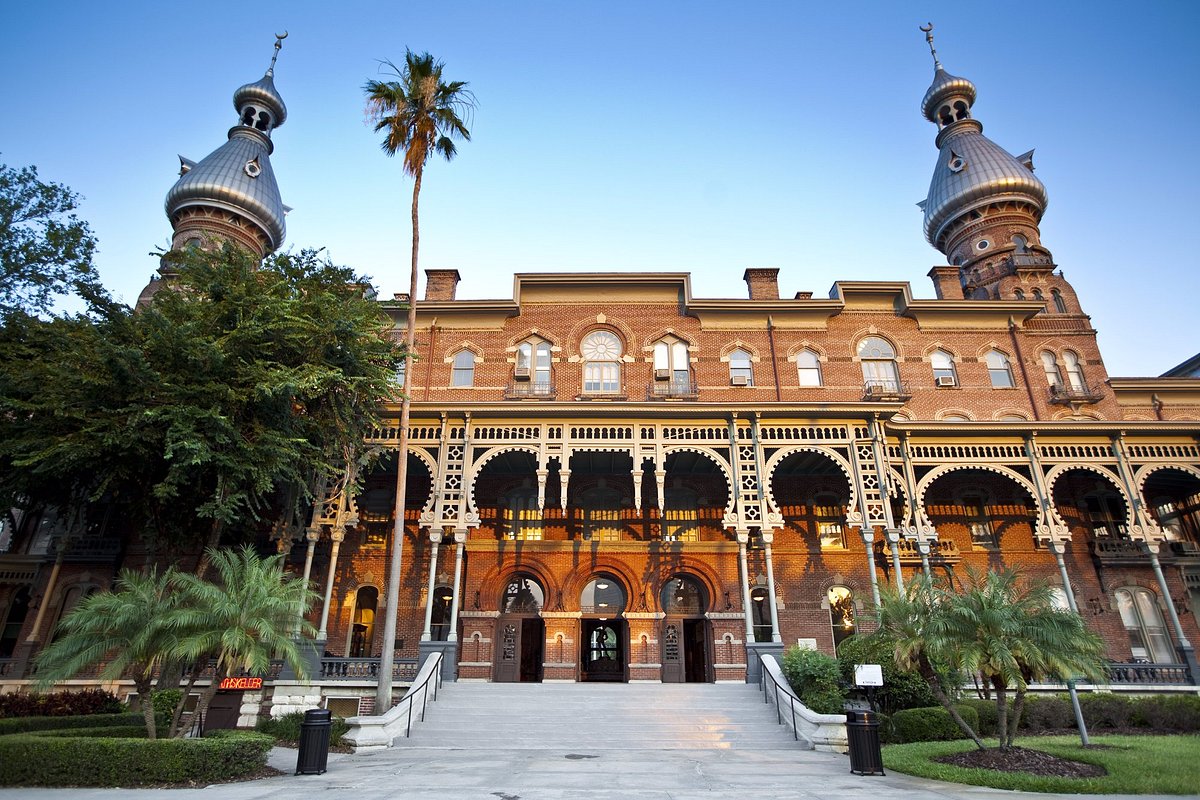
The University of Tampa offers a sun-drenched, urban campus in downtown Tampa, where strong business and health programs contend with a pronounced party-school reputation. Its 64% graduation rate and median earnings of $59,436 a decade after entry reflect an academic experience that can be as mixed as its social scene. With a 40% acceptance rate and an average net price of $36,211, it attracts students prioritizing location and campus life over elite outcomes.
Admission requirements
Test-blind — scores not considered
Required
High school transcript
Grade point average
Letters of recommendation
College-prep program
TOEFL (non-native English)
Considered (not required)
Class rank
Source: IPEDS Admissions survey (2022) via Urban Institute. Covers formal factors only — it does not reflect essays, extracurriculars, or other holistic criteria.
More details
Undergrad enrollment
10,572
In-state tuition
$34,408
Out-of-state tuition
$34,408
Campus Vibe
Urban, Greek-driven, limited school spirit
Popular Majors
Business, Health Professions
Median Mid-Career Salary
$48,600
Six-Year Graduation Rate
62%
Median Early-Career Salary
$36,427
Outcomes & value
Outcomes & value
Median earnings (10 yr)
$59,436
Value (earnings ÷ net price)
1.6×
Median debt at graduation
$24,211
Graduation rate
64%
First-year retention
85%
Reducing loan balance (3 yr)
65%
Pell (lower-income) share
15%
First-gen share (among federal-aid recipients)
25%
Top-earning majors
Median earnings by field of study (highest credential), ~2 years after completion.
Registered Nursing, Nursing Administration, Nursing Research and Clinical Nursing$56,825
Finance and Financial Management Services$49,579
Accounting and Related Services$45,500
International Business$42,123
Economics$41,565
Teacher Education and Professional Development, Specific Levels and Methods
Applicants here also applied to
The schools that most often appear alongside The University of Tampa on applicants’ lists, from our self-reported outcomes corpus.
Co-application frequency from self-reported results — directional peer discovery, not a recommendation.
Campus & location
Campus safety
On-campus violent crimes (2024)
8
Per 1,000 students
0.70
On-campus criminal offenses classed as violent (murder/non-negligent manslaughter, rape, robbery, aggravated assault) for the most recent reported year. Source: U.S. Dept. of Education Campus Safety and Security (Clery Act). Counts reflect what’s reported to the school, and urban campuses often report more partly due to non-student incidents nearby — read alongside campus size and setting, not as a standalone safety verdict.
Climate
Pleasant days / yr
131
Summer high
88°F
Winter low
56°F
Annual rain
57.1"
Natural-hazard risk
Relatively High
Pleasant days counts days per year with a mean temperature of 55–75°F, a high at or below 90°F, a low at or above 45°F, and little precipitation — a transparent comfort measure, not a weighting we invented. Computed from Open-Meteo ERA5 daily history (2019–2023). Natural-hazard risk is the county’s composite rating from the FEMA National Risk Index.
Deep dive — research, future-scholar output & economic mobility▾
Research output
Institutional h-index
167
Scholarly works
9,671
Institutional research volume and impact from OpenAlex. The h-index reflects large research universities and will be low for teaching-focused liberal-arts colleges — not a measure of undergraduate quality.
Quick answers
What is the acceptance rate at The University of Tampa?
The University of Tampa's acceptance rate is approximately 40% (Tampa, FL), based on the most recent figures we compiled from public and primary sources.
How much does The University of Tampa cost?
At The University of Tampa, the average net price (after aid) is about $36,211 per year. Actual cost varies with financial aid and residency.
How many undergraduates attend The University of Tampa?
The University of Tampa enrolls approximately 10,572 undergraduate students.
Where is The University of Tampa located?
The University of Tampa is located in Tampa, FL.
Admissions
UTampa's admissions process is selective but not elite, with a 40% acceptance rate and middle-50% SAT scores ranging from 1150–1300 (or ACT 25+). The university is test-optional, though it recommends submitting scores if they exceed 1200 SAT/25 ACT. Nonacademic factors like demonstrated interest play a notable role, per hints in its elusive Common Data Set. Critics note a disconnect between its marketed 20s and actual 40% figure, alongside a 3.5 average GPA** for admitted students.
Earnings = median of students working ~10 years after entry; debt = median of graduates. Value divides 10-yr earnings by one year’s net price — read it as earnings per dollar of annual cost, not a full lifetime ROI; it favors lower-cost schools. Source: U.S. Dept. of Education College Scorecard. Figures lag ~2 years and reflect all students, not your intended major.
$41,193
Communication and Media Studies$39,592
Marketing$38,597
Source: U.S. Dept. of Education College Scorecard (field-of-study earnings). Figures cover graduates who received federal aid and lag ~2 years; not all programs report data.
UTampa offers 200+ programs, with business and health professions dominating as the most popular majors. The university touts small class sizes and accessible professors, though local perceptions paint it as a party school with weaker academics than nearby USF. Standout programs include elementary education and pre-professional tracks, but Reddit threads suggest its reputation leans more toward social opportunities than rigorous scholarship.
Life at UTampa revolves around its compact, downtown campus and Greek scene, with students reporting limited school spirit but ample off-campus nightlife. While 81% feel safe on campus, socializing often spills into Tampa’s bars and clubs. The Princeton Review highlights its urban proximity, but Reddit users note the campus itself is quiet, with fraternities and club sports (like hockey) driving much of the social energy.
UTampa’s 62% six-year graduation rate lands it in the top 40% of peer institutions, though male students graduate at a lower 59% rate. Early-career earnings are modest, with a $36,427 median salary one year post-graduation, rising to $48,600 after a decade—trailing some Florida peers. Career services track outcomes via a First Destination Survey, but the data underscores a return-on-investment gap compared to higher-graduation-rate schools.
UTampa heavily promotes its Net Price Calculator to estimate costs, with financial aid packages blending university, federal, and Florida-specific grants. Merit scholarships are available, but the sticker price leans high for the region, and the 62% graduation rate raises questions about value. The aid process emphasizes transparency, though the calculator’s output varies widely based on residency and academic profile.
UTampa’s downtown location and strong business programs draw students seeking a balanced college experience—part academic, part social. Its test-optional policy and 40% acceptance rate make it accessible, but the party-school reputation and middling outcomes give pause. For those prioritizing urban energy over elite academics, UTampa delivers—just don’t expect the rigor (or the ROI) of a top-tier Florida school.
The University of Tampa logo · sourceThe University of Tampa Campus - All You SHOULD Know Before Going (2026 Reviews) · sourceUniversity of Tampa · sourceBranding and Guidelines · source