Admit rate has ranged 25%–37% over the last 5 years — notably volatile, though the latest figure above (24%) falls outside that window. Source: IPEDS via Urban Institute.
Acceptance & SAT from Common Data Set / IPEDS; net price, earnings & graduation from the U.S. Dept. of Education College Scorecard. Figures lag ~1–2 years — verify with the school.
Florida State University is a powerhouse public research institution where high-achieving academics and vibrant, tradition-steeped campus life collide. It has transformed from a regional favorite into a fiercely selective destination, attracting nearly 90,000 applicants for a class with average GPAs over 4.5. The vibe is distinctly Southern, spirited, and ambitious, underpinned by a pragmatic focus on timely graduation and strong post-college outcomes.
Admission requirements
Test scores required
Required
High school transcript
Grade point average
Test scores (SAT/ACT)
College-prep program
TOEFL (non-native English)
Considered (not required)
Class rank
Source: IPEDS Admissions survey (2022) via Urban Institute. Covers formal factors only — it does not reflect essays, extracurriculars, or other holistic criteria.
More details
Undergrad enrollment
32,212
In-state tuition
$5,656
Out-of-state tuition
$18,786
No-Loan Policy
No
Graduation Rate
86%
Meets Full Need
No
Demonstrated Interest
Considered
Median Earnings (10yr)
$61,675
First-Year Retention Rate
96-97%
Outcomes & value
Outcomes & value
Median earnings (10 yr)
$61,675
Value (earnings ÷ net price)
5.5×
Median debt at graduation
$18,000
Graduation rate
86%
First-year retention
96%
Reducing loan balance (3 yr)
63%
Pell (lower-income) share
23%
First-gen share (among federal-aid recipients)
28%
Top-earning majors
Median earnings by field of study (highest credential), ~2 years after completion.
Industrial Engineering$71,643
Computer Engineering$71,015
Electrical, Electronics, and Communications Engineering$68,918
Chemical Engineering$68,305
Mechanical Engineering$61,303
Management Information Systems and Services$61,218
Applicants here also applied to
The schools that most often appear alongside Florida State University on applicants’ lists, from our self-reported outcomes corpus.
Co-application frequency from self-reported results — directional peer discovery, not a recommendation.
Campus & location
Campus safety
On-campus violent crimes (2024)
11
Per 1,000 students
0.25
On-campus criminal offenses classed as violent (murder/non-negligent manslaughter, rape, robbery, aggravated assault) for the most recent reported year. Source: U.S. Dept. of Education Campus Safety and Security (Clery Act). Counts reflect what’s reported to the school, and urban campuses often report more partly due to non-student incidents nearby — read alongside campus size and setting, not as a standalone safety verdict.
Climate
Pleasant days / yr
123
Summer high
90°F
Winter low
48°F
Annual rain
52.3"
Natural-hazard risk
Relatively Moderate
Pleasant days counts days per year with a mean temperature of 55–75°F, a high at or below 90°F, a low at or above 45°F, and little precipitation — a transparent comfort measure, not a weighting we invented. Computed from Open-Meteo ERA5 daily history (2019–2023). Natural-hazard risk is the county’s composite rating from the FEMA National Risk Index.
Deep dive — research, future-scholar output & economic mobility▾
Research output
Institutional h-index
739
Scholarly works
111,162
Institutional research volume and impact from OpenAlex. The h-index reflects large research universities and will be low for teaching-focused liberal-arts colleges — not a measure of undergraduate quality.
Future-scholar output
Humanities & social-science PhDstop 15 nationally
Share of this school’s graduates who go on to earn research doctorates (2010–20), by national rank and per-capita yield (NSF institutional-yield ratio). A signal of a research-oriented student culture — not a causal promise, since it partly reflects who enrolls. Only top producers appear. Source: NSF NCSES, Baccalaureate Origins of U.S. Research Doctorate Recipients.
Economic mobility
Mobility rate
2.2%
Bottom → top quintile
Quick answers
What is the acceptance rate at Florida State University?
Florida State University's acceptance rate is approximately 24% (Tallahassee, FL), based on the most recent figures we compiled from public and primary sources.
What SAT score do you need for Florida State University?
Admitted students at Florida State University typically score 1270–1410 on the SAT (the middle-50% range). Scores outside this band are still admitted, especially with strong applications.
How much does Florida State University cost?
At Florida State University, the average net price (after aid) is about $11,297 per year. Actual cost varies with financial aid and residency.
How many undergraduates attend Florida State University?
Florida State University enrolls approximately 32,212 undergraduate students.
Where is Florida State University located?
Florida State University is located in Tallahassee, FL.
Admissions
Getting into Florida State is no longer a foregone conclusion for strong Florida students; it has become a highly competitive, numbers-driven process. For the Class of 2030, the university received approximately 90,000 applications and admitted around 18,500 students. The admitted profile is exceptionally strong: the average core GPA was 4.5, the average SAT was 1430, and the average ACT was 32, with 92% of admits ranked in the top 10% of their high school class. This represents a significant climb in selectivity over recent years.
Admission is selective, and the university uses the highest composite or total score from a single test date when evaluating SAT or ACT scores. The middle 50% SAT range for admitted students is 1270–1410, and the ACT range is 29–32. The university offers an Early Action program, which appears to provide a strategic advantage, especially for in-state applicants; one source notes an Early Action for in-state students of approximately 38-39%. Demonstrated interest is a factor in admissions decisions, rated as "Considered" according to analyses. The overall rate—the percentage of admitted students who enroll—is a key metric tracked by the Office of Institutional Research.
Earnings = median of students working ~10 years after entry; debt = median of graduates. Value divides 10-yr earnings by one year’s net price — read it as earnings per dollar of annual cost, not a full lifetime ROI; it favors lower-cost schools. Source: U.S. Dept. of Education College Scorecard. Figures lag ~2 years and reflect all students, not your intended major.
Management Sciences and Quantitative Methods$60,878
Registered Nursing, Nursing Administration, Nursing Research and Clinical Nursing$58,923
Source: U.S. Dept. of Education College Scorecard (field-of-study earnings). Figures cover graduates who received federal aid and lag ~2 years; not all programs report data.
Mobility rate = the share of students who both start in the bottom household-income quintile and reach the top quintile; bottom → top is that chance conditional on starting at the bottom. Source: Opportunity Insights Mobility Report Cards (Chetty, Friedman, Saez, Turner & Yagan). Reflects 1980–82 birth cohorts, so it’s directional, not current.
FSU's academic environment is defined by a structured, supportive path to a degree and a collection of programs that punch well above their weight nationally. The university provides an academic map designed to help students earn their degree in four years, a focus that pays off in impressive graduation rates. Many academic units have programs that consistently rank among the top twenty-five at public universities nationwide, including Physics, Chemistry, Statistics, and others.
The most popular majors reflect a blend of pre-professional and liberal arts interests: Psychology, General; Finance, General; Marketing/Marketing Management, General; Political Science and Government, General; and Criminal Justice. This academic strength is coupled with a highly supportive structure, resulting in graduation rates that are among the best in the state system. The four-year graduation rate has reached new highs of 76-78%, and the six-year rate is 86%.
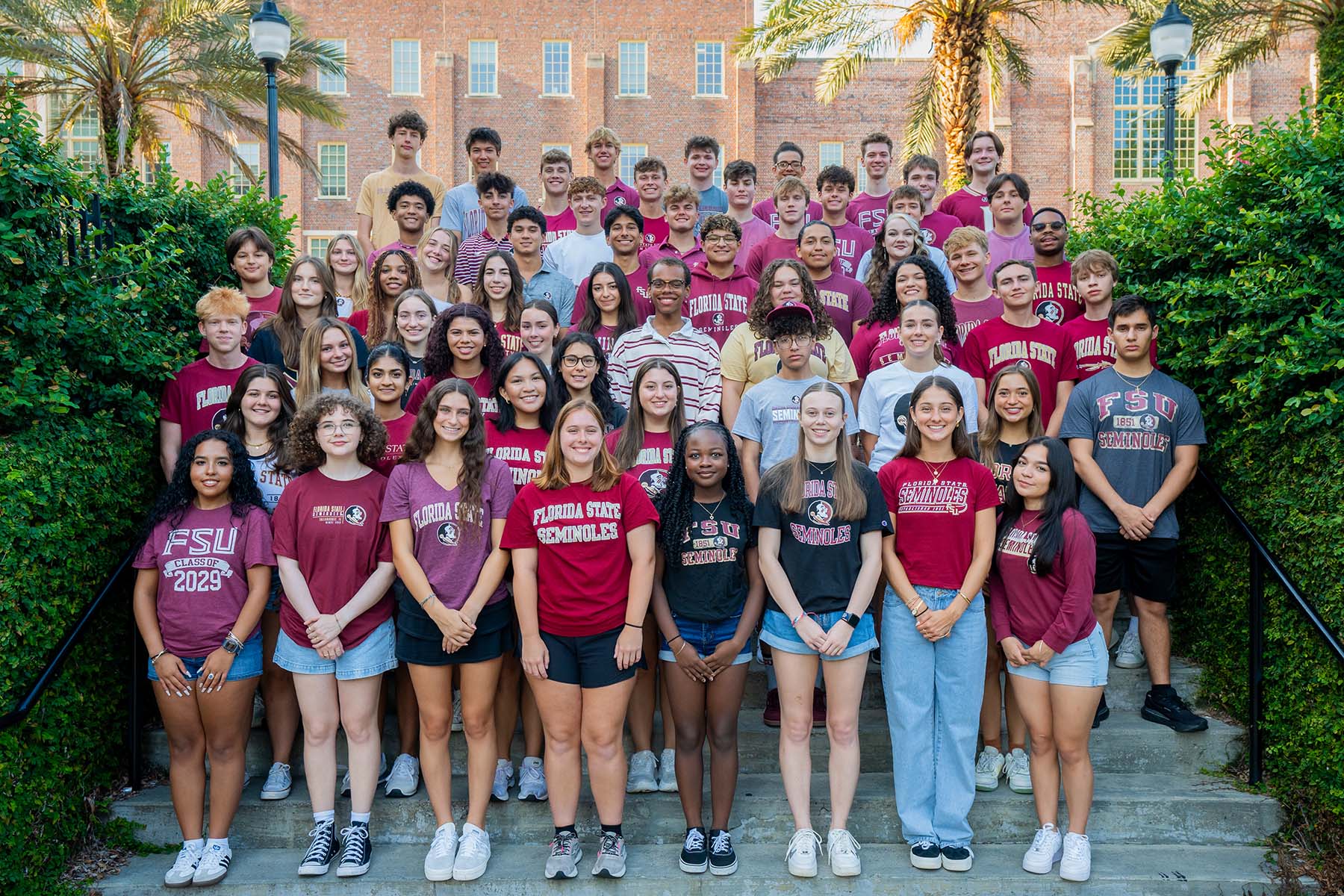
Life at FSU is steeped in tradition and bubbles with activity, offering a classic, spirited college experience in a sprawling Southern capital city. The campus life is rich with an array of co-curricular experiences designed to foster community. Students can join over 700 clubs, honor societies, Greek organizations, or community service groups, or even start their own new student organization to meet like-minded peers.
Beyond clubs, the campus itself is a hub of activity. Students have access to athletics tickets, free movies, concerts, and bowling on campus. Many enjoy relaxing with friends in one of the 14 residence halls. The overall vibe, as described by students, is one of a vibrant campus with "tons of clubs and activities," creating a dynamic environment where social and academic lives are deeply intertwined.
FSU's investment in student success is evident in its outstanding outcomes, which rival those of top-tier public universities. The most striking metrics are its retention and graduation rates. The first-year retention rate is a stellar 96-97%, and the four-year graduation rate has reached a record high of 76-78%, which the university notes is on par with the top 10 public universities in the nation. The six-year graduation rate is 86%.
This focus on timely graduation translates into strong early career prospects. While specific institutional median earnings data is limited in the sources, one report on Florida's public university system indicates that median first-year earnings for bachelor's graduates from State University System institutions ranged up to nearly $56,000, with FSU likely at the higher end of that spectrum given its profile and program strength.
As a public institution, FSU offers a strong value proposition, particularly for in-state students, with a significant portion of the student body receiving financial aid to reduce the . The average net price after aid and scholarships is $11,297. Approximately 91% of full-time beginning undergraduates receive grant or scholarship aid, with the average aid package totaling around $13,622.
The university provides a Net Price Calculator for families to estimate their individual cost after factoring in potential grants and scholarships. It's important to note that while FSU offers substantial aid, the sources do not indicate it has a "no-loan" policy or that it meets 100% of demonstrated financial need without loans. Federal Direct Loans, both subsidized and unsubsidized, are available as part of financial aid packages, and students must submit the FAFSA annually to determine eligibility.
Florida State stands out for its potent combination of skyrocketing academic prestige and an unabashedly vibrant, traditional campus culture. It has masterfully evolved from a good state school into a highly selective public research university where the average admitted student now sports a 4.5 GPA and a 1430 SAT—credentials that would have been unthinkable a decade ago. Yet, it has retained the spirited, community-oriented soul of a Southern flagship.
This duality is its defining feature. Students are immersed in a rigorous academic environment with top-ranked programs and a remarkable 96% retention rate, while also enjoying a quintessential college experience complete with football Saturdays, a massive array of clubs, and campus events. FSU proves that a university can simultaneously raise its academic bar to national heights and double down on the immersive, social student life that makes the undergraduate years memorable. It’s a place where ambition and tradition aren't at odds, but are woven together into a single, distinctive fabric.
Florida State University seal · sourceFlorida State University - State University System of Florida · sourceon Campus - Florida State University - uniexperts · sourceAbout FSU | Florida State University · source