Admit rate has ranged 77%–86% over the last 5 years — notably volatile. Source: IPEDS via Urban Institute.
Acceptance & SAT from Common Data Set / IPEDS; net price, earnings & graduation from the U.S. Dept. of Education College Scorecard. Figures lag ~1–2 years — verify with the school.
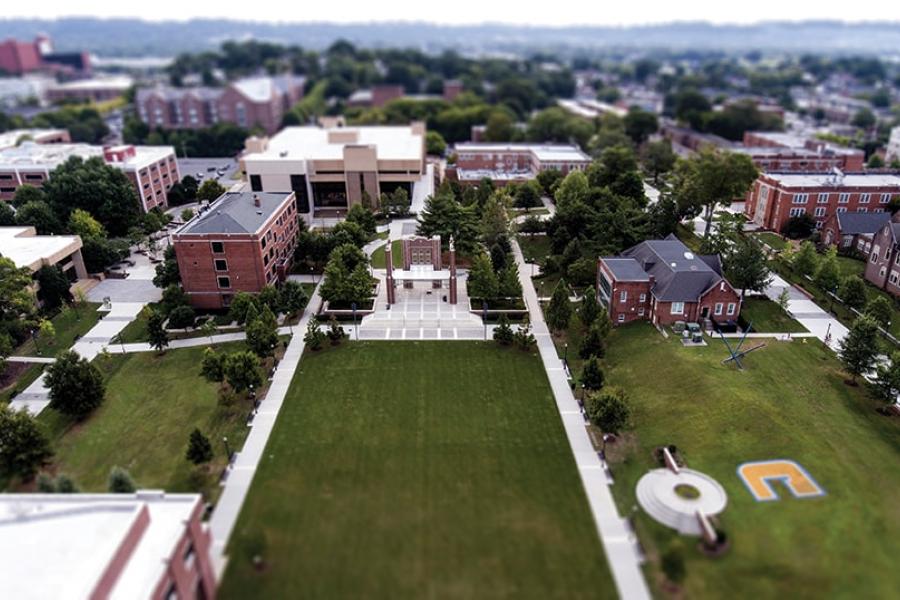
The University of Tennessee-Chattanooga is a public, metropolitan university that feels more like a scrappy, accessible engine of practical education than a cloistered campus. It’s a place where guaranteed admission for in-state students with solid grades meets a sprawling, mostly commuter student body, and where business and nursing majors dominate a curriculum designed to launch careers in the region. The vibe is distinctly Chattanooga—outdoorsy, low-key, and anchored in a mid-sized city that’s as much a part of the experience as the campus itself.
Admission requirements
Test-optional — scores considered if submitted
Required
High school transcript
Grade point average
TOEFL (non-native English)
Considered (not required)
Test scores (SAT/ACT)
College-prep program
Source: IPEDS Admissions survey (2022) via Urban Institute. Covers formal factors only — it does not reflect essays, extracurriculars, or other holistic criteria.
More details
Undergrad enrollment
10,074
In-state tuition
$10,448
Out-of-state tuition
$18,512
Graduation Rate
50%
Most Popular Major
Business (21% of grads)
Median Earnings (10yr)
$51,151
Students Living On-Campus
35%
Students Receiving Grant/Scholarship Aid
92%
Outcomes & value
Outcomes & value
Median earnings (10 yr)
$51,151
Value (earnings ÷ net price)
3.6×
Median debt at graduation
$19,500
Graduation rate
50%
First-year retention
73%
Reducing loan balance (3 yr)
57%
Pell (lower-income) share
33%
First-gen share (among federal-aid recipients)
29%
Top-earning majors
Median earnings by field of study (highest credential), ~2 years after completion.
Electrical, Electronics, and Communications Engineering$72,883
Engineering, General$69,338
Chemical Engineering$67,324
Mechanical Engineering$63,005
Civil Engineering$62,012
Computer Science$57,318
Campus & location
Campus safety
On-campus violent crimes (2024)
7
Per 1,000 students
0.60
On-campus criminal offenses classed as violent (murder/non-negligent manslaughter, rape, robbery, aggravated assault) for the most recent reported year. Source: U.S. Dept. of Education Campus Safety and Security (Clery Act). Counts reflect what’s reported to the school, and urban campuses often report more partly due to non-student incidents nearby — read alongside campus size and setting, not as a standalone safety verdict.
Climate
Pleasant days / yr
96
Summer high
87°F
Winter low
37°F
Annual rain
59.8"
Annual snow
2.5"
Natural-hazard risk
Relatively Moderate
Pleasant days counts days per year with a mean temperature of 55–75°F, a high at or below 90°F, a low at or above 45°F, and little precipitation — a transparent comfort measure, not a weighting we invented. Computed from Open-Meteo ERA5 daily history (2019–2023). Natural-hazard risk is the county’s composite rating from the FEMA National Risk Index.
Quick answers
What is the acceptance rate at The University of Tennessee-Chattanooga?
The University of Tennessee-Chattanooga's acceptance rate is approximately 81% (Chattanooga, TN), based on the most recent figures we compiled from public and primary sources.
What SAT score do you need for The University of Tennessee-Chattanooga?
Admitted students at The University of Tennessee-Chattanooga typically score 1013–1210 on the SAT (the middle-50% range). Scores outside this band are still admitted, especially with strong applications.
How much does The University of Tennessee-Chattanooga cost?
At The University of Tennessee-Chattanooga, the average net price (after aid) is about $14,265 per year. Actual cost varies with financial aid and residency.
How many undergraduates attend The University of Tennessee-Chattanooga?
The University of Tennessee-Chattanooga enrolls approximately 10,074 undergraduate students.
Where is The University of Tennessee-Chattanooga located?
The University of Tennessee-Chattanooga is located in Chattanooga, TN.
Admissions
UTC’s admissions process is defined by its accessibility, particularly for Tennessee residents. The university offers a straightforward guaranteed admission pathway for in-state applicants who meet one of two clear benchmarks: a 2.85 high school GPA with a minimum 18 ACT composite (or 960 SAT), or a minimum 2.5 high school GPA with a 21 ACT composite (or 1060 SAT).
For the broader applicant pool, the process is moderately selective. The university reports that 94% of admitted freshmen submitted ACT scores, while only 7% submitted SAT scores, highlighting the ACT's dominance in the region. The admitted student profile skews toward solid academic performance: nearly half (47%) of enrolled freshmen had high school GPAs of 3.75 or higher, and another 19% fell in the 3.50–3.74 range.
There is no Early Decision program, and the available sources do not specify whether demonstrated interest is a considered factor in admissions decisions. The process is largely numbers-driven, prioritizing academic record and standardized test scores for those not covered by the guaranteed admission standards.
Earnings = median of students working ~10 years after entry; debt = median of graduates. Value divides 10-yr earnings by one year’s net price — read it as earnings per dollar of annual cost, not a full lifetime ROI; it favors lower-cost schools. Source: U.S. Dept. of Education College Scorecard. Figures lag ~2 years and reflect all students, not your intended major.
Registered Nursing, Nursing Administration, Nursing Research and Clinical Nursing
$53,556
Engineering-Related Fields$52,941
Source: U.S. Dept. of Education College Scorecard (field-of-study earnings). Figures cover graduates who received federal aid and lag ~2 years; not all programs report data.
UTC’s academic landscape is pragmatic and career-focused, with a strong emphasis on fields that feed directly into the regional economy. The curriculum is built on a core general education program designed to provide a broad foundation before students dive into their majors.
Business is the undisputed king. 21% of 2024 graduates majored in Business, Management, Marketing, and Related Support Services, making it by far the most popular academic path. Psychology follows as a distant second at 11%. Other popular majors include Kinesiology and Exercise Science, Nursing, and Criminal Justice/Law Enforcement Administration. The mix suggests a student body largely oriented toward applied fields in healthcare, business, public service, and wellness.
The academic structure is traditional, with no mention of distinctive core curricula or extensive undergraduate research requirements in the provided sources. The focus appears to be on providing a solid, direct route to a degree and a job.
Life at UTC is characterized by its commuter-school reality blended with the amenities of a mid-sized city. Only 35% of students live in college-owned, -operated, or -affiliated housing, meaning nearly two-thirds live off-campus. This creates a more diffuse social scene where the city of Chattanooga itself—with its outdoor attractions, downtown revitalization, and mid-sized city vibe—plays a major role.
On campus, the university promotes an "engaged, metropolitan" identity. Student life is active, supported by Greek life, a wide array of student organizations, and NCAA Division I athletics (the Mocs), which contribute to a traditional collegiate atmosphere for those who seek it. Descriptions from students and the university itself point toward a "chill vibe" with a diverse student body. The experience is what you make of it: it’s possible to be deeply involved in campus clubs and sports, or to treat UTC more as a place to attend class before returning to life in the wider Chattanooga area.
Graduation rates and early-career earnings at UTC reflect its mission as an accessible public university serving a broad population. The four-year graduation rate is 35%, but this rises significantly when given more time: the six-year graduation rate is reported at 56% in one federal source, while institutional dashboards show a 37.56% increase in the six-year rate over a baseline (though the exact percentage isn't provided in the snippet).
Post-graduation earnings are modest but meaningful for the region. One source lists the median alumni salary at $40,626, while another reports median earnings six years after graduation at $42,209. Earnings tend to grow with experience, moving from an average of $32,300 after six years to $39,800 after ten years in one progression model. These figures align with the university's focus on launching graduates into practical, often local, careers in business, healthcare, and public service rather than high-finance or tech corridors.
UTC positions itself as an affordable option, particularly for Tennessee residents. A significant 92% of full-time beginning undergraduates receive grant or scholarship aid. The —the average cost after aid—is reported variably across sources, but the canonical figure is $14,265.
The university encourages all students to submit the FAFSA and provides tools like a Net Price Calculator for early estimates. It administers the UT Promise scholarship for undergraduates, though the specific eligibility details are not provided in the sources. The available materials do not indicate that UTC has a "no-loan" policy or that it meets 100% of demonstrated financial need for all admitted students. Financial aid is described as being processed within 4–6 weeks after a student's file is complete, and maintaining satisfactory academic progress is required to continue receiving aid.
UTC stands out for its unapologetically practical and regional focus. It’s not trying to be an elite liberal arts college or a giant research university. Instead, it serves as a reliable talent pipeline for Chattanooga and Tennessee, with academic programs tightly aligned to local job markets—hence the overwhelming dominance of business and health-related majors. The guaranteed admission policy for in-state students underscores its commitment to accessibility within the state.
The campus culture is inextricably linked to its setting. Unlike a secluded college town, UTC is woven into the fabric of a city that’s known for its outdoor recreation and ongoing urban renaissance. This makes for a specific type of student experience: less insular, more self-directed, and ideal for those who see college as one part of a larger life in a dynamic small city. It’s a choice for students who prioritize career-ready degrees, manageable debt, and the vibe of the Tennessee Valley over prestige or a traditional, all-encompassing residential experience.
The University of Tennessee-Chattanooga seal · sourceAbout UTC | University of Tennessee at Chattanooga · sourceChoose UTC | University of Tennessee at Chattanooga · sourceThe University of Tennessee at Chattanooga | Chattanooga TN · source