Admit rate has ranged 62%–78% over the last 5 years — notably volatile. Source: IPEDS via Urban Institute.
Acceptance & SAT from Common Data Set / IPEDS; net price, earnings & graduation from the U.S. Dept. of Education College Scorecard. Figures lag ~1–2 years — verify with the school.
Trevecca Nazarene University is a small, Christian liberal arts school embedded in the heart of Nashville, offering a faith-based education with a surprisingly pragmatic bent. Its identity is split between a traditional undergraduate campus focused on community and service, and a sprawling online and graduate division catering to working adults. While its graduation rates are modest, Trevecca provides a direct, accessible pathway to degrees in business, healthcare, and ministry for students who value its religious character and urban location.
Admission requirements
Test-optional — scores considered if submitted
Required
Grade point average
TOEFL (non-native English)
Considered (not required)
High school transcript
Class rank
Letters of recommendation
Test scores (SAT/ACT)
Source: IPEDS Admissions survey (2022) via Urban Institute. Covers formal factors only — it does not reflect essays, extracurriculars, or other holistic criteria.
More details
Undergrad enrollment
1,737
In-state tuition
$31,300
Out-of-state tuition
$31,300
Top Major
Business (33%)
Urban Setting
Nashville, TN
Graduation Rate
53%
Campus Housing Cost
$11,000/year
Regular App Deadline
August 1
Student-Faculty Ratio
19:1
Median Earnings (10yr)
$49,378
Outcomes & value
Outcomes & value
Median earnings (10 yr)
$49,378
Value (earnings ÷ net price)
2.9×
Median debt at graduation
$18,744
Graduation rate
53%
First-year retention
74%
Reducing loan balance (3 yr)
67%
Pell (lower-income) share
32%
First-gen share (among federal-aid recipients)
39%
Financial health
2.9 / 3.0Meets the federal financial-responsibility standard
U.S. Dept. of Education Financial Responsibility Composite Score (FY2022-23). Scale −1.0 to 3.0; ≥1.5 meets the standard. Reported for private nonprofit & for-profit institutions only — public universities are state-backed and not scored, so this is a stability signal, not a ranking.
Top-earning majors
Median earnings by field of study (highest credential), ~2 years after completion.
Registered Nursing, Nursing Administration, Nursing Research and Clinical Nursing$57,318
Computer and Information Sciences, General$55,964
Business Administration, Management and Operations$43,798
Source: U.S. Dept. of Education College Scorecard (field-of-study earnings). Figures cover graduates who received federal aid and lag ~2 years; not all programs report data.
On-campus criminal offenses classed as violent (murder/non-negligent manslaughter, rape, robbery, aggravated assault) for the most recent reported year. Source: U.S. Dept. of Education Campus Safety and Security (Clery Act). Counts reflect what’s reported to the school, and urban campuses often report more partly due to non-student incidents nearby — read alongside campus size and setting, not as a standalone safety verdict.
Climate
Pleasant days / yr
82
Summer high
87°F
Winter low
35°F
Annual rain
75.7"
Annual snow
4.9"
Natural-hazard risk
Relatively High
Pleasant days counts days per year with a mean temperature of 55–75°F, a high at or below 90°F, a low at or above 45°F, and little precipitation — a transparent comfort measure, not a weighting we invented. Computed from Open-Meteo ERA5 daily history (2019–2023). Natural-hazard risk is the county’s composite rating from the FEMA National Risk Index.
Deep dive — research, future-scholar output & economic mobility▾
Research output
Institutional h-index
22
Scholarly works
157
Institutional research volume and impact from OpenAlex. The h-index reflects large research universities and will be low for teaching-focused liberal-arts colleges — not a measure of undergraduate quality.
Economic mobility
Mobility rate
0.4%
Bottom → top quintile
8%
From bottom quintile
5%
Mobility rate = the share of students who both start in the bottom household-income quintile and reach the top quintile; bottom → top is that chance conditional on starting at the bottom. Source: Opportunity Insights Mobility Report Cards (Chetty, Friedman, Saez, Turner & Yagan). Reflects 1980–82 birth cohorts, so it’s directional, not current.
Quick answers
What is the acceptance rate at Trevecca Nazarene University?
Trevecca Nazarene University's acceptance rate is approximately 69% (Nashville, TN), based on the most recent figures we compiled from public and primary sources.
What SAT score do you need for Trevecca Nazarene University?
Admitted students at Trevecca Nazarene University typically score 980–1235 on the SAT (the middle-50% range). Scores outside this band are still admitted, especially with strong applications.
How much does Trevecca Nazarene University cost?
At Trevecca Nazarene University, the average net price (after aid) is about $16,813 per year. Actual cost varies with financial aid and residency.
How many undergraduates attend Trevecca Nazarene University?
Trevecca Nazarene University enrolls approximately 1,737 undergraduate students.
Where is Trevecca Nazarene University located?
Trevecca Nazarene University is located in Nashville, TN.
Admissions
Trevecca's admissions process is best described as accessible and moderately selective, designed to welcome a broad range of students into its faith-based community. With an of 69%, the university admits a clear majority of its applicants, positioning it as a realistic target for many. The middle 50% of admitted students who submit scores present SAT scores between 980 and 1235 and ACT scores between 18 and 24, reflecting a moderately prepared academic cohort. The average high school GPA of incoming students is around 3.47, with a significant portion (33.9%) reporting GPAs of 3.75 or higher. The university considers admission test scores (SAT/ACT) as part of its , though they are not the sole determinant. The regular application deadline is notably late, extending to August 1, providing flexibility for students making last-minute decisions. The rate—the percentage of admitted students who enroll—is reported at 26.82%, indicating that many admitted students ultimately choose other options. There is an early decision plan with a May 1st deadline, though specific acceptance rates for early versus regular decision are not detailed in the provided sources. The , a standardized reporting document, is referenced as the source for understanding how colleges rank various admission factors, including demonstrated interest, but the specific ranking Trevecca assigns to such factors is not provided in the snippets.
Earnings = median of students working ~10 years after entry; debt = median of graduates. Value divides 10-yr earnings by one year’s net price — read it as earnings per dollar of annual cost, not a full lifetime ROI; it favors lower-cost schools. Source: U.S. Dept. of Education College Scorecard. Figures lag ~2 years and reflect all students, not your intended major.
Academically, Trevecca operates on two distinct tracks: a traditional undergraduate experience and a robust suite of graduate and online programs. The university offers more than 100 academic programs across its colleges, with a student-faculty ratio of 19:1, which allows for more personalized attention than at many larger institutions. The curriculum is rooted in the liberal arts but has a strong vocational orientation, particularly in fields aligned with the regional Nashville economy.
The most popular majors reflect this practical focus. For the 2024 graduating class, 33% of degrees were conferred in Business, Management, Marketing, and Related Support Services. Psychology (12%) and Theology and Religious Vocations also ranked among the top majors. This distribution underscores Trevecca's dual identity as both a Christian institution and a career-launching platform. Reviews note that the school is "praised for its academic rigor in many programs" and that "academic advising is helpful, making it easier to switch majors or" navigate degree requirements. Beyond the traditional campus, Trevecca has significantly expanded its reach through its Graduate & Online division, offering face-to-face and online degree programs designed for working adults seeking to advance their careers.
Life on Trevecca's urban campus is defined by its close-knit, faith-infused community. With approximately 1,413 undergraduate students hailing from 44 states and 22 countries, the campus cultivates a small, diverse environment within the sprawling context of Nashville. Student life is actively promoted as "an important part of campus culture," with numerous invitations to "get involved, build community and grow as leaders through student organizations, campus activities, recreation, service opportunities." Housing is a central component, with campus housing costing an average of $11,000 per year. The urban setting provides easy access to the music, culture, and internship opportunities of Nashville, though the campus itself aims to be a self-contained community. Athletics, clubs, and service projects form the backbone of extracurricular engagement. The overall vibe, as reflected in student reviews and institutional messaging, is one of intentional community-building for students who share a Christian worldview.
Trevecca's student outcomes present a mixed picture, with graduation rates that lag behind national averages but post-graduation earnings that show promise, particularly for certain majors. The overall graduation rate is 53%, with only 40% of students completing their bachelor's degree within four years and 48% within five years. This pace of completion is considered "average but places the institution in the lower half of national" comparisons.
Earnings outcomes, however, provide a more positive signal. The median earnings for students working ten years after entry is $49,378. Earlier in their careers, graduates report average earnings of $43,262 one year after graduation, rising to $51,045 after five years. Some analyses indicate that Trevecca graduates earn a median of $64,175 four years after graduation, which is noted as 6% above the national average. It is crucial to note that "earnings vary significantly by major," suggesting that choice of program is a critical determinant of financial return. The university also tracks broader "student achievement objectives," though the specific metrics are not detailed in the provided snippets.
Trevecca positions itself as an affordable private option, with a that is significantly lower than its sticker tuition. The average net price after grants and scholarships is $16,813. The university reports an average financial aid package of $16,584. This aid is a mix of federal, state, and institutional grants, scholarships, and loans. Trevecca actively encourages students to use its Net Price Calculator to receive a personalized estimate of aid eligibility and emphasizes comparing college costs. There is a specific mention of matching "up to $500 for any church affiliated scholarship," highlighting its connection to religious communities. The financial aid application deadline is January 1.
It is important to distinguish Trevecca's aid policy from those of elite "no-loan" institutions. The provided sources define a "no-loan policy" as one where a school meets 100% of a qualifying student's financial need with grants alone, not loans, and note such policies are typically supported by large endowments. There is no indication in any of the Trevecca-specific sources that the university has such a policy. Instead, its financial aid includes loans, and the types and amounts "vary depending on grade level and financial need." One external analysis suggests that a net price close to the aid package amount "often means that the financial aid policy at the school is relatively weak, and grants aren't enough to cover total cost," implying loans are a necessary component for many families.
Trevecca Nazarene University stands out for its distinctive fusion of evangelical Christian identity with the practical opportunities of a major American city. It is not a secluded Bible college but a comprehensive university planted in Nashville, allowing students to engage in ministry, music business internships, and healthcare rotations within the same mile. Its academic profile is uniquely bifurcated: a small, residential undergraduate college focused on community formation sits alongside a large, pragmatic graduate and online division that functions almost like a separate career-advancement engine. This creates two different student experiences under one banner. Furthermore, its admissions approachability—a 69% and an August 1 regular deadline—makes it a tangible option for students seeking a faith-based education without the intense selectivity of similar institutions. Ultimately, Trevecca's value proposition is clear: it offers a supportive, religiously-grounded environment as a launchpad for careers in business, health, and ministry, all while leveraging its location in a dynamic urban hub.
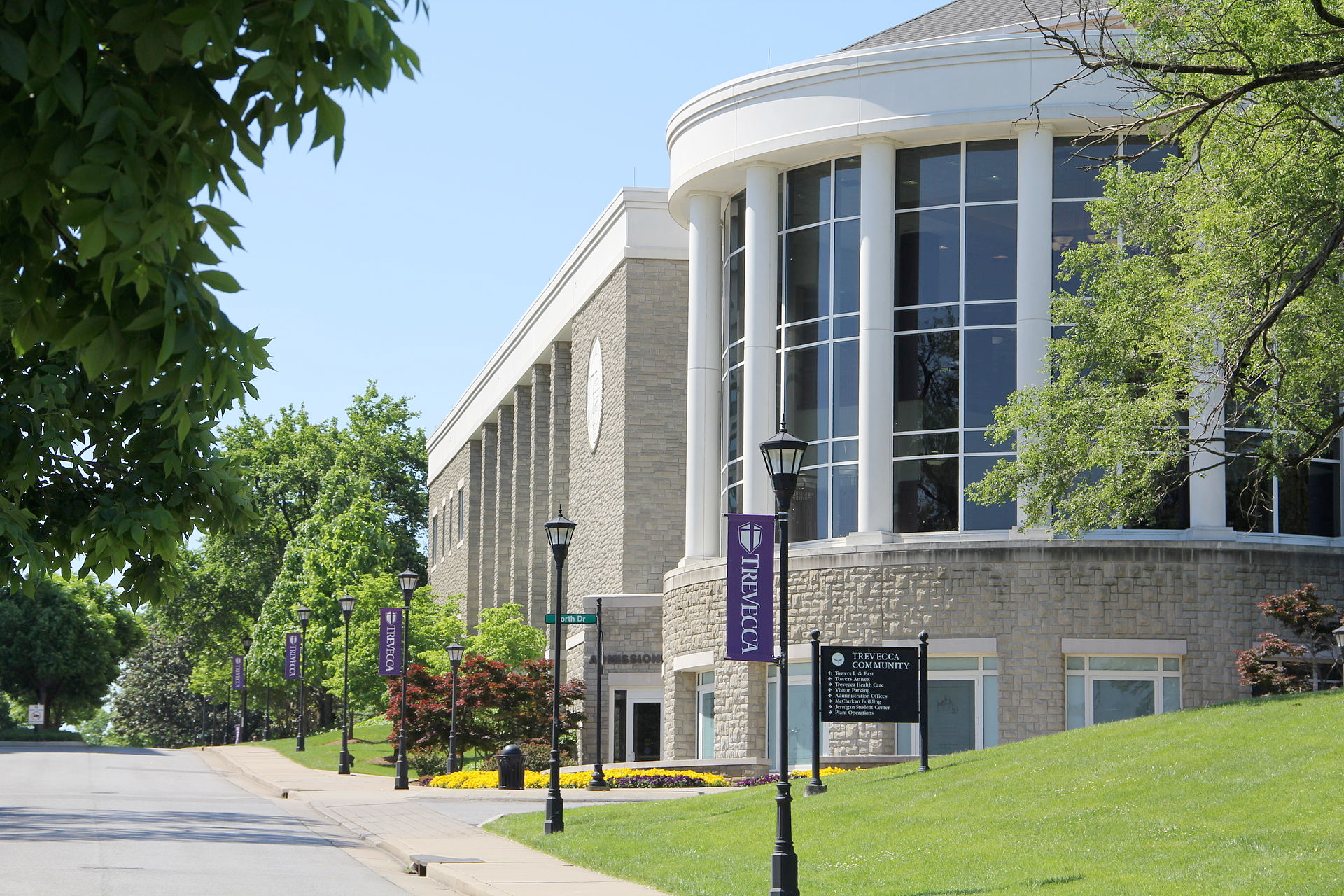
Trevecca Nazarene University seal · sourceFrom Calling to Becoming | Trevecca Nazarene University · sourceMaps & Directions | Trevecca Nazarene University · sourceTrevecca Nazarene University — Study Tennessee · source


-1.png)