Admit rate has ranged 33%–38% over the last 5 years, though the latest figure above (29%) falls outside that window. Source: IPEDS via Urban Institute.
Acceptance & SAT from Common Data Set / IPEDS; net price, earnings & graduation from the U.S. Dept. of Education College Scorecard. Figures lag ~1–2 years — verify with the school.
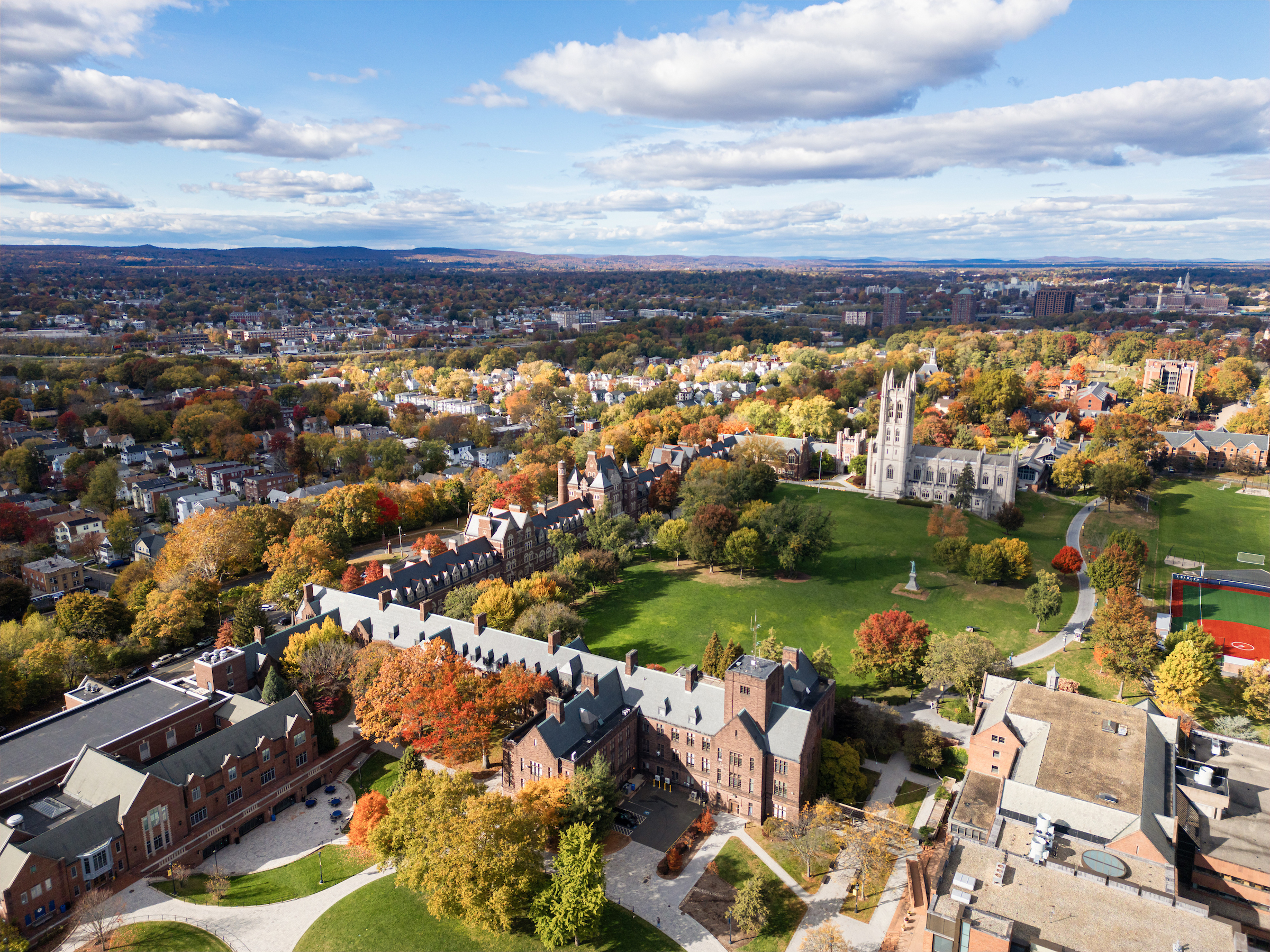
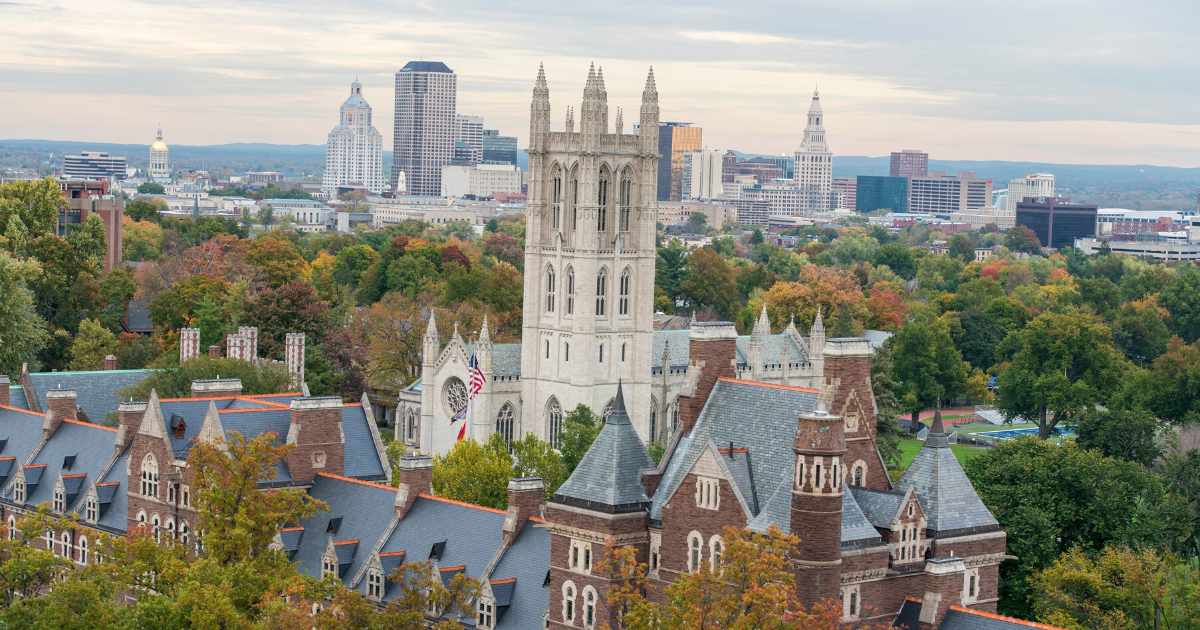
Trinity College is a selective, historic liberal arts college in Hartford, Connecticut, that offers a classic New England campus experience with the unexpected advantage of an urban backdrop. Its academic identity is firmly rooted in the social sciences and humanities, with a curriculum offering over 40 majors and a dense network of student-run clubs and activities. The college's admissions process is increasingly shaped by Early Decision, and while it projects a strong sense of community, student accounts suggest a social scene that can feel dominated by affluent cliques.
Admission requirements
Test-optional — scores considered if submitted
Required
High school transcript
Letters of recommendation
College-prep program
TOEFL (non-native English)
Considered (not required)
Grade point average
Class rank
Test scores (SAT/ACT)
Demonstrated competencies
Source: IPEDS Admissions survey (2022) via Urban Institute. Covers formal factors only — it does not reflect essays, extracurriculars, or other holistic criteria.
More details
Undergrad enrollment
2,146
In-state tuition
$70,770
Out-of-state tuition
$70,770
No-Loan Policy
Not Stated in Sources
Graduation Rate
84%
Meets Full Need
Not Stated in Sources
ED Share of Class
Not Stated in Sources
First-Year Retention
Not Stated in Sources
Demonstrated Interest
Not Stated in Sources
Median Earnings (10yr)
$90,779
Outcomes & value
Outcomes & value
Median earnings (10 yr)
$90,779
Value (earnings ÷ net price)
2.6×
Median debt at graduation
$23,000
Graduation rate
84%
First-year retention
90%
Reducing loan balance (3 yr)
80%
Pell (lower-income) share
14%
First-gen share (among federal-aid recipients)
18%
Financial health
2.6 / 3.0Meets the federal financial-responsibility standard
U.S. Dept. of Education Financial Responsibility Composite Score (FY2022-23). Scale −1.0 to 3.0; ≥1.5 meets the standard. Reported for private nonprofit & for-profit institutions only — public universities are state-backed and not scored, so this is a stability signal, not a ranking.
Top-earning majors
Median earnings by field of study (highest credential), ~2 years after completion.
Economics$61,814
Public Policy Analysis$47,260
Psychology, General$43,798
English Language and Literature, General$43,128
Political Science and Government$42,235
Source: U.S. Dept. of Education College Scorecard (field-of-study earnings). Figures cover graduates who received federal aid and lag ~2 years; not all programs report data.
Co-application frequency from self-reported results — directional peer discovery, not a recommendation.
Campus & location
Campus safety
On-campus violent crimes (2024)
5
Per 1,000 students
2.29
On-campus criminal offenses classed as violent (murder/non-negligent manslaughter, rape, robbery, aggravated assault) for the most recent reported year. Source: U.S. Dept. of Education Campus Safety and Security (Clery Act). Counts reflect what’s reported to the school, and urban campuses often report more partly due to non-student incidents nearby — read alongside campus size and setting, not as a standalone safety verdict.
Climate
Pleasant days / yr
89
Summer high
83°F
Winter low
25°F
Annual rain
51.1"
Annual snow
25.6"
Pleasant days counts days per year with a mean temperature of 55–75°F, a high at or below 90°F, a low at or above 45°F, and little precipitation — a transparent comfort measure, not a weighting we invented. Computed from Open-Meteo ERA5 daily history (2019–2023).
Deep dive — research, future-scholar output & economic mobility▾
Research output
Institutional h-index
157
Scholarly works
6,648
Institutional research volume and impact from OpenAlex. The h-index reflects large research universities and will be low for teaching-focused liberal-arts colleges — not a measure of undergraduate quality.
Quick answers
What is the acceptance rate at Trinity College?
Trinity College's acceptance rate is approximately 29% (Hartford, CT), based on the most recent figures we compiled from public and primary sources.
What SAT score do you need for Trinity College?
Admitted students at Trinity College typically score 1298–1470 on the SAT (the middle-50% range). Scores outside this band are still admitted, especially with strong applications.
How much does Trinity College cost?
At Trinity College, the average net price (after aid) is about $34,832 per year. Actual cost varies with financial aid and residency.
How many undergraduates attend Trinity College?
Trinity College enrolls approximately 2,146 undergraduate students.
Where is Trinity College located?
Trinity College is located in Hartford, CT.
Admissions
Trinity College is a selective institution where applying Early Decision has become a significant strategic advantage. The overall is 29%, but the Early Decision acceptance rate is notably higher, reported at 44% for one cycle and around 46.46% for another. This two-phase ED process (ED I and ED II) is a powerful tool for the college, yielding near-perfect enrollment rates—ED I for the Class of 2030 had a 99% enrollment rate. For the Regular Decision round, admitted students are academically strong, with a middle 50% SAT range of 1298–1470 and an ACT range of 31–34. The college has been since 2015, meaning the SAT or ACT is not required for all applicants. The admissions office receives a high volume of applications, with one recent cycle seeing 11,632 applicants for a class of 680 enrolled students, resulting in a 28% admit rate.
Earnings = median of students working ~10 years after entry; debt = median of graduates. Value divides 10-yr earnings by one year’s net price — read it as earnings per dollar of annual cost, not a full lifetime ROI; it favors lower-cost schools. Source: U.S. Dept. of Education College Scorecard. Figures lag ~2 years and reflect all students, not your intended major.
The academic experience at Trinity is defined by a traditional liberal arts curriculum with notable strength in the social sciences. The college offers 42 majors, 15 disciplinary minors, and 25 interdisciplinary minors, providing students with over 900 courses to craft their education. The most popular majors reflect this social science focus: Political Science and Government, Economics, and Psychology are consistently at the top. Other significant areas of study include Econometrics and Quantitative Economics, Engineering, and Neuroscience. Data from U.S. News shows the breakdown of degrees conferred: 34% in Social Sciences, 10% in Biological and Biomedical Sciences, 9% in Psychology, and 7% in Public Administration and Social Service Professions. This creates an intellectual environment where debates about policy, markets, and human behavior are central to the campus discourse.
Life on Trinity's 100-acre campus in Hartford is described as active and densely programmed, with more than 150 student-led clubs and organizations driving the social and cultural calendar. The college promotes a vibrant scene of "music festivals, movies, concerts, lectures, parties, student government meetings, mock trials, art shows, and athletic events." A strong majority of students (83%) live in college-owned, -operated, or -affiliated housing, creating a residential bubble within the city. However, student perspectives add a layer of complexity to this picture. Some find the campus community to be "cliquey, with a strong presence of affluent social groups dominating weekend nightlife and social activities." This suggests a social scene where Greek life and socioeconomic background can play a defining role, even as the administration strives to foster a "diverse and inclusive community where students can engage in difficult dialogues."
Trinity College produces strong graduation outcomes, with an 84% graduation rate. This places its performance in the top tier nationally. For alumni, median earnings ten years after entry are $90,779. Other sources report median alumni earnings in the range of $67,628 to over $80,000, indicating that Trinity graduates typically achieve earnings well above the national average. The college's outcomes are a key part of its value proposition as a member of the "Little Ivies," with long-term career trajectories for alumni often landing in the professional and financial sectors aligned with its popular majors.
The comprehensive at Trinity is high, with tuition listed at $70,360. However, the college provides substantial financial aid to offset this sticker price. The average financial aid package for the Class of 2029 was $59,000, and grant assistance can be as high as $69,210 in example aid awards. The result is an average after aid of $34,832. Trinity encourages families to use its Net Price Calculator and a Quick College Cost Estimator to get an early, personalized estimate of their cost. The college states that students are eligible for financial aid provided they applied for it at admission and continue to have demonstrated financial need. The available sources do not specify a universal "no-loan" policy or a guarantee to meet 100% of demonstrated need for all admitted students; financial aid packages typically include a mix of grants, scholarships, work-study, and loans.
Trinity College stands out for its distinctive blend of a classic, self-contained liberal arts campus and its location in a state capital, offering students a traditional collegiate experience with proximate urban opportunities. Its academic identity is sharply defined by deep strength in political science, economics, and psychology, attracting students geared toward policy, finance, and law. The admissions landscape is increasingly bifurcated, making it a prime example of a school where the Early Decision advantage is pronounced and strategically critical for applicants. Furthermore, the student life narrative presents a fascinating tension: an administration promoting inclusive community and vibrant programming coexists with student-reported social dynamics that are often perceived as exclusive and influenced by wealth. This makes Trinity a complex and specific choice—ideal for students who thrive in a socially traditional, academically rigorous environment and are savvy enough to navigate its particular admissions and social codes.
Trinity College seal · sourceWelcome to Trinity College | Trinity College · sourceTrinity College, Cambridge - Wikipedia · sourceCampus Tour - Study - Trinity College Dublin · source