Loading…
← All schools
University of Akron Main Campus
Akron, OHpublicwww.uakron.edu/
Acceptance
60%
SAT 25–75
900–1190
Avg net price
$13,946
Earnings (10 yr)
$46,600
Graduation rate
52%
Admit rate has ranged 71%–85% over the last 5 years — notably volatile, though the latest figure above (60%) falls outside that window. Source: IPEDS via Urban Institute.
Acceptance & SAT from Common Data Set / IPEDS; net price, earnings & graduation from the U.S. Dept. of Education College Scorecard. Figures lag ~1–2 years — verify with the school.
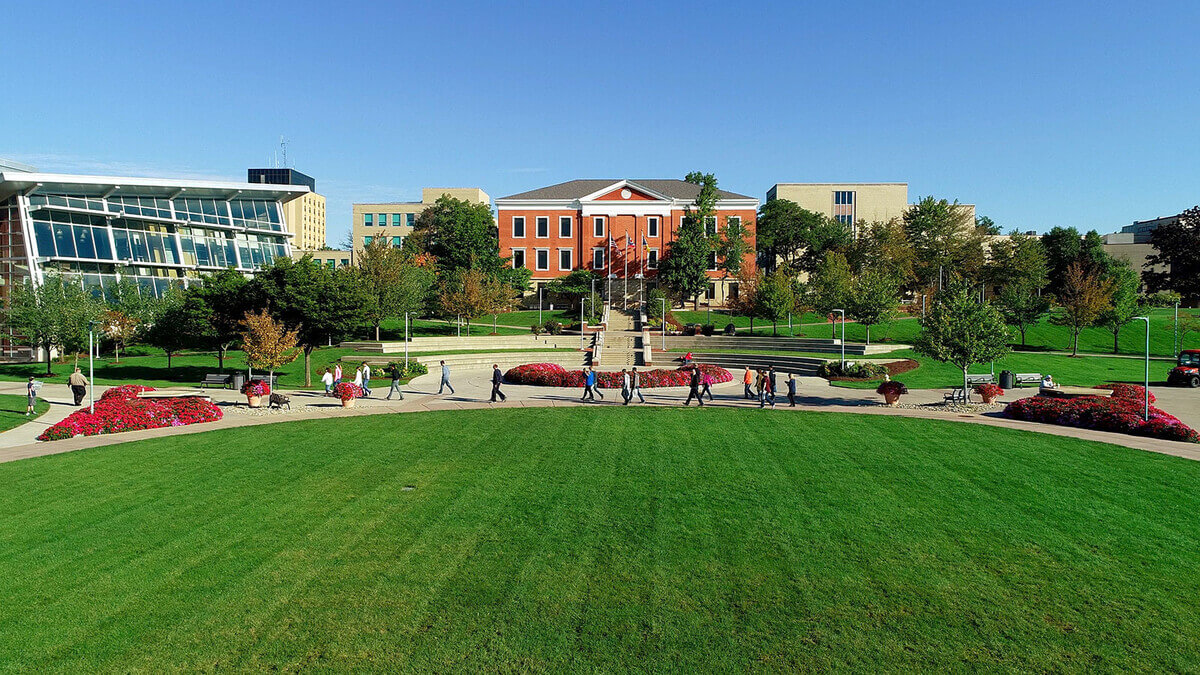
The University of Akron is a public research university that operates like a sprawling, pragmatic engine for Northeast Ohio. It's defined by its deep, symbiotic relationship with the industrial and healthcare sectors of its namesake city, offering a massive catalog of 200+ majors with a particular gravitational pull toward engineering, nursing, and criminal justice. The vibe is commuter-heavy and career-focused, where a significant portion of the student body lives off-campus and the measure of success is often a solid first job in the region.
Admission requirements
Test-optional — scores considered if submitted
Required
- Grade point average
- College-prep program
- TOEFL (non-native English)
Considered (not required)
- High school transcript
- Letters of recommendation
- Test scores (SAT/ACT)
- Demonstrated competencies
Source: IPEDS Admissions survey (2022) via Urban Institute. Covers formal factors only — it does not reflect essays, extracurriculars, or other holistic criteria.
More details
- Undergrad enrollment
- 9,052
- In-state tuition
- $13,135
- Out-of-state tuition
- $20,815
- Campus Housing
- 24% of students
- Early Decision
- Not offered
- No-Loan Policy
- No
- Graduation Rate
- 52%
- Meets Full Need
- No policy stated
- Most Popular Major
- Registered Nursing (8%)
- Demonstrated Interest
- Not considered
- Student Organizations
- 340+
- Median Earnings (10yr)
- $46,600
Outcomes & value
Outcomes & value
- Median earnings (10 yr)
- $46,600
- Value (earnings ÷ net price)
- 3.3×
- Median debt at graduation
- $23,250
- Graduation rate
- 52%
- First-year retention
- 73%
- Reducing loan balance (3 yr)
- 46%
- Pell (lower-income) share
- 29%
- First-gen share (among federal-aid recipients)
- 36%
Top-earning majors
Median earnings by field of study (highest credential), ~2 years after completion.
- Chemical Engineering$71,015
- Electrical, Electronics, and Communications Engineering$70,558
- Electrical/Electronic Engineering Technologies/Technicians$69,338
- Computer Engineering$69,002
- Mechanical Engineering$66,821
- Mathematics and Computer Science
Campus & location
Campus safety
- On-campus violent crimes (2024)
- 7
- Per 1,000 students
- 0.62
On-campus criminal offenses classed as violent (murder/non-negligent manslaughter, rape, robbery, aggravated assault) for the most recent reported year. Source: U.S. Dept. of Education Campus Safety and Security (Clery Act). Counts reflect what’s reported to the school, and urban campuses often report more partly due to non-student incidents nearby — read alongside campus size and setting, not as a standalone safety verdict.
Climate
- Pleasant days / yr
- 97
- Summer high
- 81°F
- Winter low
- 25°F
- Annual rain
- 43"
- Annual snow
- 30.4"
- Natural-hazard risk
- Relatively Moderate
Pleasant days counts days per year with a mean temperature of 55–75°F, a high at or below 90°F, a low at or above 45°F, and little precipitation — a transparent comfort measure, not a weighting we invented. Computed from Open-Meteo ERA5 daily history (2019–2023). Natural-hazard risk is the county’s composite rating from the FEMA National Risk Index.
Quick answers
- What is the acceptance rate at University of Akron Main Campus?
- University of Akron Main Campus's acceptance rate is approximately 60% (Akron, OH), based on the most recent figures we compiled from public and primary sources.
- What SAT score do you need for University of Akron Main Campus?
- Admitted students at University of Akron Main Campus typically score 900–1190 on the SAT (the middle-50% range). Scores outside this band are still admitted, especially with strong applications.
- How much does University of Akron Main Campus cost?
- At University of Akron Main Campus, the average net price (after aid) is about $13,946 per year. Actual cost varies with financial aid and residency.
- How many undergraduates attend University of Akron Main Campus?
- University of Akron Main Campus enrolls approximately 9,052 undergraduate students.
- Where is University of Akron Main Campus located?
- University of Akron Main Campus is located in Akron, OH.
Admissions
Akron's admissions process is best described as accessible and moderately selective, with a focus on bringing in a large, diverse undergraduate class. The university does not have a binding Early Decision program; its early action pathway is non-binding. The admissions office states that special consideration is given for participation in both school and non-school-related activities, indicating a beyond just grades and test scores. A high school diploma is required, and a GED is not accepted for admission. The process is test-flexible, with the middle 50% SAT range for admitted students who submitted scores falling between 900 and 1190. The most important factors in admissions decisions are the applicant's academic GPA and the rigor of their secondary school record. Class rank, standardized test scores, and the application essay are also considered. Notably, the university does not consider an applicant's status, alumni relation, geographical residence, state residency, religious affiliation, volunteer work, work experience, or level of interest in attending (demonstrated interest) in its admissions decisions.
Compare University of Akron Main Campus
vs University of Central Missourivs Southeast Missouri State Universityvs Saginaw Valley State Universityvs University of Missouri-St Louis
See colleges similar to University of Akron Main Campus →Sources
- Common Data Set | Institutional Research - The University Of Akron
- [PDF] Common Data Set 2022-2023 - University of Akron
- [PDF] Common Data Set 2021-2022 - The University Of Akron
- Student Enrollment - The University Of Akron
- [PDF] Common Data Set 2023-2024
- University of Akron Main Campus - IPEDS - Department of Education
- University of Akron Admissions - BigFuture College Search
- University of Akron SAT Scores and GPA
- University of Akron: Acceptance Rate, SAT/ACT Scores, GPA
- University of Akron SAT, ACT & GPA Requirements for Admissions