Loading…
← All schools
University of Hawaii at Manoa
Honolulu, HIpublicmanoa.hawaii.edu
Acceptance
87%
SAT 25–75
1081–1293
Avg net price
$15,664
Earnings (10 yr)
$57,624
Graduation rate
64%
Admit rate has ranged 58%–84% over the last 5 years — notably volatile, though the latest figure above (87%) falls outside that window. Source: IPEDS via Urban Institute.
Acceptance & SAT from Common Data Set / IPEDS; net price, earnings & graduation from the U.S. Dept. of Education College Scorecard. Figures lag ~1–2 years — verify with the school.
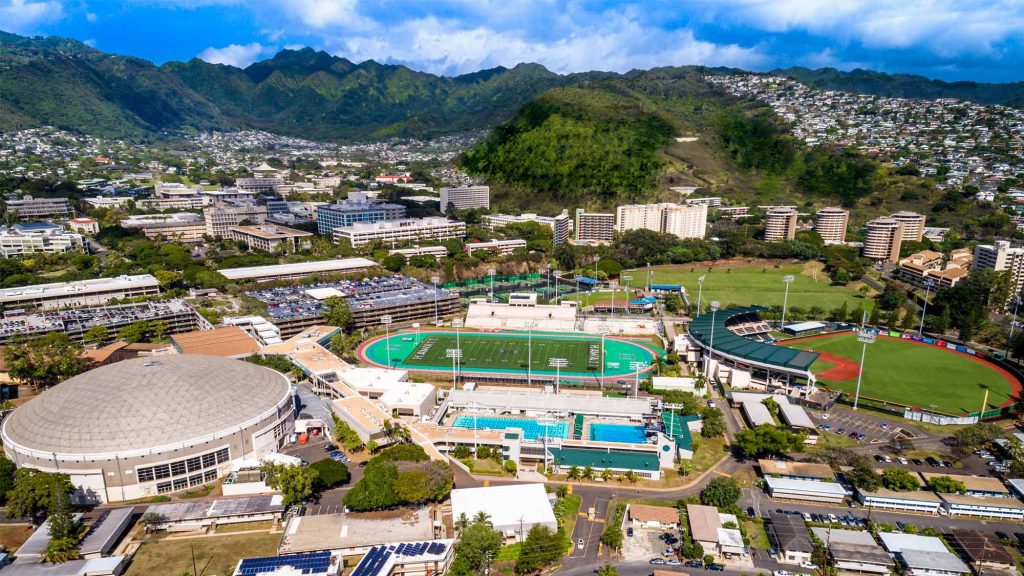
The University of Hawaii at Manoa is not your typical flagship state university. It’s a sprawling, lush research powerhouse where the Pacific Ocean is a living laboratory and the student body is a genuine global crossroads. The vibe is famously laid-back, but the work is serious in fields you can't find just anywhere: oceanography, tropical medicine, volcanology, and astronomy, all fueled by its unique geographic and cultural position. It’s an accessible, high-value portal to the Asia-Pacific region, though the island paradise comes with real challenges, from eye-watering living costs for out-of-staters to a graduation timeline that often stretches beyond four years.
Admission requirements
Test-optional — scores considered if submitted
Required
- High school transcript
- Grade point average
- Class rank
- College-prep program
- TOEFL (non-native English)
Considered (not required)
- Letters of recommendation
- Test scores (SAT/ACT)
- Demonstrated competencies
Source: IPEDS Admissions survey (2022) via Urban Institute. Covers formal factors only — it does not reflect essays, extracurriculars, or other holistic criteria.
More details
- Undergrad enrollment
- 15,029
- In-state tuition
- $12,186
- Out-of-state tuition
- $34,218
- Early Decision
- Not offered
- No-Loan Policy
- No
- Graduation Rate
- 64%
- Meets Full Need
- No
- Most Popular Majors
- Psychology, Marketing, Nursing
- First-Year Retention
- Data not provided in sources
- Demonstrated Interest
- Not considered
- Student-Faculty Ratio
- 13:1
- Median Earnings (10yr)
- $57,624
Outcomes & value
Outcomes & value
- Median earnings (10 yr)
- $57,624
- Value (earnings ÷ net price)
- 3.7×
- Median debt at graduation
- $18,500
- Graduation rate
- 64%
- First-year retention
- 81%
- Reducing loan balance (3 yr)
- 69%
- Pell (lower-income) share
- 26%
- First-gen share (among federal-aid recipients)
- 34%
Top-earning majors
Median earnings by field of study (highest credential), ~2 years after completion.
- Computer Engineering$74,576
- Registered Nursing, Nursing Administration, Nursing Research and Clinical Nursing$70,710
- Mechanical Engineering$65,557
- Dental Support Services and Allied Professions$65,486
- Civil Engineering$63,600
- Electrical, Electronics, and Communications Engineering
Applicants here also applied to
The schools that most often appear alongside University of Hawaii at Manoa on applicants’ lists, from our self-reported outcomes corpus.
Co-application frequency from self-reported results — directional peer discovery, not a recommendation.
Campus & location
Campus safety
- On-campus violent crimes (2024)
- 6
- Per 1,000 students
- 0.30
On-campus criminal offenses classed as violent (murder/non-negligent manslaughter, rape, robbery, aggravated assault) for the most recent reported year. Source: U.S. Dept. of Education Campus Safety and Security (Clery Act). Counts reflect what’s reported to the school, and urban campuses often report more partly due to non-student incidents nearby — read alongside campus size and setting, not as a standalone safety verdict.
Climate
- Pleasant days / yr
- 89
- Summer high
- 84°F
- Winter low
- 69°F
- Annual rain
- 27.9"
- Natural-hazard risk
- Relatively High
Pleasant days counts days per year with a mean temperature of 55–75°F, a high at or below 90°F, a low at or above 45°F, and little precipitation — a transparent comfort measure, not a weighting we invented. Computed from Open-Meteo ERA5 daily history (2019–2023). Natural-hazard risk is the county’s composite rating from the FEMA National Risk Index.
Quick answers
- What is the acceptance rate at University of Hawaii at Manoa?
- University of Hawaii at Manoa's acceptance rate is approximately 87% (Honolulu, HI), based on the most recent figures we compiled from public and primary sources.
- What SAT score do you need for University of Hawaii at Manoa?
- Admitted students at University of Hawaii at Manoa typically score 1081–1293 on the SAT (the middle-50% range). Scores outside this band are still admitted, especially with strong applications.
- How much does University of Hawaii at Manoa cost?
- At University of Hawaii at Manoa, the average net price (after aid) is about $15,664 per year. Actual cost varies with financial aid and residency.
- How many undergraduates attend University of Hawaii at Manoa?
- University of Hawaii at Manoa enrolls approximately 15,029 undergraduate students.
- Where is University of Hawaii at Manoa located?
- University of Hawaii at Manoa is located in Honolulu, HI.
Admissions
UH Manoa operates with an open-door philosophy for a public flagship, admitting the vast majority of its applicants. The process is straightforward and , with academic performance in high school carrying the most weight.
- Selectivity & Process: The university is "less selective," with a high that reflects its mission to serve the state of Hawaii. For the Fall 2024 cycle, it reported an overall acceptance rate of 86.60%, with in-state applicants enjoying a slightly higher rate (87.34%) than out-of-state (87.74%) and international (75.92%) students. There is no Early Decision or Early Action program, so all applicants are evaluated on the same regular decision timeline. The university's rate—the percentage of admitted students who enroll—was 56% for a recent spring semester.
- Academic Profile: The middle 50% of admitted students who submitted test scores had an SAT range of 1080–1290 and an ACT range of 20–27. The academic focus is squarely on the high school transcript: 25% of admitted students had a GPA above 4.0 (weighted), and the most common GPA range for admits was 3.75 and above. The university requires a high school diploma (or GED) and its admissions office states that it does not consider demonstrated interest as a factor in its decisions, per the .
- Advice for Applicants: For out-of-state students, the primary hurdle is less about ultra-competitive admissions and more about justifying the significant . The advice from current students and admissions pages emphasizes strong grades in a college-prep curriculum as the key. The test-optional policy provides flexibility, but submitting solid scores within or above the stated ranges can strengthen an application.
Compare University of Hawaii at Manoa
See colleges similar to University of Hawaii at Manoa →Sources
- AnalysisBrief_CommonDataSet_... - UH Manoa
- [PDF] Common Data Set 2025-2026 - UH Manoa
- Common Data Set: Home
- What is the acceptance rate of the University of Hawaii at Manoa?
- University of Hawaii at Manoa | US News Best Colleges
- Common Data Set - GradGPT
- University of Hawaii at Manoa Admissions - US News Best Colleges
- requirements - UH Manoa - University of Hawaii System
- University of Hawaii at Manoa Admission Requirements - PrepScholar
- University of Hawaii at Manoa Admissions - BigFuture College Search