Admit rate has ranged 83%–91% over the last 5 years — notably volatile, though the latest figure above (81%) falls outside that window. Source: IPEDS via Urban Institute.
Acceptance & SAT from Common Data Set / IPEDS; net price, earnings & graduation from the U.S. Dept. of Education College Scorecard. Figures lag ~1–2 years — verify with the school.
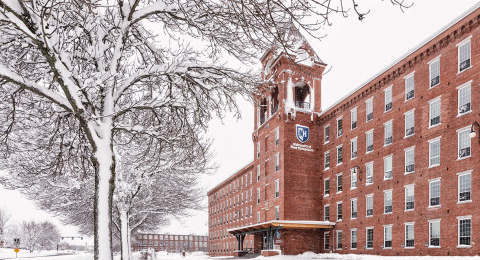
The University of New Hampshire at Manchester is an urban satellite campus built for accessibility and applied learning, not leafy quadrangles. It’s a commuter school with a 9:1 student-to-faculty ratio where 97% of classes have fewer than 30 students, offering career-driven programs in high-demand fields directly in New Hampshire's largest city. This is a pragmatic, no-frills institution where the value proposition is clear: an affordable, small-classroom UNH degree for students who want to stay local and launch directly into the workforce.
Admission requirements
Test-optional — scores considered if submitted
Required
High school transcript
Letters of recommendation
College-prep program
TOEFL (non-native English)
Considered (not required)
Grade point average
Class rank
Test scores (SAT/ACT)
Source: IPEDS Admissions survey (2022) via Urban Institute. Covers formal factors only — it does not reflect essays, extracurriculars, or other holistic criteria.
More details
Undergrad enrollment
443
In-state tuition
$15,838
Out-of-state tuition
$36,418
Graduation Rate
50%
Granite Guarantee
No tuition for Pell-eligible NH residents
Demonstrated Interest
Not considered
Student-Faculty Ratio
9:1
Median Earnings (10yr)
$66,479
Classes Under 30 Students
97%
Students Receiving Financial Aid
90%
Outcomes & value
Outcomes & value
Median earnings (10 yr)
$66,479
Value (earnings ÷ net price)
6.7×
Median debt at graduation
$26,814
Graduation rate
50%
First-year retention
85%
Reducing loan balance (3 yr)
81%
Pell (lower-income) share
29%
First-gen share (among federal-aid recipients)
17%
Top-earning majors
Median earnings by field of study (highest credential), ~2 years after completion.
Computer and Information Sciences, General$70,112
Communication and Media Studies$41,317
Biology, General$39,849
Political Science and Government$38,289
Neurobiology and Neurosciences$35,240
Psychology, General$32,711
Campus & location
Campus safety
On-campus violent crimes (2024)
0
Per 1,000 students
0.00
On-campus criminal offenses classed as violent (murder/non-negligent manslaughter, rape, robbery, aggravated assault) for the most recent reported year. Source: U.S. Dept. of Education Campus Safety and Security (Clery Act). Counts reflect what’s reported to the school, and urban campuses often report more partly due to non-student incidents nearby — read alongside campus size and setting, not as a standalone safety verdict.
Climate
Pleasant days / yr
87
Summer high
81°F
Winter low
21°F
Annual rain
48.2"
Annual snow
47.1"
Natural-hazard risk
Relatively Moderate
Pleasant days counts days per year with a mean temperature of 55–75°F, a high at or below 90°F, a low at or above 45°F, and little precipitation — a transparent comfort measure, not a weighting we invented. Computed from Open-Meteo ERA5 daily history (2019–2023). Natural-hazard risk is the county’s composite rating from the FEMA National Risk Index.
Deep dive — research, future-scholar output & economic mobility▾
Research output
Institutional h-index
250
Scholarly works
16,641
Institutional research volume and impact from OpenAlex. The h-index reflects large research universities and will be low for teaching-focused liberal-arts colleges — not a measure of undergraduate quality.
Quick answers
What is the acceptance rate at University of New Hampshire at Manchester?
University of New Hampshire at Manchester's acceptance rate is approximately 81% (Manchester, NH), based on the most recent figures we compiled from public and primary sources.
What SAT score do you need for University of New Hampshire at Manchester?
Admitted students at University of New Hampshire at Manchester typically score 973–1236 on the SAT (the middle-50% range). Scores outside this band are still admitted, especially with strong applications.
How much does University of New Hampshire at Manchester cost?
At University of New Hampshire at Manchester, the average net price (after aid) is about $9,992 per year. Actual cost varies with financial aid and residency.
How many undergraduates attend University of New Hampshire at Manchester?
University of New Hampshire at Manchester enrolls approximately 443 undergraduate students.
Where is University of New Hampshire at Manchester located?
University of New Hampshire at Manchester is located in Manchester, NH.
Admissions
UNH Manchester is an accessible, moderately selective public institution designed to serve the region. The is 81%, according to the canonical figure, which aligns closely with recent public data showing rates of 80.9% and 81%. The process is straightforward and emphasizes academic preparation within the context of a student's high school. The middle 50% SAT range for admitted students is 973–1236.
Admissions decisions are based primarily on academic factors. The most important criteria are the rigor of a student's high school course selection, their academic achievement (with most accepted first-year students having an average weighted GPA of 3.4), and class rank. Standardized test scores are considered but are not required for all applicants; only 18% of first-time enrollees submitted SAT scores with their applications. The school does not track or consider demonstrated interest in its admissions process, as indicated by its reporting. There is no mention of a binding Early Decision program offering a significant admissions advantage at this campus; the admissions focus remains on year-round, rolling accessibility for New Hampshire students.
Earnings = median of students working ~10 years after entry; debt = median of graduates. Value divides 10-yr earnings by one year’s net price — read it as earnings per dollar of annual cost, not a full lifetime ROI; it favors lower-cost schools. Source: U.S. Dept. of Education College Scorecard. Figures lag ~2 years and reflect all students, not your intended major.
English Language and Literature, General$29,503
Source: U.S. Dept. of Education College Scorecard (field-of-study earnings). Figures cover graduates who received federal aid and lag ~2 years; not all programs report data.
Academics at UNH Manchester are defined by intimate scale, career focus, and faculty accessibility. The campus boasts a 9:1 student-to-faculty ratio, and a striking 97% of classes have fewer than 30 students. This creates an environment where, as the university promotes, students "work side-by-side with expert faculty" in dynamic, discussion-based settings. The curriculum is explicitly designed to be "accessible, affordable and career-driven" with programs in "today's high-demand fields."
The program offerings are practical and aligned with regional economic needs. Students can pursue majors in fields like Psychology (noted as a "good fitting program" by local observers), Business, English, and more, with degrees ranging from associate to bachelor's levels. The catalog includes specific, applied majors like ASL/English Interpreting. The teaching model is hands-on and direct, leveraging the campus's location in Manchester's historic millyard to connect classroom learning with the professional community. This is not a traditional residential liberal arts college; it's a professional launchpad where the small-class experience is the norm, not the exception.
Student life at UNH Manchester reflects its identity as a compact, urban commuter campus. The experience is centered on involvement and connection within the campus community rather than a traditional residential college atmosphere. The campus is situated in the heart of Manchester's historic millyard, placing students within the city's commercial and cultural hub.
On-campus social life is club-driven. Students connect through shared interests in clubs focused on arts, athletics, culture, academics, and community service. There is no mention of Greek life or large-scale residential traditions, consistent with its profile as a non-residential or minimally residential campus. The Office of Student Life serves as a central hub for organizing this community-focused involvement. Reviews describe a "vibrant learning community," though the vibe is decidedly more pragmatic and integrated with city life than that of the flagship Durham campus. For many students, UNH Manchester is a place to study, connect with peers in clubs, and then return to jobs and homes in the greater Manchester area.
Outcomes for UNH Manchester graduates emphasize employability and value. The median earnings ten years after entry are $66,479, a strong return for a public institution with a relatively low . The university reports a high 94% undergraduate success rate across the UNH system, which includes positive outcomes like employment, graduate school enrollment, or other meaningful pursuits shortly after graduation.
Graduation rates tell a more nuanced story. The graduation rate is 50%, per the canonical figure. This aligns with external data showing a 6-year graduation rate of 69% and a much lower rate for shorter-degree programs; one source notes that for an associate degree, only 21.7% of students complete within three years. This suggests a student body with significant numbers of part-time, working, or non-traditional students who may take longer to graduate or transfer. The focus, as presented by the institution, is less on a four-year conveyor belt and more on ensuring that those who do complete their degrees are competitively positioned in the job market, as evidenced by the solid median earnings figure.
Affordability is a cornerstone of UNH Manchester's mission. The average net price after aid is $9,992. The campus awards $1 million in scholarships each year, and 90% of students receive some form of financial aid, with an average aid package reported at $7,162. This aggressive aid strategy makes a UNH degree accessible to a broad population.
The most significant financial aid initiative is the Granite Guarantee. This program ensures that any Pell-eligible New Hampshire undergraduate student (including those at the Manchester campus) will pay no tuition to attend UNH. This is a substantial commitment to removing cost barriers for the state's lowest-income students. The university does not advertise a universal "no-loan" policy for all students meeting full need. Federal Direct Loans and Parent PLUS loans are standard components of financial aid packages for those who need them, with the standard requirement that first-time borrowers complete a Master Promissory Note. The financial proposition is clear: a combination of scholarships, grants, and the Granite Guarantee aims to keep debt low and value high.
UNH Manchester stands out as a deliberate and successful experiment in urban, accessible public higher education. It is not a smaller copy of the flagship; it's a different model entirely. Its distinctiveness lies in three intertwined factors:
Urban Integration & Career Focus: Nestled in Manchester's millyard, the campus is physically and philosophically integrated into the economic heart of New Hampshire. Programs are explicitly "career-driven" and tailored to "high-demand fields," creating a direct pipeline from classroom to local industry.
Unmatched Scale & Access: With a 9:1 student-faculty ratio and 97% of classes under 30 students, it offers a small-college learning environment at a public university price. This is coupled with an 81% and the transformative Granite Guarantee (no tuition for Pell-eligible NH residents), making it one of the most accessible pathways to a UNH degree.
Pragmatic Value Proposition: It serves a student population often overlooked by traditional rankings: commuters, working adults, career-changers, and place-bound New Hampshire residents. The solid median graduate earnings ($66,479) against the low ($9,992) validates this model. It forgoes the amenities of a residential campus to deliver concentrated value: expert faculty attention, a professional network, and a degree that pays off quickly in the local market.
University of New Hampshire at Manchester seal · sourceUniversity of New Hampshire at Manchester - Wikipedia · sourceUNH Manchester | University of New Hampshire · sourceApply | UNH Manchester · source
.jpg?width=1600)