Loading…
← All schools
University of St Thomas
Saint Paul, MNprivate nonprofitstthomas.edu
Acceptance
85%
SAT 25–75
1260–1423
Avg net price
$29,155
Earnings (10 yr)
$73,739
Graduation rate
76%
Admit rate has ranged 76%–87% over the last 5 years — notably volatile. Source: IPEDS via Urban Institute.
Acceptance & SAT from Common Data Set / IPEDS; net price, earnings & graduation from the U.S. Dept. of Education College Scorecard. Figures lag ~1–2 years — verify with the school.
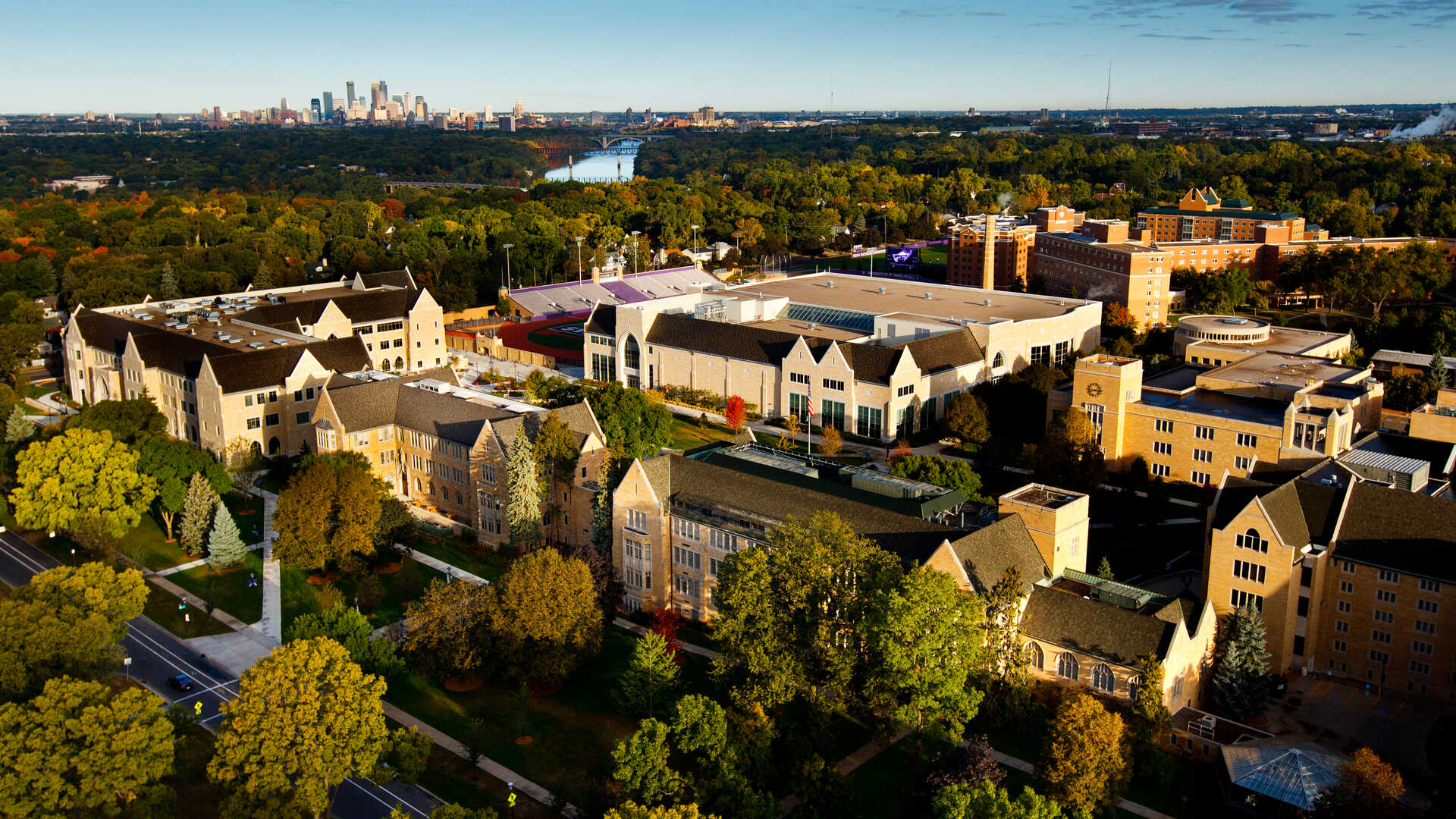
The University of St. Thomas in Saint Paul, Minnesota, is a Catholic liberal arts university that operates like a pragmatic, career-focused business school with a soul. It’s a place where the Core Curriculum demands philosophy and theology, but the most popular majors are squarely in business and health professions, reflecting a student body that values both intellectual grounding and immediate professional outcomes. With a sprawling campus life and deep ties to the Twin Cities' corporate community, St. Thomas offers a high-acceptance, high-engagement path to a solid middle-class career.
Admission requirements
Test-optional — scores considered if submitted
Required
- High school transcript
- Grade point average
- TOEFL (non-native English)
Considered (not required)
- Class rank
- Letters of recommendation
- Test scores (SAT/ACT)
Source: IPEDS Admissions survey (2022) via Urban Institute. Covers formal factors only — it does not reflect essays, extracurriculars, or other holistic criteria.
More details
- Undergrad enrollment
- 6,245
- In-state tuition
- $54,398
- Out-of-state tuition
- $54,398
- Popular Majors
- Health Professions (48%), Business
- Graduation Rate
- 76%
- On-Campus Housing
- 49% of students
- Early Decision Policy
- No Early Decision; Non-binding Early Action only
- Median Earnings (10yr)
- $73,739
- Reported Employment Rate (2020-21)
- 96% (for reporting graduates)
Outcomes & value
Outcomes & value
- Median earnings (10 yr)
- $73,739
- Value (earnings ÷ net price)
- 2.5×
- Median debt at graduation
- $23,250
- Graduation rate
- 76%
- First-year retention
- 88%
- Reducing loan balance (3 yr)
- 79%
- Pell (lower-income) share
- 22%
- First-gen share (among federal-aid recipients)
- 14%
Top-earning majors
Median earnings by field of study (highest credential), ~2 years after completion.
- Computer Science$73,321
- Electrical, Electronics, and Communications Engineering$71,686
- Management Sciences and Quantitative Methods$69,897
- Mechanical Engineering$68,101
- Finance and Financial Management Services$58,293
- Accounting and Related Services
Campus & location
Campus safety
- On-campus violent crimes (2024)
- 7
- Per 1,000 students
- 0.75
On-campus criminal offenses classed as violent (murder/non-negligent manslaughter, rape, robbery, aggravated assault) for the most recent reported year. Source: U.S. Dept. of Education Campus Safety and Security (Clery Act). Counts reflect what’s reported to the school, and urban campuses often report more partly due to non-student incidents nearby — read alongside campus size and setting, not as a standalone safety verdict.
Climate
- Pleasant days / yr
- 85
- Summer high
- 83°F
- Winter low
- 8°F
- Annual rain
- 36.6"
- Annual snow
- 43.3"
- Natural-hazard risk
- Relatively High
Pleasant days counts days per year with a mean temperature of 55–75°F, a high at or below 90°F, a low at or above 45°F, and little precipitation — a transparent comfort measure, not a weighting we invented. Computed from Open-Meteo ERA5 daily history (2019–2023). Natural-hazard risk is the county’s composite rating from the FEMA National Risk Index.
Quick answers
- What is the acceptance rate at University of St Thomas?
- University of St Thomas's acceptance rate is approximately 85% (Saint Paul, MN), based on the most recent figures we compiled from public and primary sources.
- What SAT score do you need for University of St Thomas?
- Admitted students at University of St Thomas typically score 1260–1423 on the SAT (the middle-50% range). Scores outside this band are still admitted, especially with strong applications.
- How much does University of St Thomas cost?
- At University of St Thomas, the average net price (after aid) is about $29,155 per year. Actual cost varies with financial aid and residency.
- How many undergraduates attend University of St Thomas?
- University of St Thomas enrolls approximately 6,245 undergraduate students.
- Where is University of St Thomas located?
- University of St Thomas is located in Saint Paul, MN.
Admissions
St. Thomas is a broadly accessible institution, admitting the majority of its applicants. The university reports an of 85%. The middle 50% of admitted students for the fall of 2025 had an ACT range of 23-29 and an SAT range of 1170-1360, with an average GPA between 3.3 and 4.0. The admissions process is straightforward and student-friendly: St. Thomas offers both Early Action and Regular Decision options, and both are explicitly non-binding and free to apply. There is no Early Decision program. While some sources suggest a rate (the percentage of admitted students who enroll) of around 23%, the university's own materials emphasize a process designed to minimize pressure on applicants. The most recent data shows admissions growing by 11.4% year-over-year, indicating increasing interest.
- Application Options: Early Action (non-binding), Regular Decision (non-binding).
- No Early Decision.
- Standardized Tests: Middle 50% SAT: 1170-1360; Middle 50% ACT: 23-29.
- Academic Profile: Middle 50% GPA range: 3.3-4.0.
Compare University of St Thomas
See colleges similar to University of St Thomas →Sources
- Quick Facts | University of St. Thomas - Minnesota
- University of St Thomas - IPEDS - Department of Education
- University of St Thomas | Data USA
- Consumer Information | University of St. Thomas - Minnesota
- University of St. Thomas | US News Best Colleges
- [PDF] Common Data Set 2022-2023 - Aquinas College
- University of St. Thomas Admissions - BigFuture College Search
- University of St. Thomas SAT Scores and GPA - PrepScholar
- College admissions predictions. - University of St. Thomas
- University of St. Thomas - Minnesota Admissions & Acceptance